



Happy Birthday to those who have passed on and to those great wrestlers still with us:
In Memoriam:
Charlie Vaden 1907
Roger McKay 1928
Jumbo Tsuruta 1951
Tim White 1954
Happy Birthday:
(none)
RIP Memorial: We stop & remember those who have passed on this day and gave themselves to the business for us, the fans. We salute you and thank you.
Wally Karbo 3-25-1993 at the age of 77

The Life & Career of Warren Bockwinkel
Though he never captured a world championship, Bockwinkel earned a reputation as a tough, legitimate “shoot-style” grappler and reliable mid-card performer. Warren Francis Bockwinkel born on May 21, 1911, in St. Louis, Missouri, was a pioneering American professional wrestler whose career bridged the rough-and-tumble territorial era of the 1930s–1950s. He competed across National Wrestling Alliance (NWA) territories, became one of the earliest wrestlers featured on television, and played a crucial role in training the next generation—including his own son, the legendary Nick Bockwinkel. His life story is one of hard work, opportunity seized through chance, and quiet influence that helped shape professional wrestling’s evolution from carnival sideshow to broadcast entertainment.

Before entering the ring, Bockwinkel worked as a truck driver for the International Shoe Company in his hometown. His entry into wrestling came by pure happenstance in the early 1930s when a small man he met in a bar introduced him to a local training gym run by George Tragos, an experienced European wrestler. Bockwinkel debuted in 1934 and quickly embraced the era’s demanding style, which emphasized real grappling skill over theatrical flair. Billed from St. Louis at approximately 6’0” and 220–240 pounds, he developed into a credible, no-nonsense competitor who could hold his own against anyone.
St. Louis quickly became his primary base under promoter Tom Packs. One of Bockwinkel’s most significant early contributions was helping elevate a young Lou Thesz. The two trained together, and Warren reportedly introduced Thesz to Packs. On January 9, 1937, Thesz defeated Bockwinkel for the St. Louis Championship in a match that marked an important early push for the future NWA legend. Throughout the 1940s, Bockwinkel remained a consistent draw. He was ranked the #4 attraction in St. Louis in 1944, and his matches against top star Bill Longson drew massive crowds including over 10,000 fans on July 23, 1943, and 11,470 for a rematch on February 11, 1944. He also notched a notable victory over the famous multi-sport athlete Mildred “Babe” Didrikson Zaharias on March 17, 1936.
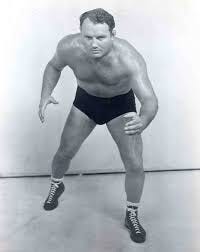
Bockwinkel was never a world champion, but he thrived in high-profile feuds and tag-team matches against and alongside the era’s biggest names. He clashed with stars such as Ernie Dusek, Paul Boesch, Sandor Szabo, and George Zaharias, and even challenged NWA World Heavyweight Champion Lou Thesz. On the tag side, he teamed with Ray Vilmer, Killer Kowalski, and “Classy” Freddie Blassie. In the early 1950s he expanded into Northern and Southern California, Calgary, Alberta, Hamilton, Ontario, and Buffalo, New York. By 1951–1952 he was working frequently with Kowalski in San Francisco; in 1954 he teamed with Gene Kiniski and Mike DiBiase in Los Angeles. He even briefly teamed with his son Nick during that period.
One of Bockwinkel’s most lasting contributions was his role as an early television pioneer. He was among the first generation of wrestlers whose matches reached living rooms across the country, helping legitimize and popularize the sport during its post-World War II boom. Outside the ring, he remained a trainer of note. Also in St. Louis, along with Lou Thesz, he helped prepare his son Nick for the business. He also trained Wilbur Snyder and used his friendship with promoter Lord James Blears to secure bookings for Nick in the NWA Hawaii territory. According to Thesz’s autobiography Hooker, Bockwinkel’s full-time day job as a truck driver ultimately prevented him from pursuing the absolute top tier of stardom, but it never diminished his respect within the industry. .

Warren trained his son Nicholas Warren Francis Bockwinkel from a young age. When Nick debuted in 1954 in Los Angeles for the North American Wrestling Alliance aka the NWA Los Angeles territory, he was often billed as the fresh-faced “Nicky Bockwinkel” or simply “Young Nicky.”
Father and son quickly formed a tag team in Southern California, working venues like the historic Olympic Auditorium in Los Angeles and spots in Bakersfield. The duo received a genuine push in 1955–1957. They drew with teams such as Lord Blears & Lord Carlton and traded wins and losses with rugged combinations like Shag Thomas & Sky Hi Lee. These matches were more than routine bouts; they were a living lesson in ring psychology, selling, and survival. Warren, then in his mid-40s and nearing retirement, was passing the torch in real time. Nick, barely 20, absorbed every lesson while building his own identity. Decades later, Nick spoke fondly of those early days with his father, crediting Warren not only for technical training but for teaching him the dignity and discipline the business demanded.
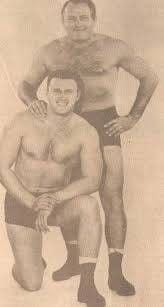
Pictured: Proud Warren Bockwinkel and son, Nick
By 1955 Warren Bockwinkel had largely stepped away from full-time competition. He made one documented return, facing Hans Schmidt in Los Angeles on October 2, 1957. Unverified claims suggest he may have wrestled as late as 1983 at age 72, but his active in-ring career effectively ended in the late 1950s.
Warren Bockwinkel passed away on March 25, 1986, in St. Louis at the age of 74 from complications of Alzheimer’s disease.
He was survived by his son, Nick, who went on to become a four-time AWA World Heavyweight Champion, a WWE Hall of Famer, and one of the most respected technical wrestlers of the 20th century. Nick frequently credited his father in induction speeches, including those for the Professional Wrestling Hall of Fame in 2003 and the WWE Hall of Fame in 2007.
Warren’s legacy received formal recognition in 2010 when he was posthumously inducted into the George Tragos/Lou Thesz Professional Wrestling Hall of Fame at the National Wrestling Hall of Fame in Waterloo, Iowa. The induction honored his contributions as a competitor, trainer, and bridge between wrestling’s territorial roots and its televised future.
In an era dominated by larger-than-life champions, Warren Bockwinkel was never the headline act—but he was the dependable backbone. A truck driver who became a wrestler through a chance meeting in a bar, he helped elevate future stars, entertained early television audiences, and literally trained the man who would carry the family name to greater heights. While his son Nick achieved worldwide fame and multiple world titles, Warren Bockwinkel’s steady, legitimate work in the ring and behind the scenes helped lay the foundation for one of professional wrestling’s most respected dynasties.
One Thing I Learned About Wally Karbo
As a teenager in Northeast Minneapolis during the tail end of Prohibition in the 1930s, long before he ever stepped into a ring or co-founded the AWA, young Wally ran bootleg booze errands for local promoter Tony Stecher, using his neighborhood connections to help supply Stecher’s friends and crew. That early side hustle with Stecher’s inner circle got him a low-level assistant job in the promotion — which quickly led to his first referee gig in December 1936 at the Gayety Theater (he borrowed shoes from Joe Stecher, spent $5 on a uniform, and ended up calling the entire card). From there he refereed thousands of matches, became a key behind-the-scenes figure, and eventually partnered with Verne Gagne to launch the American Wrestling Association in 1960.
Thank You for Reading
I’m Tony Richards, Pro Wrestling Historian, Author and Storyteller. I share pro wrestling historical items in each issue of the Time Tunnel Pro Wrestling History Newsletter. Thanks for reading! If you enjoy my information on select events, matches and insights, please share it with folks you think might like to be a subscriber!
Remember, premium investors get access to exclusive and special content such as some special issues including a multi-part deep dives on wrestling territories, wrestler bios and championship title histories, special audio and video interviews on territory pro wrestling and more available in the Pro Wrestling Time Tunnel for Premium Investors.