


Happy Birthday to those who have passed on and to those great wrestlers still with us:
In Memoriam:
Gorgeous George 1915
Buddy Fuller 1925
Fran Gravette 1938
Don Jardine\Super Destroyer\The Spoiler 1940
Thomas Kasar\Teijo Khan 1956
Happy Birthday:
Barry Horowitz (66)
Mark Calaway\The Undertaker (61)
Christopher Daniels (56)
Epico Colon (44)
Jake Hager (44)
CJ Perry (41)
Lacey Evans (36)
RIP Memorial: We stop & remember those who have passed on this day and gave themselves to the business for us, the fans. We salute you and thank you.
Warren Bockwinkel 3-24-1986 at the age of 74

Dr. Bill Miller 3-24-1997 at the age of 69

Significant Debuts:
Jumbo Tsuruta 3-24-1973 at the age of 22
The Life & Career of Dr. Bill Miller
The life story of Bill Miller began on the Twin Pines Farm in Fremont, Ohio, where he developed the work ethic and physical strength that defined his life. Born on June 5, 1927, in the town of Fremont, and passing away on March 24, 1997, at age 69, Miller embodied the archetype of the “gentle giant” outside the ring and the “Silent Monster” inside it. At a billed 6 ft 6 in (1.98 m) and 290 lb (132 kg), he combined raw athleticism, medical expertise, and theatrical villainy to carve out a nearly 25-year career across the American Wrestling Association (AWA), National Wrestling Alliance (NWA), World Wide Wrestling Federation (WWWF), and other major territories. What set him apart was his genuine profession as a licensed veterinarian—the source of his “Dr.” moniker—which he balanced with wrestling before returning to it full-time after retirement.
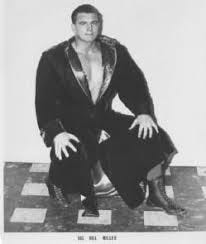
He attended Ohio State University, where he became a legendary nine-letterman—earning three letters each in football, wrestling, and track and field. As an All-American heavyweight wrestler, he captured two Big Ten Conference championships (1950 and 1951), was named Conference MVP his senior year, and placed fourth in the 1951 NCAA tournament. He also excelled in track as an All-American in the shot put and discus, and he contributed to the Buckeyes’ 1950 Rose Bowl victory. After college, Miller served in the U.S. Navy. These accomplishments earned him induction into the Ohio State University Athletic Hall of Fame in 1997 for both wrestling and track.
While building his athletic résumé, Miller pursued a degree in veterinary medicine. He qualified as a veterinarian early in his wrestling career, a fact that promoters cleverly incorporated into his ring persona. This dual path—professional athlete and animal doctor—remained central to his identity. After his Navy service, he debuted in professional wrestling in 1951 (or 1952, depending on the source) under Columbus promoter Al Haft. His first major success came quickly: on May 1, 1952, he defeated Don Eagle to capture the Ohio version of the AWA World Heavyweight Championship, holding it until September.
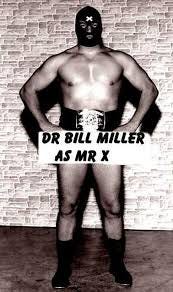
Pictured: Bill Miller as Dr. X
Miller’s career truly took flight in the early 1960s when he adopted masked gimmicks that amplified his menacing presence. Wrestling as “Dr. X” or the silent heel “Mr. M” in the Minneapolis–Saint Paul area for the AWA, he engaged in a storied feud with Verne Gagne—a man he had actually faced in college. On or around January 1962, Mr. M defeated Gagne for the AWA World Heavyweight Championship (Boston version in some records) and held the title for more than seven months. The rivalry culminated dramatically on August 21, 1962, when Gagne unmasked him in front of a raucous crowd. Miller also captured the Omaha World Heavyweight Championship twice and the International Wrestling Enterprises (IWA) World Heavyweight Championship during this period.
Tag-team wrestling became another cornerstone of Miller’s success, often alongside his real-life brothers. He teamed with storyline brother “Big Ed” Miller (Edmund von Albers) to win multiple NWA tag titles in San Francisco, including the NWA World Tag Team Championship (San Francisco version) and Pacific Coast Tag Team Championship. More significantly, he paired with his actual younger brother, Dan “Dandy Dan” Miller, to claim the WWWF United States Tag Team Championship in August 1965. The brothers defeated Gorilla Monsoon and Cowboy Bill Watts in Washington, D.C., and defended the titles for approximately six months before losing them to Johnny Valentine and Antonio Pugliese at Madison Square Garden in February 1966. Miller also partnered with Bob Geigel for the AWA Canadian Open Tag Team Championship and NWA North American Tag Team Championship (Central States version), with Dick the Bruiser for the WWA World Tag Team Championship in Indianapolis, and with Killer Kowalski for the IWA World Tag Team Championship in Australia.
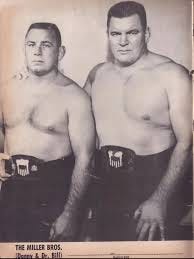
Pictured: Bill and Danny Miller, WWWF United States Tag Team Champions
Throughout the 1960s and early 1970s, Miller worked major territories and feuded with some of wrestling’s biggest names. In Detroit’s Big Time Wrestling, he formed a brutal partnership with The Sheik (Eddie Farhat). In the WWWF, he served as a top challenger to Bruno Sammartino’s World Championship, famously going to a one-hour time-limit draw and later suffering a 48-second squash loss in a memorable mismatch. He donned the mask once more as the Crimson Knight before Dory Funk Jr. unmasked him on November 20, 1970. One of his most notorious matches occurred on June 21, 1969, at the Cow Palace in San Francisco: a “death match” against Ray Stevens for the United States title, refereed by boxing legend Rocky Marciano, who knocked Miller out for repeated rule-breaking. Near career’s end, Miller aligned with Dick the Bruiser in the Indianapolis-based World Wrestling Association. He wrestled until around 1973–1976, retiring with an impressive list of regional titles and a reputation as a hard-hitting, agile big man.
Away from the spotlight, Miller remained devoted to veterinary medicine. After retiring from the ring, he opened a full-time practice in the Columbus, Ohio, area (including Reynoldsburg), where he also performed animal autopsies and reportedly served as a USDA meat inspector. A family man, he was survived by his wife and six children; contemporary reports noted his impressive strength even at home, such as doing push-ups with his young children on his back. His quiet, community-oriented post-wrestling life stood in stark contrast to the monstrous heel persona that once terrified fans.
On March 24, 1997, while leaving a workout at the Wyandotte Athletic Club in Columbus—the same area where promoter Al Haft had launched his career decades earlier—Miller suffered a fatal heart attack. He was 69. His contributions to wrestling have since been honored with inductions into the George Tragos/Lou Thesz Professional Wrestling Hall of Fame (Class of 2005), the St. Louis Wrestling Hall of Fame (2016), the Stampede Wrestling Hall of Fame (1995), and recognition through the National Wrestling Hall of Fame’s biographical archives.
Dr. Bill Miller’s legacy endures as a bridge between two worlds: the rigorous discipline of amateur athletics and veterinary science on one hand, and the theatrical, physical demands of professional wrestling on the other. He proved that a farm-raised Ohio boy with a doctorate in animal medicine could become a world champion, tag-team titleholder, and top-draw heel without ever losing his core identity. In an era when wrestlers often lived larger-than-life characters 24 hours a day, Miller quietly balanced the spotlight with scalpel and stethoscope—leaving behind a unique blueprint for athletes who pursue excellence both in and out of the ring.
One Thing I Learned About Fran Gravette
She ran a western-saddle shop in Oklahoma and worked for the May Drugstore Chain for over 25 years after wrestling.
Thank You for Reading
I’m Tony Richards, Pro Wrestling Historian, Author and Storyteller. I share pro wrestling historical items in each issue of the Time Tunnel Pro Wrestling History Newsletter. Thanks for reading! If you enjoy my information on select events, matches and insights, please share it with folks you think might like to be a subscriber!
Remember, premium investors get access to exclusive and special content such as some special issues including a multi-part deep dives on wrestling territories, wrestler bios and championship title histories, special audio and video interviews on territory pro wrestling and more available in the Pro Wrestling Time Tunnel for Premium Investors.
Very good.