


Happy Birthday to those who have passed on and to those great wrestlers still with us:
In Memoriam:
Tor Kamata 1937
Cocoa Samoa 1945
Charlie Fulton 1949
Happy Birthday:
Norvell Austin (75)
Nikita Koloff (67)
Rick Steiner (65)
Tiger Ali Singh (55)
Melina Perez (47)
Aubrey Edwards (39)
RIP Memorial: We stop & remember those who have passed on this day and gave themselves to the business for us, the fans. We salute you and thank you.
Burt Ruby 3-9-1968 at the age of 57
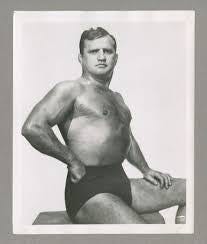
Dick Lever 3-9-1992 at the age of 81

Eddie Creatchman 3-9-1994 at the age of 66
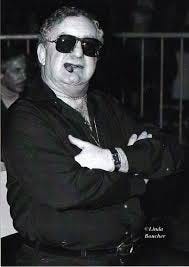
Wally Yamaguchi 3-9-2019 at the age of 60
70 Year Flashback
Flashback 1956: The Month In Pro Wrestling
Territory Era Stage of Growth: Investigation Stage
The world of professional wrestling in the mid-1950s was defined by the National Wrestling Alliance (NWA), a loose coalition of territorial promoters who recognized a single world heavyweight champion. That champion, Lou Thesz, had reigned supreme since November 27, 1949—an astonishing 2,300 days that stood as the longest single reign in NWA history. Thesz embodied technical mastery and defensive reliability, touring North America and headlining arenas from St. Louis to Toronto. But in March 1956, the status quo shattered in dramatic fashion, delivering one of the decade’s most memorable title changes and injecting new energy into the Canadian wrestling scene.
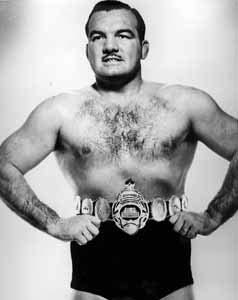
Pictured: Whipper Billy Watson, NWA World Heavyweight Champion
The pivotal moment arrived on March 15 at Toronto’s Maple Leaf Gardens. A crowd of 15,000 fans packed the historic arena to witness hometown hero Whipper Billy Watson challenge Thesz for the NWA World Heavyweight Championship. Adding star power and mainstream credibility, former heavyweight boxing champion Jack Dempsey served as the special referee. The bout ended in controversial fashion: Watson won by count-out when Thesz failed to beat the ten-count. While some territories traditionally frowned upon title changes via disqualification or count-out, the NWA board recognized Watson as the new champion. The Canadian icon’s victory ended Thesz’s marathon reign and launched Watson’s own 239-day title run.
The significance of this moment extended far beyond one match. Watson, a Toronto native known for his clean-cut persona, scientific style, and patriotic appeal, became a symbol of national pride in Canada. Thesz, meanwhile, remained a top draw and would reclaim the belt later that year in St. Louis on November 9. In the short term, the count-out finish sparked debate among promoters and fans—some initially questioned its legitimacy—but the NWA’s decision stood, underscoring the alliance’s flexibility in an era before pay-per-view or centralized booking.
The rest of the month offered a snapshot of wrestling’s vibrant territorial system. Earlier in March, Thesz (still champion at the time) continued his rigorous schedule. On March 3 in Milwaukee’s Auditorium, he defended the title against Dick Afflis (later the fearsome Dick the Bruiser) in a two-out-of-three-falls match before 10,200 fans. Other mid-month cards featured rising or established stars: Killer Kowalski, Gorgeous George, Pat O’Connor, Fred Atkins, Hard Boiled Haggerty, and the Lisowski Brothers (Reggie and Stan), who held NWA World Tag Team gold. Shows in Minneapolis and ongoing Toronto cards kept arenas busy, proving that even without the world title on the line every night, the territories thrived on star power and local rivalries.
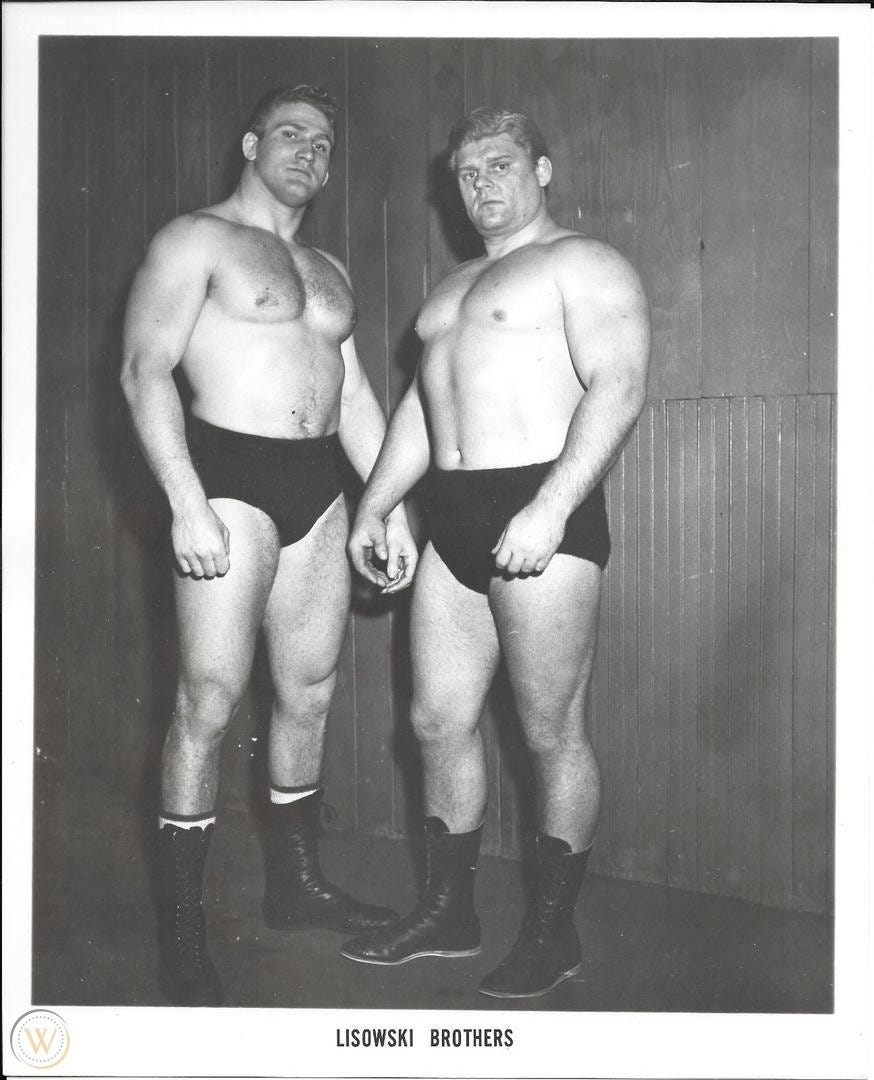
Pictured: Reggie & Stan Lisowski, NWA World Tag Team Champions
Beyond the ring, March 1956 quietly planted seeds for the future. On March 18, future AWA and WWF star Rick Martel was born in Quebec. Other notable births included Ryuma Go (March 23) and Dangerous Danny Davis (March 28), wrestlers who would later make their marks in different eras. No major deaths or scandals dominated headlines, but the sport’s growing television presence continued to expand its reach into American and Canadian living rooms.
In many ways, March 1956 encapsulated the golden age of territorial wrestling at its most exciting. The NWA’s world title remained the ultimate prize, yet it was still possible for a beloved regional hero like Watson—backed by a capacity hometown crowd and a celebrity referee—to dethrone a seemingly invincible champion. The month’s events reminded fans and promoters alike that the wrestling landscape could shift overnight, setting the stage for Watson’s defenses, Thesz’s comeback, and the continued evolution of the NWA system through the rest of the decade.
By the end of March 1956, pro wrestling had a new world champion, a fresh narrative, and proof that even the longest reigns could end in one unforgettable Toronto night.
Whipper Billy Watson, at 5’10” and around 227 lbs in his prime, the clean-cut, scientific-style babyface embodied reliability, patriotism, and resilience. He wrestled for 35 years (1936–1971), headlined Maple Leaf Gardens for three decades, drew an estimated five million fans to Toronto cards alone, and captured the NWA World Heavyweight Championship twice. Beyond the ring, his post-career charity work raised millions for children with disabilities, cementing a legacy that transcended wrestling.
When Watson defeated Thesz for the NWA World Title, the victory did not just hand Watson the most prestigious title in the sport; it ended Thesz’s dominant six-year reign and made Watson the first Canadian ever to hold the NWA World Title. For a nation whose wrestling pride had long centered on regional heroes, Watson’s triumph represented a seismic shift: the “everyman” from East York had taken over as the undisputed king of the squared circle.
The NWA had unified the heavyweight title under Thesz on November 27, 1949, after Orville Brown’s career-ending car accident. Thesz’s first recognized reign stretched 2,300 days—one of the longest in history—making him the face of the sport across North America. A legitimate shooter with a Greco-Roman background, Thesz defended the belt relentlessly and commanded respect everywhere he went. Watson had history with Thesz; he had lost the earlier National Wrestling Association version of the world title to him in St. Louis on April 25, 1947, in front of 10,462 fans. Nine years later, the stage was set for redemption on home soil.
The March 15, 1956, match was billed as the biggest in Toronto wrestling history. With Dempsey in the ring to lend star power and legitimacy, the two giants clashed for nearly an hour. Details of the finish remain classic wrestling theater: Thesz was knocked to the floor and could not beat the ten-count, giving Watson the title by count-out. The crowd erupted. Watson, the local boy, had toppled the unbeatable champion. The NWA Board of Directors recognized the change immediately, and Watson became the standard-bearer for the Alliance.
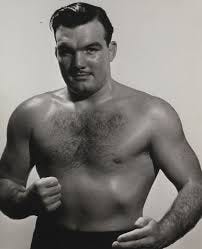
Watson’s 239-day reign (March 15 to November 9, 1956) was no ceremonial interlude. He defended the championship approximately 120 times, crisscrossing North America and headlining in Toronto, St. Louis, and beyond. He faced a who’s-who of 1950s stars—Gorgeous George, Pat O’Connor, Dick Hutton, and Buddy Rogers—while remaining the top attraction at Maple Leaf Gardens. For Canadian fans, Watson’s reign symbolized national pride; he carried the flag for a country that had never before produced an NWA World Champion. His “everyman” persona resonated even more powerfully with the gold around his waist: here was proof that hard work and heart could conquer the world.
The legacy of that March night in 1956 extends far beyond the ring. Watson’s victory opened the door for future Canadian world champions—Gene Kiniski, Killer Kowalski, and later Bret Hart and Chris Jericho—proving that talent from north of the border belonged on the global stage. Watson himself became a national treasure. Inducted into the Professional Wrestling Hall of Fame (2015), the Ontario Sports Hall of Fame (1995), and honored with a public school named after him in Keswick, Ontario, he raised millions for Easter Seals through his “Snowarama for Timmy” charity. His post-wrestling life embodied the same decency that defined his in-ring persona.
In other action around the territory system during the month, on March 6 in Minneapolis, a special two-referee tag-team match (with Bronko Nagurski and Butch Levy as guest officials) saw the Kalmikoffs defeat Bobby Managoff and Lord Athol Layton. These cards kept regional stars like Verne Gagne (Chicago’s NWA United States Champion) and local draws busy while the world title remained the top story.
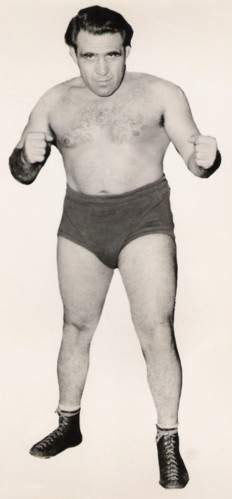
Pictured: Bull Montana, NWA Pacific Northwest Champion
In the Pacific Northwest territory, no major title changes occurred in March (Bull Montana had won the NWA Pacific Northwest Heavyweight Title the previous month), but the territory continued its steady schedule of house shows. The Canadian territories outside Toronto—Montreal and Edmonton—featured stars such as Killer Kowalski, Yvon Robert, and Edouard Carpentier, though their biggest March cards were overshadowed by the Toronto title switch. Capitol Wrestling Corporation in the Northeast (the future WWE territory) was still building momentum after debuting its TV program “Heavyweight Wrestling” in January; no world-title defenses occurred there in March, but the promotion benefited indirectly from the buzz surrounding the new champion.
Mexico’s Empresa Mexicana de Lucha Libre (EMLL), an NWA affiliate for certain world titles, ran its usual Arena Coliseo schedule but had no major championship changes or cross-border storylines tied to the North American title switch in March. The focus remained squarely on the U.S. and Canadian territories where the NWA’s flagship belt actually traveled.
Thank You for Reading
I’m Tony Richards, Pro Wrestling Historian, Author and Storyteller. I share pro wrestling historical items in each issue of the Time Tunnel Pro Wrestling History Newsletter. Thanks for reading! If you enjoy my information on select events, matches and insights, please share it with folks you think might like to be a subscriber!
Remember, premium investors get access to exclusive and special content such as some special issues including a multi-part deep dives on wrestling territories, wrestler bios and championship title histories, special audio and video interviews on territory pro wrestling and more available in the Pro Wrestling Time Tunnel for Premium Investors.