


Happy Birthday to those who have passed on and to those great wrestlers still with us:
In Memoriam:
Gus Sonnenberg 1898
Saul Weingeroff 1916
Harold Wantanabe\Tojo Yamamoto 1927
Killer Khan 1947
Happy Birthday:
Val Venis (55)
Ken Anderson (50)
David Flair (47)
RIP Memorial: We stop & remember those who have passed on this day and gave themselves to the business for us, the fans. We salute you and thank you.
Ray “Hercules” Hernandez 3-6-2004 at the age of 47
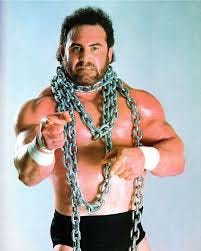
Allen Coage\Bad News Allen 3-4-2007 at the age of 63
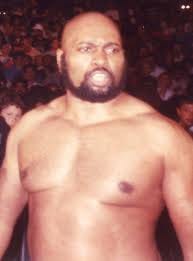
Ray Stern 3-4-2007 at the age of 74
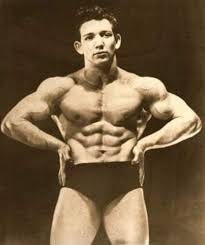
Don Curtis 3-4-2008 at the age of 80
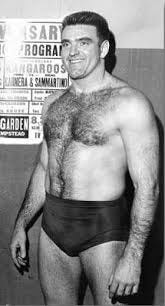
The Life & Career of Ray “Hercules” Hernandez
Raymond Constantine Fernandez Jr., better known to wrestling fans worldwide as Hercules Hernandez or simply Hercules, was a larger-than-life figure whose imposing physique, raw power, and memorable ring presence defined an era of professional wrestling. Born on May 7, 1956, in New York City, Fernandez passed away on March 6, 2004, at the age of 47 in Tampa, Florida, from heart disease. Often referred to as Ray “Hercules” Hernandez, he carved out a respected career spanning territories, the World Wrestling Federation, World Championship Wrestling, New Japan Pro-Wrestling, and independent promotions. Though he never captured a major singles world title in the United States, his work as a powerhouse babyface and heel, combined with tag team success abroad, left an indelible mark on the industry. He was also a noted bodybuilder whose muscular frame graced muscle magazines and complemented his in-ring style.
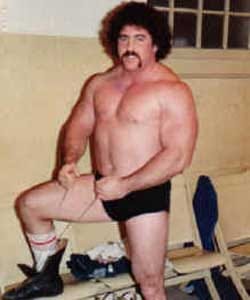
Fernandez’s early life was marked by tragedy and resilience. His mother died of cancer when he was just six years old, after which his father moved the family from New York City to Tampa, Florida. He attended A.P. Leto High School in Tampa, where he excelled in amateur wrestling. After graduating in 1974, he served three years in the United States Air Force before pursuing a career in professional wrestling. Trained by the legendary Hiro Matsuda, Fernandez debuted in 1979 and quickly adopted the ring name Hercules Hernandez, drawing on his impressive build and strength.
His early career (1979–1985) was spent honing his craft in the territorial era, primarily in Florida and Texas. In 1982, he joined NWA Central States Wrestling, where he teamed with Dewey Robertson (as The Missing Link) to win the NWA Central States Tag Team Championship twice. He also held the Central States Television Championship for more than six months. Notable feuds included battles against Manny Fernandez and Harley Race; one memorable angle involved a steel cage stipulation that ended with Fernandez using brass knuckles, leading to a kayfabe piledriver on manager Oliver Humperdink. Fernandez toured Japan with All Japan Pro Wrestling in 1983. In Jim Crockett Promotions, he worked as the masked Assassin #2 alongside Jody Hamilton, scoring a victory at the inaugural Starrcade in 1983 before being unmasked by Jimmy Valiant.
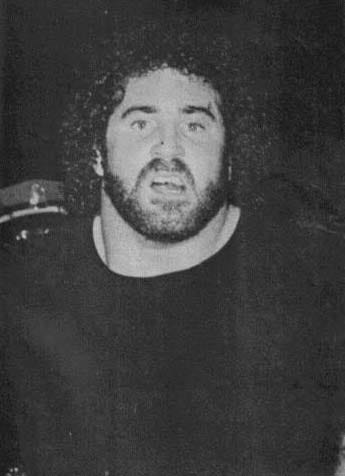
Pictured: Ray Hernandez after being unmasked by Jimmy Valiant as Jody Hamilton’s partner in the Assassins
By 1984–1985, he appeared in Bill Watts’ Mid-South Wrestling (later the Universal Wrestling Federation) as the masked Mr. Wrestling III, feuding with “Hacksaw” Jim Duggan and later joining Skandor Akbar’s Devastation Inc. stable alongside Ted DiBiase. A brief but successful run in Championship Wrestling from Florida saw him capture both the NWA Florida Southern Heavyweight Championship (from Brian Blair) and the NWA Florida Heavyweight Championship (from Hector Guerrero) in 1985, making him a double champion—though he was fired after a real-life dressing room altercation with Wahoo McDaniel and stripped of the titles. A short stint in World Class Championship Wrestling followed before the biggest opportunity of his career arrived.
Fernandez signed with the WWF in late 1985, debuting under the management of “Classy” Freddie Blassie. His first major spotlight came at WrestleMania 2 in 1986, where he lost to Ricky “The Dragon” Steamboat. After Blassie retired and Slick briefly managed him, his contract was “sold” to Bobby “The Brain” Heenan in late 1986. Dropping “Hernandez” from his name and embracing a more muscular look complete with a steel chain, he became simply Hercules—a dominant heel in the Heenan Family. On November 29, 1986, he challenged WWF Champion Hulk Hogan on Saturday Night’s Main Event, applying his signature Hercules Backbreaker but ultimately falling short.

A heated rivalry with Billy Jack Haynes, centered on competing full nelson holds, spilled over from other promotions and peaked at WrestleMania III with a double count-out; a subsequent chain match saw Hercules victorious after a brutal chain-wrapped punch. In 1988, a memorable tug-of-war segment with the Ultimate Warrior on WWF Superstars (in which the chain snapped) led to a WrestleMania IV clash that Warrior won. Later that year, Heenan “sold” Hercules to Ted DiBiase, who treated him as a “slave”—prompting a face turn and a feud that included Hercules defeating DiBiase’s bodyguard Virgil to earn his “freedom.” He pinned Haku at WrestleMania V but never ascended to main-event status. By the late 1980s and early 1990s, he was largely a mid-carder or enhancement talent, suffering high-profile losses to Earthquake at WrestleMania VI and others.
In 1990, Fernandez turned heel once more, forming the tag team Power and Glory with Paul Roma under Slick’s management. The duo defeated The Rockers at SummerSlam 1990 and challenged The Hart Foundation for the WWF Tag Team Titles, but they were famously squashed by The Legion of Doom in under a minute at WrestleMania VII. After Roma departed in 1991, Hercules returned to singles competition, participating in Royal Rumbles (lasting nearly 40 minutes in 1991) and jobbing to top stars before his final WWF match—a quick loss to Sid Justice at Madison Square Garden in 1992.
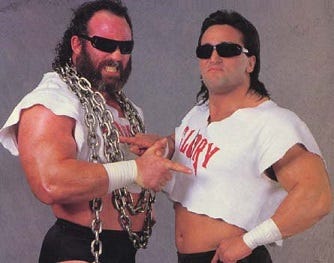
Pictured: Hercules Hernandez & Paul Roma as Power & Glory
Fernandez briefly joined WCW in 1992 as the masked Super Invader, managed by Harley Race. He scored wins at WrestleWar and participated in a major elimination tag at Clash of the Champions XX. By 1993, he found renewed success in NJPW, teaming with Scott Norton as the Jurassic Powers. On August 16, 1993, they defeated The Hell Raisers (Hawk and Power Warrior) to win the IWGP Tag Team Championship, holding the titles for four months with successful defenses before losing them back on January 4, 1994, at the Tokyo Dome. He also competed in various independent promotions and the American Wrestling Federation tournament until retiring in 1999.
Fernandez was a dedicated family man. He married Debbie Fernandez in 1976, and the couple had seven children: Nichole, Jeremy, Jaclyn, Amanda, Taylor, Katelyn, and Keith. His bodybuilding background earned him features in prominent muscle magazines, underscoring the impressive physique that defined his gimmick. In retirement, he trained several wrestlers, including Donovan Morgan.
Tragically, Fernandez died peacefully in his sleep on March 6, 2004, at his Tampa home. The cause was heart disease, a condition his wife publicly attributed to years of intense physical demands. He was buried with full military honors at Florida National Cemetery in Bushnell, Florida, reflecting his Air Force service.
One Thing I Learned About Lou Thesz During His Career In The 1940s
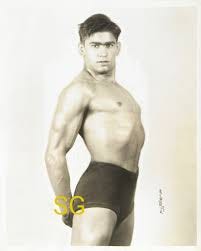
Pictured: Lou Thesz at 28 years old in 1944
During World War II, after being drafted into the U.S. Army in 1944, despite a legitimate knee injury and prior deferments, his routine shifted from full-time territorial wrestling to serving as a hand-to-hand combat instructor for medics and recruits.
He taught real grappling techniques—drawn from catch-as-catch-can, amateur, and pro wrestling holds—using methods outlined in the U.S. Navy’s official 1943 Wrestling Guidebook (which blended styles for practical military use). This “plum gig” let wrestlers like Thesz (along with others such as Verne Gagne and “Man Mountain” Dean) stay in fighting shape while performing exhibition matches on the side for troop morale or war bond rallies (e.g., Thesz headlined a massive 1944 Houston event with “Wild” Bill Longson that raised over $7 million).
It was a unique blend of his wrestling expertise with wartime duty—far from the glamorous (or grueling road-trip) image most people associate with the era’s territories—and it kept him connected to the business until his 1946 discharge, after which he returned to full-time title runs. This side of 1940s wrestler life is rarely highlighted today but shows how the sport’s “shoot” skills had real-world impact beyond the ring.
Thank You for Reading
I’m Tony Richards, Pro Wrestling Historian, Author and Storyteller. I share pro wrestling historical items in each issue of the Time Tunnel Pro Wrestling History Newsletter. Thanks for reading! If you enjoy my information on select events, matches and insights, please share it with folks you think might like to be a subscriber!
Remember, premium investors get access to exclusive and special content such as some special issues including a multi-part deep dives on wrestling territories, wrestler bios and championship title histories, special audio and video interviews on territory pro wrestling and more available in the Pro Wrestling Time Tunnel for Premium Investors.
Great article. It’s such a shame Herc passed so young. He always reminds me of Ed 'The Bull' Gantner—another powerhouse who came up through the Florida circuit in the mid 80s and also died well before his time.