


Happy Birthday to those who have passed on and to those great wrestlers still with us:
In Memoriam:
Chris Markoff 1938
Sheik Adnan Al-Kaissie 1939
Happy Birthday:
Mike Tenay (71)
Booker T. Huffman (61)
Scotty Riggs (59)
Davey Richards (43)
Mark Sterling (43)
Errore Ewen\Big E (40)
Kyle O’Reilly (39)
Tenille Dashwood (37)
RIP Memorial: We stop & remember those who have passed on this day and gave themselves to the business for us, the fans. We salute you and thank you.
Ann Casey 3-1-2021 at the age of 82

Butcher Paul Vachon 3-1-2024 at the age of 85

50 Year Flashback
January-March 1976 Tulsa Office, NWA Tri-State Territory Analysis
The NWA Tri-State territory, overseen by blind promoter LeRoy McGuirk with the influential booking and in-ring presence of “Cowboy” Bill Watts, was a rugged proving ground for professional wrestling in the mid-1970s. Covering Oklahoma, Arkansas, Louisiana, and parts of Mississippi, the promotion—often referred to as the Oklahoma/Alabama Midwest Wrestling Association in some historical contexts, though primarily known as Tri-State—emphasized stiff, believable matches, bloody feuds, and the development of future stars. In the first quarter of 1976 (January through March), the territory buzzed with title transitions, visiting world champions, and intense rivalries that blended athleticism with dramatic storytelling. This period highlighted established veterans like Danny Hodge and Bill Watts while elevating younger talents like Ted DiBiase and Dick Murdoch, all amid a backdrop of house shows in cities like Shreveport, Tulsa, Lafayette, New Orleans, and Jackson. The action was raw, often spilling into the crowd, and set the stage for the territory’s evolution into Mid-South Wrestling later in the decade.
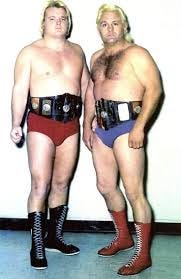
Pictured: Greg Valentine & Gorgeous George, Jr. NWA United States Tag Team Champions
January 1976 kicked off with a focus on tag team dynamics and high-profile world title defenses, showcasing the territory’s ability to draw crowds with a mix of local feuds and national prestige. The NWA United States Tag Team Championship (Tri-State version) was a central attraction, held by Greg Valentine and Bill Watts early in the month. However, Watts suffered an injury, leading to Gorgeous George Jr. stepping in as Valentine’s partner. This substitution added intrigue to the division, as the duo defended the belts against challengers like the Hollywood Blondes (Jerry Brown and Buddy Roberts), a cocky heel team known for their underhanded tactics and bleach-blond hair. The Blondes, managed occasionally by figures like Buck Robley, were building heat through their arrogant promos and cheap-shot victories, setting up a feud that would boil over in the coming months. Singles action also heated up, with Ken Patera—a powerhouse with Olympic weightlifting credentials—dominating midcard opponents like Bob Griffin in brutal squash matches that emphasized his raw strength.
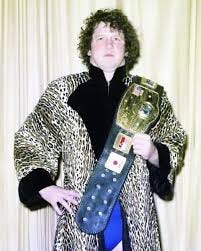
Pictured: NWA World Heavyweight Champion Terry Funk
A standout event occurred on January 30 in Lafayette, Louisiana, where NWA World Heavyweight Champion Terry Funk defended his title against Bill Watts in a grueling encounter. Funk, the rugged Texan with a brawling style, clashed with Watts’ powerhouse football-background offense, resulting in a hard-fought draw that left fans clamoring for more. This match exemplified Tri-State’s philosophy: no-nonsense wrestling where stipulations like time limits heightened the drama. Elsewhere, emerging face Ted DiBiase was honing his skills in tag matches alongside Dick Murdoch, a duo that had turned fan favorites after Murdoch’s 1975 heel-to-face shift. Their ongoing rivalry with Killer Karl Kox—a vicious heel managed by the scheming Buck Robley—carried over from late 1975, with bloody TV segments featuring loaded gloves and chain attacks that blurred the lines between kayfabe and reality.
February maintained the momentum with consistent house shows emphasizing handicap challenges and midget wrestling for variety. On February 24 at the Municipal Auditorium in Shreveport, Louisiana, a stacked card highlighted the territory’s depth. Ted DiBiase faced Killer Karl Kox in a 15-minute handicap challenge, where Kox failed to pin DiBiase within the time limit, resulting in DiBiase’s victory and furthering their heated feud. DiBiase, still early in his career, used these matches to build credibility as a resilient underdog. Other bouts included Ken Patera defeating Bob Griffin in a dominant display, and tag action featuring Dick Murdoch and Waldo von Erich, a faux-Nazi heel whose stiff chops drew massive heat. Danny Hodge, the legendary amateur wrestler turned pro, was also on the card, preparing for his big title opportunity. Midget wrestlers like Little Coco, Little John, Little Louie, and Billy The Kid added levity, a common Tri-State staple to balance the violence.

Pictured: Buck Robley
Angles in February revolved around managerial betrayals and power struggles. Buck Robley, a cowardly heel turned manager, continued pitting Kox against the Murdoch-DiBiase team, using underhanded interference to escalate the bloodbaths. Robley’s “loaded arm pad” gimmick from prior years evolved into full-blown managerial antics, including post-match ambushes that often required babyfaces like Watts to make the save. Visiting talent like Hiro Matsuda, a technical Japanese heel, began appearing more frequently, setting up ethnic-based feuds that played on cultural tensions. The Hollywood Blondes ramped up their pursuit of the tag titles, clashing with Valentine and George Jr. in preliminary matches across Oklahoma and Louisiana, building toward a climactic change.
March 1976 proved pivotal, marked by title changes, a shocking injury, and guest appearances that elevated the territory’s profile. The month opened with Danny Hodge capturing the NWA World Junior Heavyweight Championship from Hiro Matsuda on March 2 in Shreveport. This victory—Hodge’s eighth and final reign—came via his signature Oklahoma Roll after a technical masterpiece that showcased both men’s grappling prowess. Tragically, just 13 days later on March 15, Hodge vacated the title following a severe car accident that broke his neck, effectively ending his in-ring career and leaving a void in the junior heavyweight division. Fans mourned the loss of the “white knight” of wrestling, whose mythic feuds with heels like Matsuda and Skandor Akbar had defined Tri-State for years.
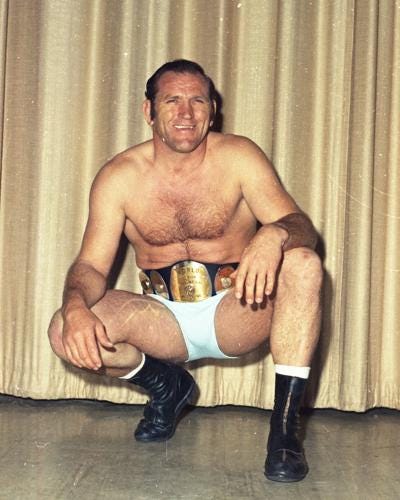
Pictured: Danny Hodge, NWA World Junior Heavyweight Champion
Tag team turmoil dominated the latter half of March. On March 18 in New Orleans, the Hollywood Blondes dethroned Greg Valentine and Gorgeous George Jr. for the US Tag Team Titles in a controversial two-out-of-three falls match riddled with interference. This win solidified Brown and Roberts as top heels, their cocky celebrations drawing boos across the circuit. However, their reign was short-lived; on March 29 in Tulsa, Buck Robley and Bob Slaughter (later known as Sgt. Slaughter) captured the belts from the Blondes, marking Robley’s second tag reign and injecting fresh energy into the division. Slaughter’s military gimmick added a patriotic angle, contrasting the Blondes’ vanity.
Singles feuds intensified with visiting stars. On March 10 in Jackson, Mississippi, a young Ric Flair—still honing his “Nature Boy” persona—defeated Butcher Brannigan in a midcard bout, showcasing Flair’s emerging charisma in a territory known for testing talent. Ongoing storylines saw DiBiase and Murdoch continuing their war with Kox, with chain matches and no-DQ stipulations leading to crimson masks. Bill Watts, recovering from injury, resumed his role as a top draw, feuding with Waldo von Erich in powerhouse collisions that emphasized von Erich’s “iron claw” hold.
One Thing I Learned About Butcher Paul Vachon
He had an operatic singing voice and once engaged in a memorable ‘sing-off’ with fellow wrestler Fabulous Kangaroo Al Costello at a Cauliflower Alley Club reunion.
Thank You for Reading
I’m Tony Richards, Pro Wrestling Historian, Author and Storyteller. I share pro wrestling historical items in each issue of the Time Tunnel Pro Wrestling History Newsletter. Thanks for reading! If you enjoy my information on select events, matches and insights, please share it with folks you think might like to be a subscriber!
Remember, premium investors get access to exclusive and special content such as some special issues including a multi-part deep dives on wrestling territories, wrestler bios and championship title histories, special audio and video interviews on territory pro wrestling and more available in the Pro Wrestling Time Tunnel for Premium Investors.
Tony, were many of these matches preserved?