


Happy Birthday to those who have passed on and to those great wrestlers still with us:
In Memoriam:
Pierre Lefebvre 1955
Happy Birthday:
Bas Rutten (61)
Floyd Mayweather, Jr. (49)
Sjinsuke Nakamura (46)
Corey Graves (42)
RIP Memorial: We stop & remember those who have passed on this day and gave themselves to the business for us, the fans. We salute you and thank you.
Bob Clay 2-24-2004 at the age of 79

Joseph Hudson\Josephus\The Question Mark 2-24-2021 at the age of 44

80 Year Flashback
2-23-1946: Gory Guerrero defeated Tarzan Lopez (ch) for the NWA World Middleweight Championship in Mexico City, Mexico
Salvador “Gory” Guerrero Quesada (January 11, 1921 – April 18, 1990) was a pioneering Mexican-American wrestler, often credited as one of the early stars of lucha libre who helped popularize the style. Born in Ray, Arizona, to migrant workers, he moved to Mexico as a child after his mother’s death. Initially interested in boxing, he trained under Diablo Velasco and Indio Mejía before debuting in 1937 under the name Joe Morgan (later changing to Gory Guerrero due to his reputation for bloody, intense matches). He joined EMLL in 1943, where he was named Rookie of the Year.
By the mid-1940s, Guerrero was rising rapidly, in April 1945, he won the Mexican National Welterweight Championship from Jack O’Brien (a title he never lost). In September 1945, he captured the Mexican National Middleweight Championship from Bobby Bonales, holding it for about a year. These early successes established him as a technical powerhouse with a flair for high-flying moves and submissions, earning him the nickname “El Inventor de la Lucha Libre” (The Inventor of Lucha Libre) for innovations like the Camel Clutch (later popularized by his son Eddie as the Lasso from El Paso). Guerrero’s innovative style, blending grappling and aerial maneuvers, influenced generations to come in the future.
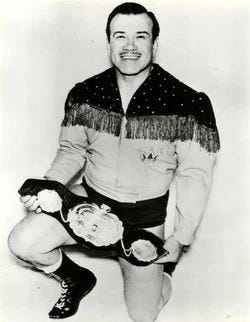
Pictured: Gory Guerrero, NWA World Middleweight Champion
Carlos López Tovar (August 28, 1912 – August 28, 1975), better known as Tarzán López, was a dominant force in Mexican wrestling during the 1930s and 1940s. Hailing from Jerez, Zacatecas, he debuted in 1934 after training under Gonzalo Avendaño. Known for his impressive bodybuilder physique and athleticism, López quickly became a fan favorite through feuds like his early rivalry with Salvador Flores. He signed with EMLL and amassed an impressive resume, including being named Luchador of the Year in Mexico in 1940, 1944, and 1948.
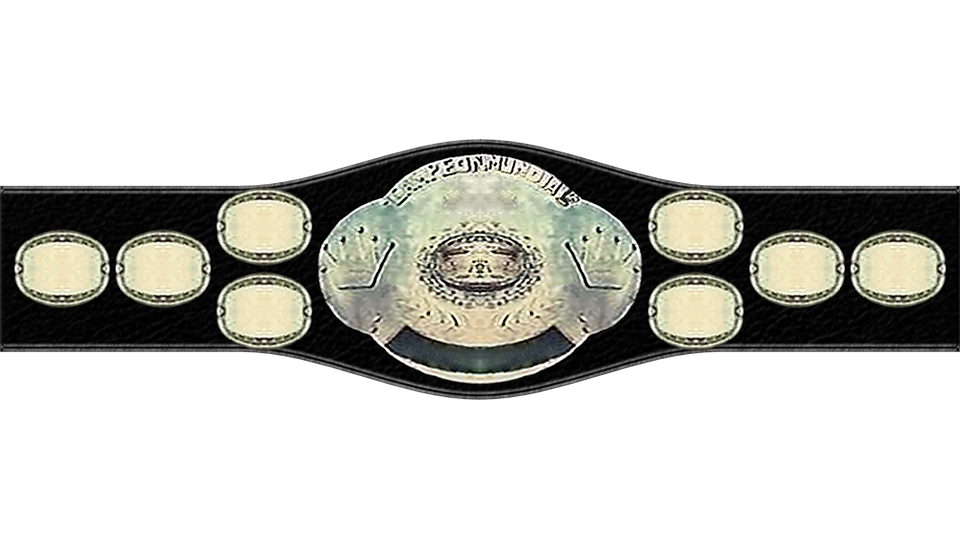
Pictured: The NWA World Middleweight Championship Title Belt
López was a multi-time champion across weight classes. This particular championship, the NWA World Middleweight Title he won an amazing 4 times in total from 1940 to 1953. The Middleweight Category was traditionally between 182 and 192 lbs, but those classes were adjusted when convenient. The NWA Middleweight Championship’s inception traces back to early 1939, when Salvador Lutteroth, the visionary founder of EMLL (now known as Consejo Mundial de Lucha Libre or CMLL), created the “World Middleweight Championship” to elevate the middleweight division in Mexico. Lutteroth awarded the title to Finnish-American wrestler Gus Kallio, a renowned figure nicknamed “The King of the Middleweights” for his five-time reign as the National Wrestling Association (NWA predecessor) World Middleweight Champion in the United States. This move was strategic, blending international credibility with local promotion, as Kallio’s reputation helped legitimize the new belt.
Once Lutteroth’s Mexico City office joined the National Wrestling Alliance in the early 1950s, Lutteroth chaired the Championship Committees for his three EMLL controlled NWA World Titles and he listened to input from others, but he always controlled the three titles and booked them from Mexico City, much the same as Sam Avey and LeRoy McGuirk did with the World Junior Heavyweight Title in Tulsa.
The first official title change occurred on February 19, 1939, in Mexico City, where Mexican star Octavio Gaona defeated Kallio to claim the championship. Gaona’s victory unified Kallio’s U.S.-based title with Lutteroth’s creation, though the National Wrestling Association version was retired in 1940 to prioritize the Mexican iteration. Gaona held the belt for 350 days, setting a tone of technical mastery and high-flying action that would define the division.
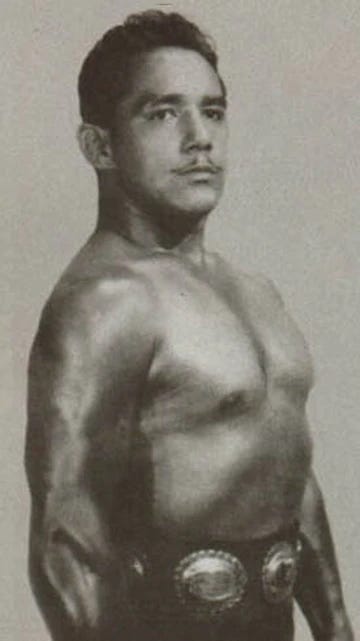
Pictured: Tarzan Lopez, NWA World Middleweight Champion
The early 1940s saw the rise of Tarzán López, who captured the title on February 4, 1940, in Mexico City by defeating Gaona. López’s first reign lasted 681 days, during which he solidified the championship’s status in EMLL events. He lost it briefly to Black Guzmán on December 16, 1941, but regained it on February 11, 1942, embarking on a remarkable 1,473-day second reign. This era highlighted the title’s focus on endurance and storytelling, with matches often headlining EMLL’s anniversary shows. Lopez’ career was cut short in the early 1950s after a financial dispute with EMLL (reportedly over a loan request for a friend’s medical needs), leading to his retirement from full-time wrestling.
Guerrero and López were part of EMLL’s golden era, where rivalries often blended technical wrestling with high-stakes drama. Their paths crossed in the mid-1940s amid feuds involving tag teams and singles competition. In 1945, Guerrero teamed with El Santo (as the “Atomic Pair”) to defeat López and Jack O’Brien in a sold-out tag match at Arena Coliseo. This built to a larger feud involving Guerrero against López and his tag partner Enrique Llanes.
The culmination was the title match on February 23, 1946, at a live EMLL event in Mexico City (likely Arena Coliseo, which frequently hosted sellouts for their encounters). Guerrero defeated López to win the NWA World Middleweight Championship, ending López’s second reign (which had lasted 1,473 days since 1942). The match was a major draw, packing the arena and earning rave reviews for its intensity and technical prowess—considered a potential “Match of the Year” candidate by modern standards if such awards existed then. It elevated Guerrero to “consagrado” status (a lifelong superstar in lucha libre culture) and solidified his place among Mexico’s elite wrestlers.
In lucha libre (Mexican professional wrestling), “consagrado” is a Spanish term that translates to “consecrated” or “sanctified,” but in the context of the sport, it refers to a wrestler who has achieved veteran or legendary status. These are established performers with a proven track record of success, respect, and longevity in the industry, often having won multiple championships, masks, or hair matches (apuestas). It’s not an official title or rank like “tecnico” (hero) or “rudo” (villain), but rather an informal designation for top-tier stars who are considered icons or “made men” in the business.
For example, groups like “Los Consagrados” (The Consecrated Ones) have been used as stable names for teams of experienced wrestlers, such as El Texano, Pirata Morgan, Espectro Jr., and El Cobarde in promotions like AAA. Events often pay “homenaje a consagrados” (homage to the consecrated ones) to honor such figures, like tributes to legends such as Dos Caras Sr. or Carlos Maynez. This status reflects a wrestler’s elevation from mid-card or up-and-coming talent to a revered position, similar to “hall of fame” caliber in other wrestling traditions.
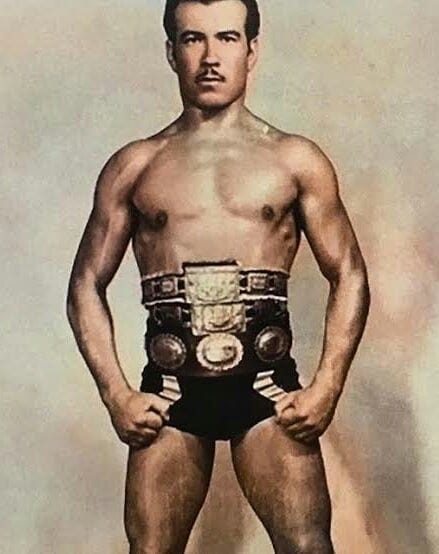
Pictured: Gory Guerrero portrait with his three championships in February 1946: Mexican National Welterweight Champion, Mexican National Middleweight Champion and NWA World Middleweight Champion.
Gory Guerrero held the World Middleweight Title for 782 days before losing it to Mike Kelly in 1948. The two had additional encounters, but this 1946 bout remains the most iconic. Their styles complemented each other: Guerrero’s innovative submissions against López’s power and experience created a very memorable match that I only wish we had more photo or video documentation of what was surely a wild and crazy crowd and hot environment.
One Thing I Learned About Bob Clay
He was the driver in a 1950 car accident that permanently blinded his trainer and fellow wrestler Leroy McGuirk, effectively ending McGuirk’s in-ring career. While heading to a restaurant in Little Rock, Arkansas, Clay slammed on the brakes to avoid a collision, throwing McGuirk (who was already blind in one eye from a childhood incident) into the windshield and shattering his glasses, with the shards damaging his remaining good eye.
Thank You for Reading
I’m Tony Richards, Pro Wrestling Historian, Author and Storyteller. I share pro wrestling historical items in each issue of the Time Tunnel Pro Wrestling History Newsletter. Thanks for reading! If you enjoy my information on select events, matches and insights, please share it with folks you think might like to be a subscriber!
Remember, premium investors get access to exclusive and special content such as some special issues including a multi-part deep dives on wrestling territories, wrestler bios and championship title histories, special audio and video interviews on territory pro wrestling and more available in the Pro Wrestling Time Tunnel for Premium Investors.