


Happy Birthday to those who have passed on and to those great wrestlers still with us:
In Memoriam:
Chuck O’Connor\Big John Studd 1948
Happy Birthday:
Francine (54)
Danny Doring (52)
Shawn Spears (45)
Mascarita Dorada (44)
RIP Memorial: We stop & remember those who have passed on this day and gave themselves to the business for us, the fans. We salute you and thank you.
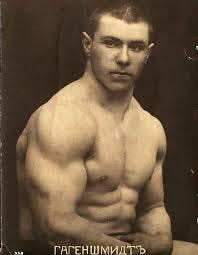
George Hackenschmidt 2-19-1968 at the age of 90
Harold Watanabe\Tojo Yamamoto 2-19-1992 at the age of 65

Pierre Villeneuve\Farmer Pete 2-19-1997 at the age of 69
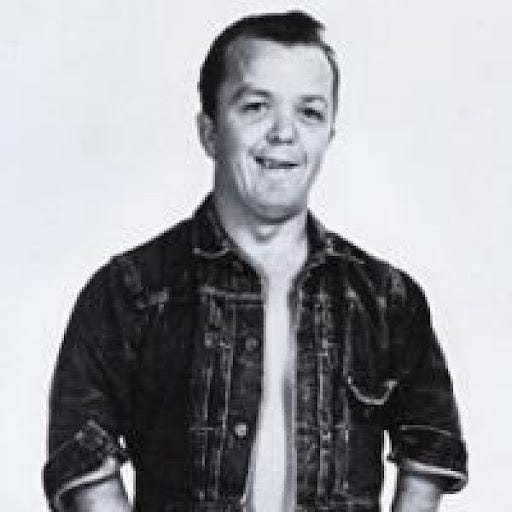
Swede Hanson 2-19-2002 at the age of 68

The Life and Career of Tojo Yamamoto
He actually was not Japanese like the character he portrayed and was identified with, but actually Harold Watanabe, who was born on January 6, 1927, in Hawaii. After taking on the Yamamotot character, he rose to prominence in the mid-20th century by channeling post-World War II animosities into a persona that captivated and enraged audiences across the American South. His career spanned nearly four decades, from his debut in 1953 to his retirement in 1991, during which he amassed an astonishing array of championships, mentored future stars, and left an indelible mark on the territorial wrestling scene. Yet, behind the snarling facade of the “most hated wrestler of all time,” lay a complex individual—a former U.S. Marine of Japanese descent—who navigated personal hardships and health struggles, ultimately meeting a tragic end in 1992.
Harold Watanabe’s origins were far removed from the villainous character he would later portray. Born in Kaanapali, Hawaii, to Japanese-American parents, Watanabe grew up in a multicultural environment shaped by the islands’ diverse heritage. His early life was marked by service in the U.S. Marine Corps, a detail that added irony to his later heel persona, which exploited anti-Japanese sentiments lingering from World War II. After his military stint, Watanabe turned to professional wrestling in the early 1950s, making his debut in 1953 under various aliases before settling on the name that would define him.
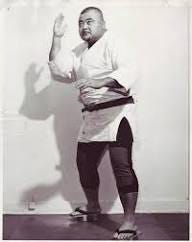
Initially wrestling as P.Y. Chung in the Northeast and Carolinas during the late 1950s, Watanabe honed his skills in regional promotions. The transition to “Tojo Yamamoto” was a calculated move, blending the names of two infamous Japanese wartime leaders—Prime Minister Hideki Tojo and Admiral Isoroku Yamamoto—to evoke memories of Pearl Harbor and stoke patriotic fervor among American crowds.
This gimmick was not unique; other wrestlers like the von Brauners had similarly capitalized on Axis stereotypes. However, Yamamoto’s commitment to the role—complete with a scowling demeanor, wooden shoes as weapons as well as throwing salt along with signature moves like the judo chop and abdominal grab—set him apart. By the early 1960s, he had migrated to the Southern territories, where promoters like Nick Gulas recognized his potential as a top draw.
Yamamoto’s early career was characterized by his ability to generate heat, or audience disdain, through psychological tactics rather than sheer athleticism. As one source notes, he was promoted as “the most hated wrestler of all time,” a title earned through antics that played on cultural fears and wartime grudges. His first major success came in Florida in 1961-1962, where he teamed with Taro Myaki to capture the NWA United States Tag Team Championship from Eddie Graham and Dick Steinborn. This victory marked the beginning of a pattern: Yamamoto excelled in tag team wrestling, often pairing with fellow “Asian” heels to form dominant alliances that terrorized babyface opponents.
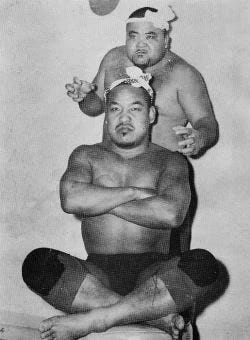
Pictured: Tojo Yamamoto and Yoshino Sato in 1963
The 1960s and 1970s represented the peak of Yamamoto’s villainous run, particularly in the Tennessee Territory of Roy Welch and Nick Gulas. Gulas & Welch had tremendous success with an asian heel named Tor Yamato, who had been killed in an unfortunate incident in his home with his wife in late 1960. Gulas and Welch decided that Watanabe would be perfect as a Japanese heel to succeed the initial success of Yamato, naming Tojo with a name closely resembling the original heel’s name with Yamamoto.
His heel persona thrived in the South, where audiences were receptive to narratives pitting American heroes against foreign menaces. Yamamoto’s matches were masterclasses in ring psychology; he would taunt crowds with gestures evoking Japanese imperialism, sneak-attack opponents with his wooden shoes, and employ underhanded tactics sych as throwing salt in the eyes of the babyface to secure victories. One memorable anecdote from Boaz, Alabama, highlights his performative genius: before a match, he requested to address the crowd, only to deliver a heel promo that incited near-riots, demonstrating his ability to blur the lines between kayfabe and reality. Yamamoto would apologize to the crowd about his country bombing Pearl Harbor and wished it had not happened. Once the crowd quieted down and begin to sympathize with him, he would yell, “Instead I wish they BOMB Boaz!” The crowd in the arena would erupt in heat and outrage. Yamamoto repeated this gimmick in town after town.
Tag team wrestling was Yamamoto’s forte, and his resume boasts an extraordinary 51 tag team titles across various promotions, often with rotating partners like Mitsu Hirai, Tor Kamata, the Great Togo, and later Gypsy Joe. In 1978, he and Gypsy Joe formed the “No Pain Train,” capturing the Mid-America Tag Team Championship. He also secured seven six-man tag titles, showcasing his versatility in multi-man matches. Singles success was notable too, though secondary to his tag prowess; he held regional belts and engaged in high-profile feuds with stars like Jackie Fargo, whose real-life friendship with Yamamoto contrasted their ongoing storyline rivalry.
Feuds defined Yamamoto’s career, none more iconic than his long-running battles with Fargo in Chattanooga and Memphis. These programs often involved dramatic sneak attacks, such as Yamamoto ambushing Fargo with a shoe during interviews, building anticipation for packed house shows. His work extended to Texas and other territories, where he managed and wrestled, solidifying his reputation as a reliable heat magnet.
From the late 1950s through the early 1970s, Yamamoto was booked as as “the most hated wrestler of all time” and “the epitome of evil”. However, in the early 1970s, the unthinkable actually happened as it often does with the most hated heels, Tojo turned babyface. He aligned with a young protégé, Jerry Jarrett, in what became one of the most successful and memorable tag teams in Memphis wrestling lore.
Yamamoto’s relationship with Jarrett began not in the ring but through mentorship. Jarrett, who debuted as a wrestler in 1965 after training under Yamamoto and Sailor Moran, was initially a referee and promoter’s assistant in the Gulas-Welch promotion. Yamamoto, recognizing Jarrett’s potential, took him under his wing, sharing road trips filled with discussions on philosophy, religion, and wrestling psychology. He emphasized the importance of selling moves, facial expressions, and evoking emotion from the audience—lessons that Jarrett credited with shaping his career.
This bond laid the groundwork for Yamamoto’s first major babyface turn, which occurred around 1970 amid Jarrett’s push as an up-and-coming talent. As detailed in Jarrett’s autobiography The Best of Times, Memphis television announcers Lance Russell and Dave Brown built Jarrett’s character by highlighting his weekly improvements in matches. The storyline revealed Yamamoto as Jarrett’s secret mentor, culminating in a pivotal angle where Jarrett was receiving a severe beating during a match. Yamamoto rushed to the ring to rescue him, instantly flipping his heel persona to that of a heroic ally. This turn transformed Yamamoto from a despised villain into the territory’s top babyface in 1970, a stark contrast to his heel dominance in 1968 and 1969.
The rescue angle propelled Yamamoto and Jarrett into a powerhouse tag team, capitalizing on their real-life friendship and contrasting styles—Y Yamamoto’s rugged, experienced brawling complemented Jarrett’s athletic, good-looking babyface appeal. Fans embraced the duo, and they quickly became a dominant force, feuding with top heel teams like The Interns (Bill and Joe Wilhoit) and Al and Don Greene throughout 1970 and beyond. Their in-ring chemistry translated to championship success, with the pair capturing multiple titles in the NWA Mid-America territory. Their first joint reign came on October 19, 1970, when they won the NWA Southern Tag Team Championship (Mid-America version) from The Interns.
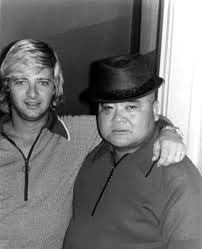
Pictured: Jerry Jarrett and Tojo Yamamoto
They followed this with additional victories over Al and Don Greene on January 9, 1971, and May 31, 1971. After a brief hiatus, they reclaimed the belts in January 1973 (opponents unknown), and again in October 1974 from Al Greene and Phil Hickerson. They also secured the NWA Southeastern Tag Team Championship in May 1974 and the NWA Tennessee Tag Team Championship once. Their partnership culminated in 1980 under Jarrett’s Continental Wrestling Association (CWA), where they became the inaugural CWA World Tag Team Champions on July 28 by defeating Austin Idol and Dutch Mantel in a tournament final. In total, they held tag team gold at least seven times, making them one of the most decorated teams in the region’s history.
In February 1974, Yamamoto turned heel on Jarrett, leading to a feud where Jackie Fargo avenged Jarrett by battling Yamamoto. This split highlighted Yamamoto’s versatility, as he reverted to his villainous roots before reuniting with Jarrett later that year for another title run. Their loyalty was tested again in 1977 when Jarrett broke from Gulas to form his own promotion; Yamamoto initially stayed with Gulas out of allegiance but rejoined Jarrett after Gulas’ outfit folded, resuming their friendship seamlessly. Behind the scenes incidents, like the 1973 real-life backstage assault on Jack Donovan involving Yamamoto, Jarrett, and Fargo—stemming from a match finish dispute—added to their notoriety, blurring the lines between kayfabe and reality.

Pictured: Tojo Yamamoto & Tommy Rich
Yamamoto’s babyface turn and tag team with Jarrett not only revitalized his career but also cemented his legacy as a mentor and versatile performer. He trained numerous stars, including Jarrett’s son Jeff, Bobby Eaton, and Tommy Rich, extending his influence beyond the ring. Jerry Jarrett repeated the success he had in a tag team with Tojo by booking Yamamoto with another young, blonde babyface rookie in 1975, Tommy Rich. Yamamoto and Rich had a tag team championship run through 1975, before Rich got his first singles push in early 1976.
By the 1980s, as wrestling evolved with national expansions like the WWF, Yamamoto remained a territorial staple, adapting his style to mentor younger talent while still drawing crowds. Yamamoto’s role shifted from active heel to a more multifaceted figure. Health issues began to surface, including severe diabetes and kidney problems, which would later force his retirement. His influence as a mentor was profound; Lawler and others credited Yamamoto with teaching ring psychology and the art of drawing emotion from crowds. Yamamoto also dabbled in management, guiding younger heels and extending his career beyond physical limitations.
By 1991, at age 64, mounting health woes—exacerbated by decades on the road—compelled his retirement. The constant travel, injuries, and emotional toll of the wrestling lifestyle had worn him down, setting the stage for his tragic final chapter.

Pictured: Tojo Yamamoto and Plowboy Frazier
Away from the spotlight, Harold Watanabe led a life marked by contrasts. As a Hawaiian native and Marine veteran, he embodied American patriotism, yet his career thrived on portraying its antithesis. The loss of mobility and independence, coupled with the depression that often plagues retired athletes, proved overwhelming. On February 19, 1992, at age 65, Watanabe died by suicide via a self-inflicted gunshot wound at his home in Hermitage, Tennessee. Yamamoto was a giant in the history of Tennessee wrestling, his 51 tag team titles and innovative heel work influenced generations, proving that psychology could outshine athleticism.
Besides the championships he held, the crowds he drew and the stars he mentored, Yamamoto would be proud to be called one of the last “old-time Tennessee heels.”
One Thing I Learned About Swede Hanson
Before entering professional wrestling, he had a successful amateur boxing career, compiling an impressive 61–3 record in New Jersey Golden Gloves competitions.
Thank You for Reading
I’m Tony Richards, Pro Wrestling Historian, Author and Storyteller. I share pro wrestling historical items in each issue of the Time Tunnel Pro Wrestling History Newsletter. Thanks for reading! If you enjoy my information on select events, matches and insights, please share it with folks you think might like to be a subscriber!
Remember, premium investors get access to exclusive and special content such as some special issues including a multi-part deep dives on wrestling territories, wrestler bios and championship title histories, special audio and video interviews on territory pro wrestling and more available in the Pro Wrestling Time Tunnel for Premium Investors.
Really enjoying your historical research on the greatest sport in the world. In the future when you do a long form on some aspect of pro wrestling, would you do it on your platform so you will have control over the flow of it.