


Happy Birthday to those who have passed on and to those great wrestlers still with us:
In Memoriam:
Joe Garigiola 1926
Happy Birthday:
George Gray\The One Man Gang (66)
RIP Memorial: We stop & remember those who have passed on this day and gave themselves to the business for us, the fans. We salute you and thank you.
Gypsy Joe Dorsetti 2-12-1986 at the age of 70

Pedro Morales 2-12-2019 at the age of 76

Significant Debut:
Wayne Munn 1924 age: 28 at the 71st Regiment Armory in New York City, New York
The Life and Career of Everett Marshall
He was nicknamed the “Blond Bear of the Rockies” for his powerful build and Colorado roots, Everett Marshall competed from 1928 to 1949, amassing world titles and leaving a lasting legacy as a tough competitor who popularized high-flying maneuvers in an otherwise ground-based sport.
Everett Marshall grew up in the rural town of La Junta, the son of farmers Claude and Pearl Marshall. Life on the family ranch instilled in him a strong work ethic and natural physical strength, which would later define his wrestling persona. As a young man, he excelled in athletics, particularly football. In 1925, he played tackle for the La Junta High School Tigers, helping lead them to a state championship by defeating Pueblo Central in the semi-finals—a team featuring the legendary Earl “Dutch” Clark. This early success in high school sports showcased his potential as an athlete, and reports suggest he could have pursued a professional football career, but wrestling captured his interest instead.

Marshall’s entry into wrestling was influenced by the era’s grappling legends. He began training under the mentorship of Ed “Strangler” Lewis, one of the most dominant wrestlers of the time, and was managed by Billy Sandow, a prominent promoter and brother of Eugen Sandow, the famous strongman. His training methods were unconventional, emphasizing endurance and strength-building exercises drawn from his farm background, such as lifting heavy bales and wrestling livestock—tales that added to his mythic “Blond Bear” image. By 1928, at the age of 23, Marshall made his professional debut, quickly establishing himself in regional circuits with his blend of technical skill and raw power.
Marshall’s career took off in the 1930s, a period when professional wrestling was fragmented across various regional promotions, each claiming their own “world” champions. Standing at 5’11” and weighing around 225 pounds, he was not the largest wrestler, but his agility and tenacity set him apart. He became known as the “Armpull King” for his signature armlocks and armpulls, moves that targeted opponents’ limbs with precision. More famously, Marshall is credited with inventing and popularizing the Airplane Spin—a dynamic finisher where he would hoist an opponent onto his shoulders and spin them dizzy before slamming them down. This move injected excitement into matches that were often slow and mat-based, foreshadowing the high-flying elements that would later define wrestling entertainment.
His first major title came in 1935 when he captured the Ohio version of the Midwest Wrestling Association (MWA) World Heavyweight Championship, previously held by John Pesek. This victory solidified his status in the Midwest circuit. The title changed hands briefly to Ray Steele in February 1937, but after Steele’s injury in a car accident, it was returned to Marshall. That same year, in May, Marshall defeated Chief Little Beaver to win the Texas version of the World Heavyweight Championship, expanding his influence southward.
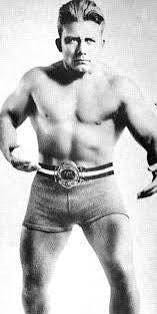
Pictured: Everett Marshall, National Wrestling Association (NWA) World Heavyweight Champion
Marshall’s crowning achievement arrived on June 26, 1936, at Red Bird Stadium in Columbus, Ohio, where he defeated Ali Baba to claim the National Wrestling Association (NWA) World Heavyweight Championship. Initially, this win was not universally recognized due to the era’s promotional disputes, and John Pesek briefly claimed the title by posting a $1,000 bond. However, at the 1938 NBA/NWA annual meeting, recognition was officially reinstated for Marshall. He held the title for over a year before losing it to the young phenom Lou Thesz on December 29, 1937, in St. Louis, Missouri. Remarkably, Marshall regained the championship on September 14, 1938, when it was awarded to him after Steve Casey was stripped for leaving the country. His second reign ended on February 23, 1939, again at the hands of Thesz in St. Louis. These reigns totaled about three years as world champion, a feat that earned him recognition as the champion in Colorado in 1935 and beyond.
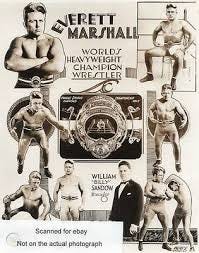
Throughout his career, Marshall faced off against some of wrestling’s greatest talents, including Ali Baba, John Pesek, Ray Steele, and multiple bouts with Lou Thesz, who would go on to become a multi-time world champion. His 1936 victory over Ali Baba in Columbus was a landmark event, drawing large crowds and cementing his status as a top draw. The rematches with Thesz were particularly grueling, showcasing Marshall’s endurance against the technically superior younger wrestler.
Marshall’s contributions extended beyond wins and losses. By popularizing the Airplane Spin, he helped transition wrestling toward more entertaining, athletic displays— a shift that signaled the move from pure sport to the next stage of the evolution of pro wrestling. His matches in promotions like the Rocky Mountains circuit, where he held the Heavyweight Championship multiple times between 1945 and 1947, kept him relevant in his later years.
As the 1940s progressed, Marshall continued competing but scaled back due to the physical toll of over two decades in the ring. He retired in 1949 after a 21-year career, returning to his roots as a rancher-farmer in La Junta. In retirement, he lived quietly, though his legacy endured through stories of his exploits.
Marshall passed away on February 10, 1973, at the age of 67.
One Thing I Learned About Joe Garigiola
During World War II, he played baseball for the Manila Dodgers in the Philippines—a military team managed by Kirby Higbe—on a bullet-riddled ballpark, where he once heard an Armed Forces Radio broadcast extravagantly praising him as “the greatest catcher since the invention of shin guards.”
Thank You for Reading
I’m Tony Richards, Pro Wrestling Historian, Author and Storyteller. I share pro wrestling historical items in each issue of the Time Tunnel Pro Wrestling History Newsletter. Thanks for reading! If you enjoy my information on select events, matches and insights, please share it with folks you think might like to be a subscriber!
Remember, premium investors get access to exclusive and special content such as some special issues including a multi-part deep dives on wrestling territories, wrestler bios and championship title histories, special audio and video interviews on territory pro wrestling and more available in the Pro Wrestling Time Tunnel for Premium Investors.
Hi Tony;
I am enjoying your historical content.
Billy Sandow's real name was William Baumann. His real brother was named Max Baumann. Max was a promoter. https://www.wrestlingdata.com/index.php?befehl=bios&wrestler=38539