


Happy Birthday to those who have passed on and to those great wrestlers still with us:
In Memoriam:
Max Baer 1907
Bull Montana 1913
Cowboy Bradley 1935
Happy Birthday:
Ken Shamrock (61)
Shawn Hernandez (53)
*Tony Note: A special Happy Birthday to my Mother, Shirley who turns 82 today. She has seen a lot in her time! We had a surprise birthday party for her in one of our neighbor’s barns here at the last Saturday night. She is the boss here at the Richards Ranch and we pray for her safety and peace of mind every day so we can have her with us here for years to come!
RIP Memorial: We stop & remember those who have passed on this day and gave themselves to the business for us, the fans. We salute you and thank you.
Bill Parks 2-11-2004 at the age of 83

Vic Rossitani 2-11-2014 at the age of 75

Chavo Guerrero 2-11-2017 at the age of 67
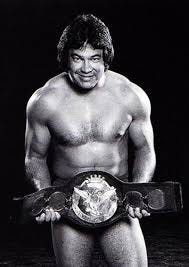
90 Year Flashback
2-11-1936: Billy Weidner defeated The Bat in two straight falls at the Memorial Hall in Chico, California, unmasking The Bat to reveal Sammy Kohen.
The history of masked wrestlers in professional wrestling is a topic that really fascinates me and I am sure that I will be doing a “History of Masked Wrestlers” Series here in the Time Tunnel at some point. In the meantime, it was on this day in pro wrestling history in 1936 that one of the more prolific feuds came to a conclusive blow off in Chico, California ending the fascinating and compelling run of the masked wrestler known as The Bat.
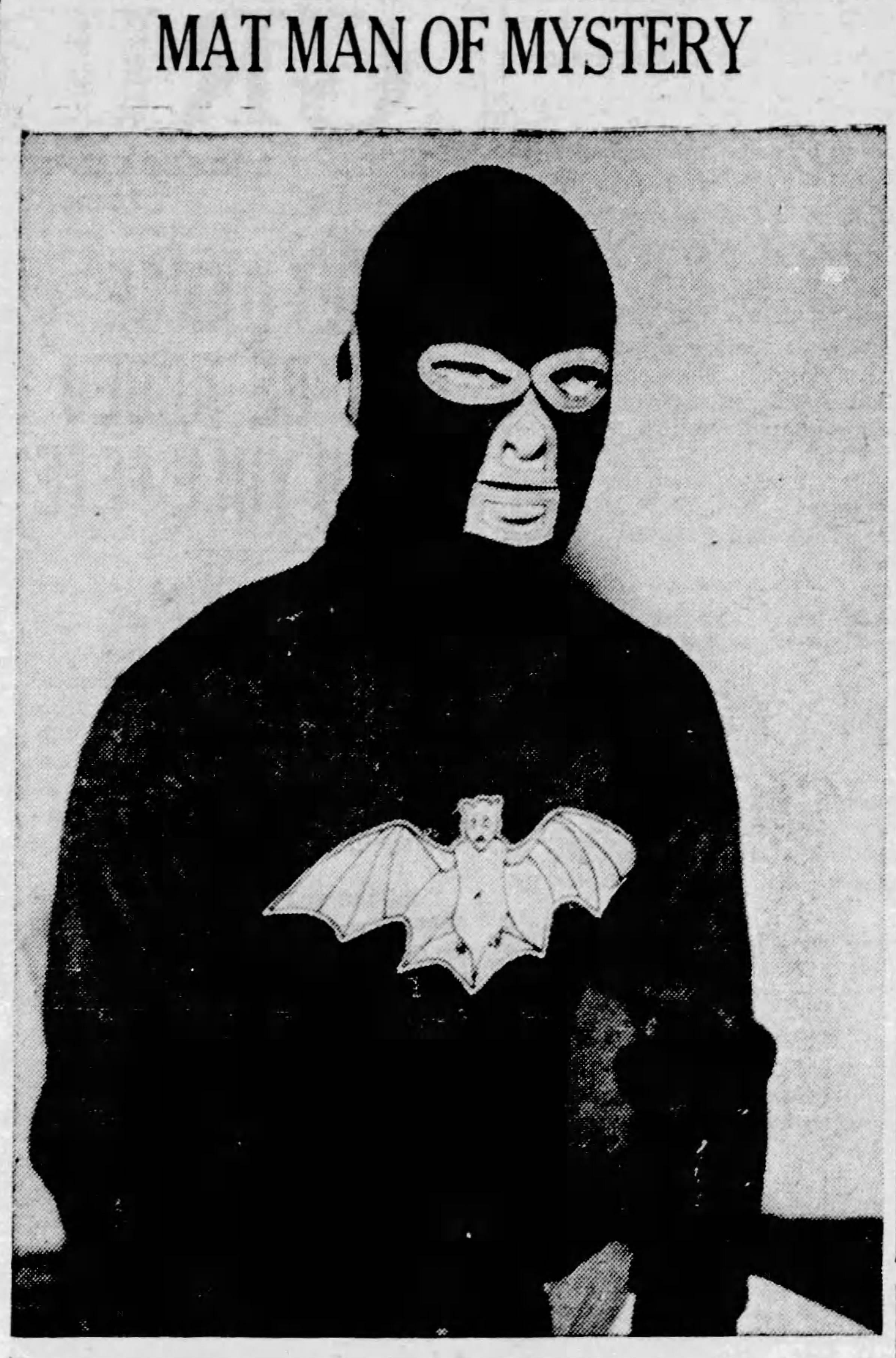
Pictured: Sammy Kohen as The Bat
The rivalry between Sammy Kohen and Billy Weidner in professional wrestling during the 1930s exemplifies the type and kind of thay era’s territorial feuds, often built around dramatic stipulations like mask matches and multi-fall bouts. Both were lightweight to middleweight competitors—Kohen at 5’7” and 175 pounds, Weidner similarly built—who emphasized technical grappling, endurance, and rough tactics in the catch-as-catch-can style popular then.
Kohen was born in Poland in 1904 and he immigrated to the U.S. and debuted in 1928, wrestling over 1,246 matches until the 1950s. He frequently used the masked gimmick “The Bat” to add mystery, a common draw for crowds seeking spectacle amid the Great Depression. Billy Weidner, born William Weidenauer in 1903, was a durable performer active from the early 1930s to the 1940s, holding titles like the MWA Light Heavyweight Championship and competing in regions like Ohio, California, and Hawaii. Weidner passed away in 1966. Their paths crossed in the territorial system, where creative programs and feuds for the times combined with repeated bookings fostered heated rivalries to boost attendance to the shows.
The earliest documented clash was on November 7, 1933, at the Civic Auditorium in Honolulu, Hawaii. Weidner defeated Kohen in a singles match on a card that also featured Billy Spendlove and Johnny Nemanic. Anecdotal notes from the time described Kohen as a “rough-house wrestler” who faced transportation issues, adding to the era’s logistical challenges for touring performers. This bout occurred during Hawaii’s vibrant wrestling scene, which attracted mainland talent for exotic tours.
Their rivalry escalated )n September 24th 1935 with another encounter: a 2 out of 3 falls match between Weidner and Kohen, at the Liberty Hall in El Paso, Texas. It was a grueling match that went 35 minutes and 15 seconds with Kohen coming out with the pinfall in that final fall to win the bout. Weidner and Kohen were working in the West Texas area after the amazing program had drawn big money between Ben Sherman under a mask as The Masked Marvel against Cyclone Mackey. Mackey, interestingly enough been the original Masked Marvel in West Texas in 1933 and had pioneered the gimmick there. His abilities to draw money with the mask had drawn the attention of Salvador Lutteroth in Mexico City, where Mackey’s appearance had started a cultural revolution of masked wrestlers for the country that continues to this day.
I wrote about this in a piece as part of The Evolution of Pro Wrestling Series here:
The Masked Mysery of West Texas in 1935
Evidently both Kohen and Weidner learned about the gimmick and the drawing power of it from Sherman, who accompanied them to Northern California when the West Texas run was over. The pinnacle came on February 11, 1936, when Weidner defeated Kohen’s masked alter ego, “The Bat,” in a stipulation match that resulted in unmasking. This loss forced Kohen to reveal his identity, effectively ending or pausing the gimmick in many territories. Unmaskings were high-stakes events at this time in pro wrestling history, often headlining cards to draw crowds eager for revelations.
The way these matches were typically booked, whether it was The Masked Marvel in Amarillo and Lubbock or The Green Shadow in Nashville and Knoxville, is that the mysterious masked wrestler would show up and go on an amazing winning streak. One by one, each wrestler would be lined up to take on, in this case, The Bat, and every attempt to beat him would fail, allowing the wrestler to keep his mask on and his identity hidden. This would create a stir among the town’s fans, buying tickets each week to see if this latest challenger would be able to defeat and reveal the face of the masked wrestler.
This is how this angle and program was unfolding in Northern California in the towns of Merced, Modesto, Redding, Santa Rosa, Chico and Marysville in the Fall of 1935 and Winter of 1936. What is amazing is that Kohen was wrestling Weidner in some towns during the feud as himself, without the Bat mask and fans were unaware that Kohen and The Bat were one and the same.
It’s also important to remember that during this era in pro wrestling history, many wrestlers traveled in small groups and took their act across the country following the example from the previous decade of The Gold Dust Trio. In this particular group, the prime guys are Ben Sherman, Herb Parks, Bill Weidner, Marvin Barackman and Luis de la Torre along without marked antagonist, Sammy Kohen as The Bat. While Weidner got the build and blow-off match in Chico, Herb Parks got the honor in Marysville, Ben Sherman in Modesto and of course Weidner in Chico. Most likely, the promoter was responsible to promote the town, but the group of wrestlers had their own matches, finishes and gimmicks they used from territory to territory and town to town. The promoter worked the town, and the wrestlers worked the crowds. Once the programs all ran their course, they moved on to the next group of towns and the next promoter. Ben Sherman, when traveling with various groups of wrestlers would at times in certain areas of the country, many times in California, would also portray a masked wrestler, usually The Phantom, or The Mask. Ben Sherman also was The Masked Marvel in the great program in Amarillo and Lubbock in 1935.
Let’s look at the progression of matches around this small loop in the Northern part of California in when the program started in November of 1935 and ended in February 1936. Also, remember, Sammy Kohen was at times wrestling in matches as himself in other combinations with the group of guys, but we only listed the matches in the program where he worked The Bat gimmick. Another thing of note is that the boxer Max Baer was in on some of these towns and cards as a special referee.
11/25/1935: The Bat defeated Luis de la Terre at the Civic Auditorium in Redding, California
11/26/1935: The Bat defeated Jack Curtis in 2 out of 3 falls at Memorial hall in Chico, California
11/27/1935: The Bat defeated Luis de la Terre at the American Legion Arena in Marysville, California
11/29/1935: The Bat defeated Flash Kelly in Modesto, California
12/2/1935: The Bat defeated Gorilla Poggi ended as a time limit draw (30 min) at the Civic Auditorium in Redding, California
12/3/1935: The Bat defeated Mervin Barackman by CO in 2 out of 3 falls at Memorial Hall in Chico, California
12/4/1935: The Bat defeated Bulldog Jackson by CO in 2 out of 3 falls at the American Legion Arena in Marysville, California
12/6/1935: The Bat defeated Mervin Barackman in Modesto, California
12/10/1935: The Bat defeated Gorilla Poggi at Memorial Hall in Chico, California
12/11/1935: The Bat defeated Luis de la Terre at the American Legion Arena in Marysville, California
12/13/1935: The Bat defeated Pete Becker in Modesto, California
12/17/1935: The Bat defeated Dan Hill at Memorial Hall in Chico, California
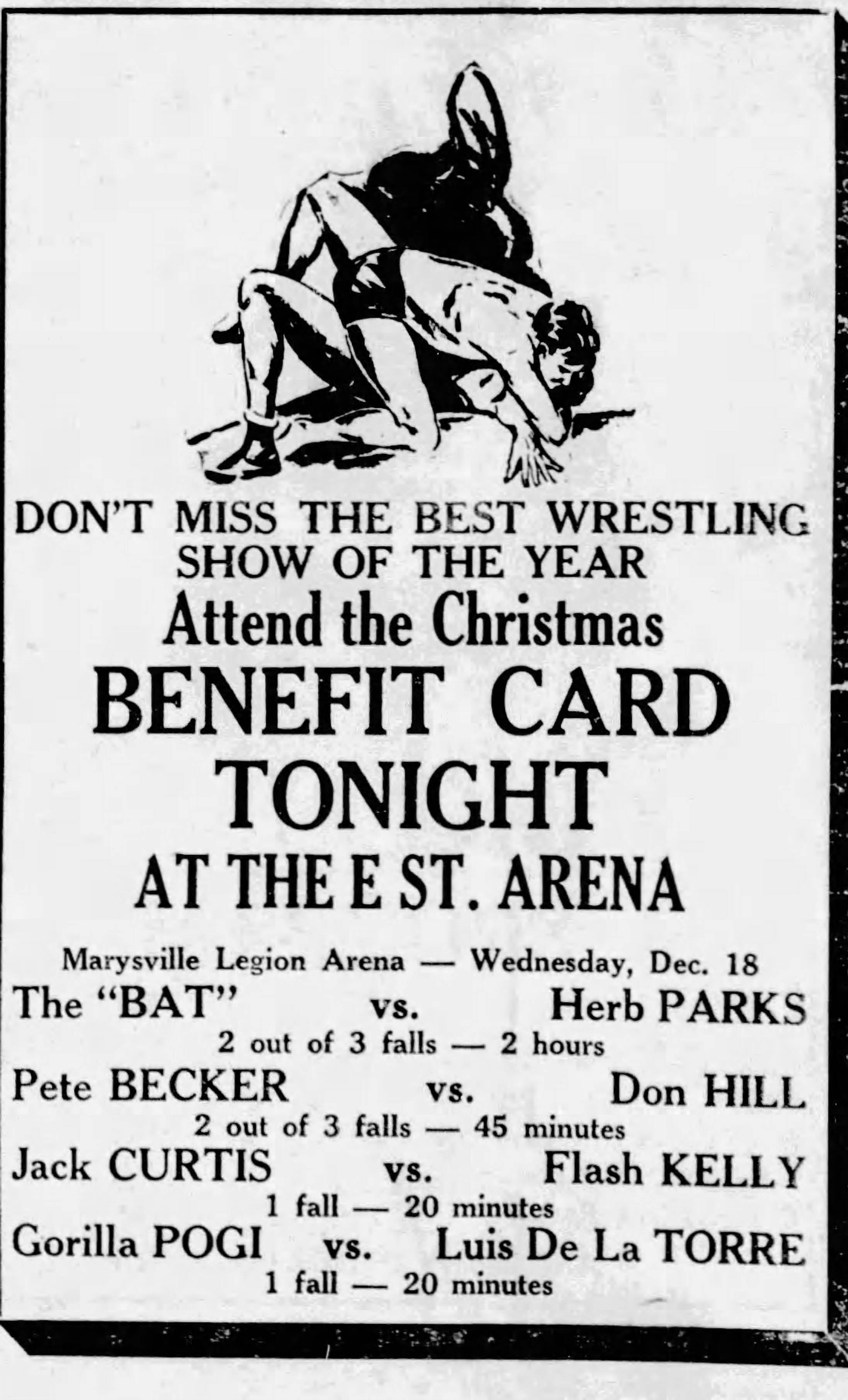
12/18/1935: Herb Parks defeated The Bat in 2 out of 3 falls in the American Legion Arena in Marysville, California
**Tony Note: The blow-off to the program in Marysville as Herb Parks gets the honors to unmask The Bat. In Modesto, Parks and Kohen will go to draws, and in Chico, Kohen will go over Parks, perhaps payback for Kohen putting Parks over in Marysville.
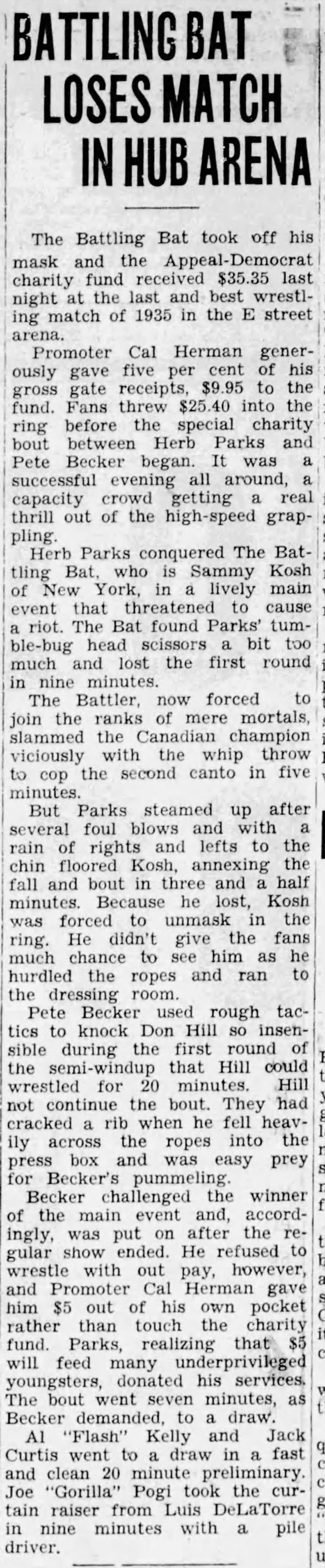
12/20/1935: The Bat defeated Luis de la Torre in Modesto, California
12/27/1935: The Bat defeated Bulldog Jackson in Modesto, California
1/3/1936: The Bat vs Pete Becker ended in a 20 min time limit draw at the DAV Arena in Modesto, California
1/7/1936: The Bat defeated Marvin Barackman in 2 out of 3 falls at Memorial Hall in Chico, California
1/10/1936: The Bat vs Herb Parks ended in a one-hour time limit draw at the DAV Arena in Modesto, California
**Tony Note: Herb Parks’ brother Bill Parks is the recognized inventor of the sunset flip wrestling move.
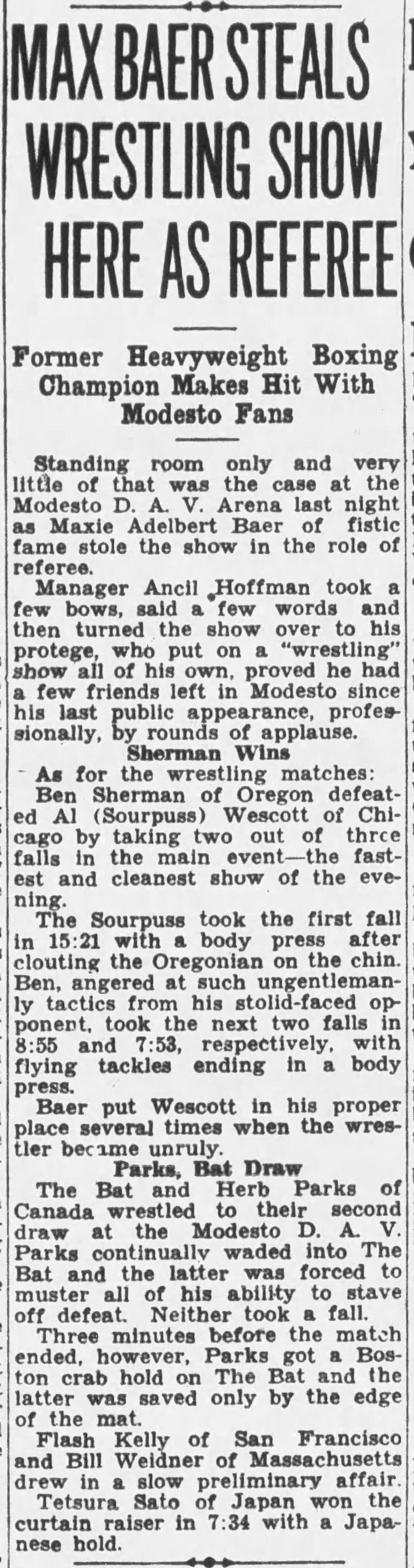
1/14/1936: The Bat defeated Herb Parks in 2 out of 3 falls at Memorial hall in Chico, California
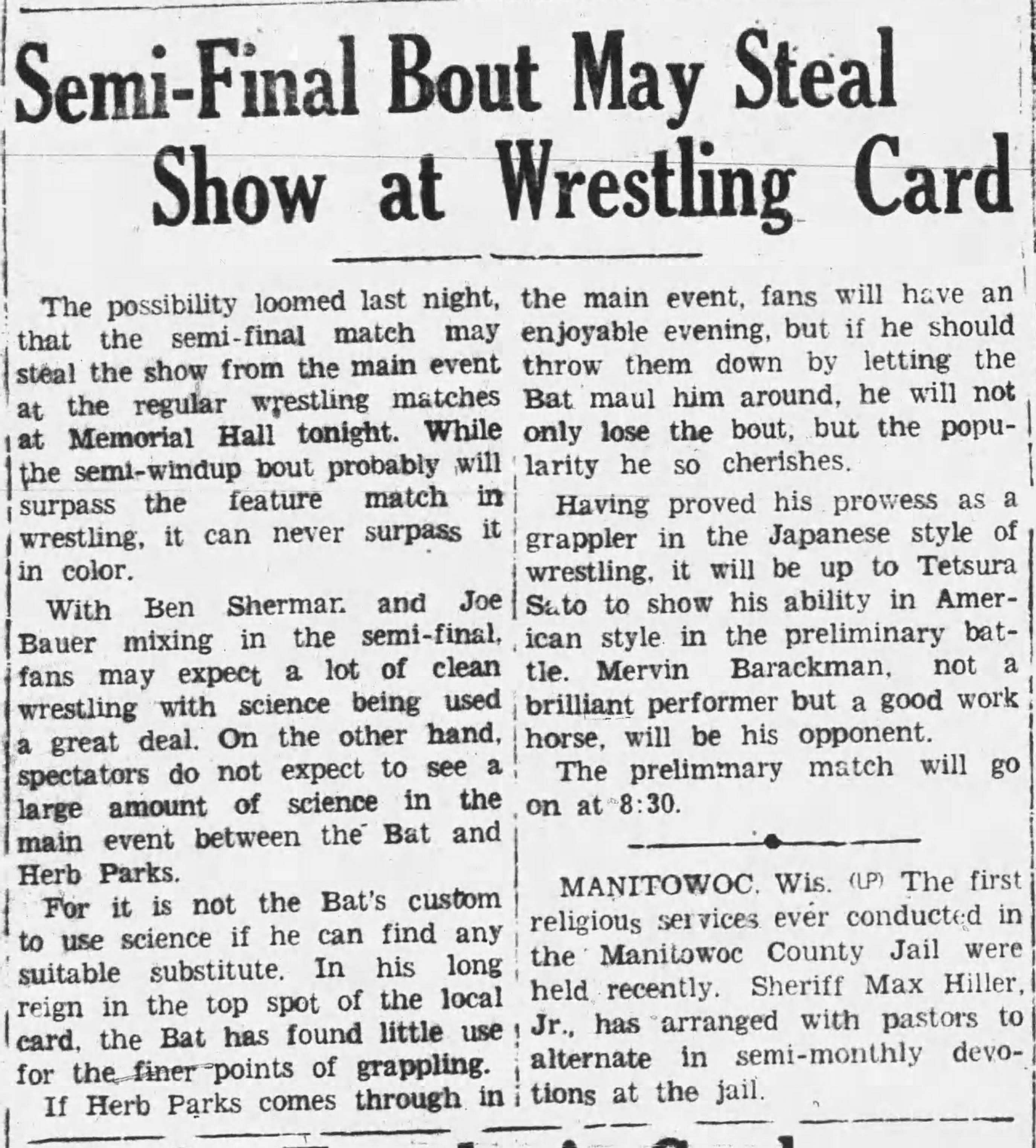
**Tony Note: When you read the newspaper account of the Chico card, you can get the sense of the wrestlers working together to provide a balanced card so the fans will get to see a variety of working. Sherman & Bauer working together to showcase a very “scientific wrestling” style match while Parks and Cohen were going to entertain in the mask gimmick match with heat spots and losing tempers. Pro wrestling would be at its best as it developed through the territory era in presenting cards of varying styles. In the 1970s, you might have Jack Bricso and Dory Funk, Jr in the main event, with Dusty Rhodes and Andre The Giant in a tag team match in the semi-man and even even different style, perhaps Dick The Bruiser type brawling match. Pro Wrestling was always at its best when it was a “variety show.”
1/17/1936: The Bat vs Joe Bauer in 2 out of 3 falls ended as a 45-time limit draw at the DAV Arena in Modesto, California
1/21/1936: The Bat defeated Luis de la Torre at the Skating Rink in Merced, California
1/24/1936: The Bat vs Herb Parks in 2 out of 3 falls ended in a 45 min time limit draw at the DAV Arena in Modesto, California
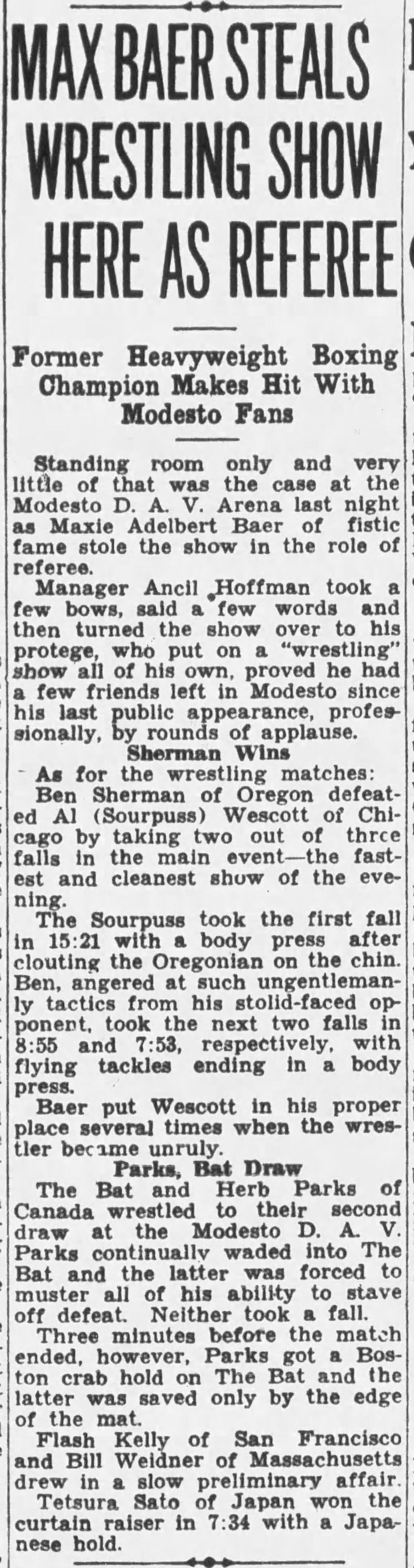
1/28/1936: The Bat defeated Husky Bird in 2 out of 3 falls at the Skating Rink in Merced, California
2/4/1936: The Bat defeated Ben Sherman in 2 out of 3 falls at Memorial Hall in Chico, California
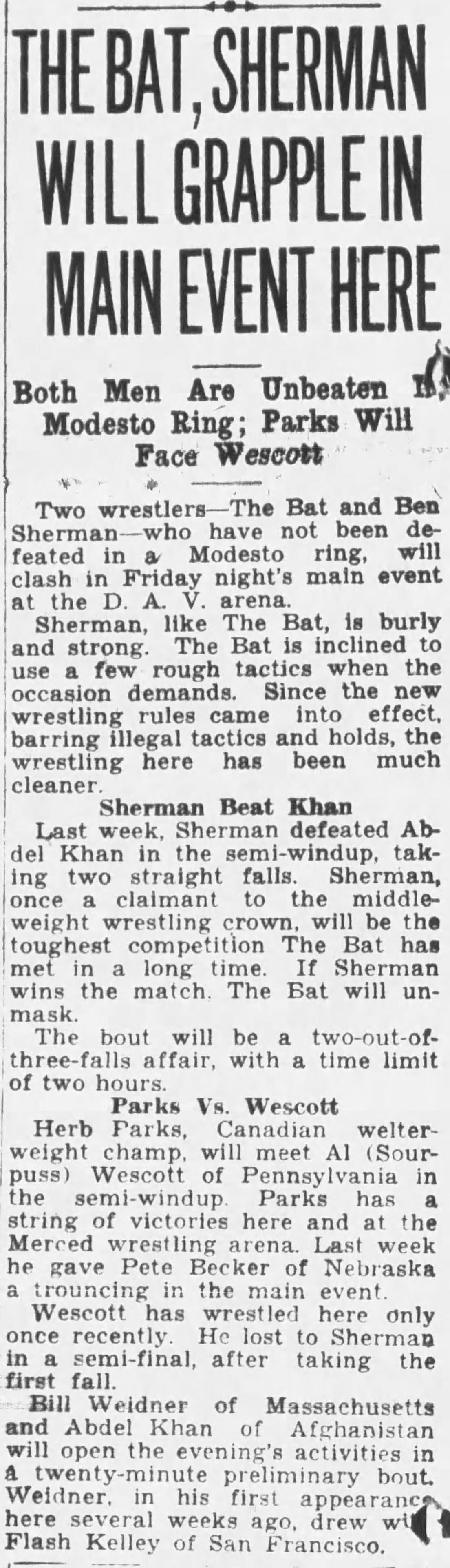
2/7/1936: Ben Sherman defeated The Bat in 2 out of 3 falls at the DAV Arena in Modesto, California
**Tony Note: Notice the newspaper account reflecting the fans’ desperate desire to see The Bat get beat and unmask. Billy Weidner is the “last hope” for the fans, he is the “only one hope that remains.” Pro Wrestling is at it’s best when it reflects desperate struggle, issues and drama. Weidner gets the opportunity to defeat The Bat and end the run.
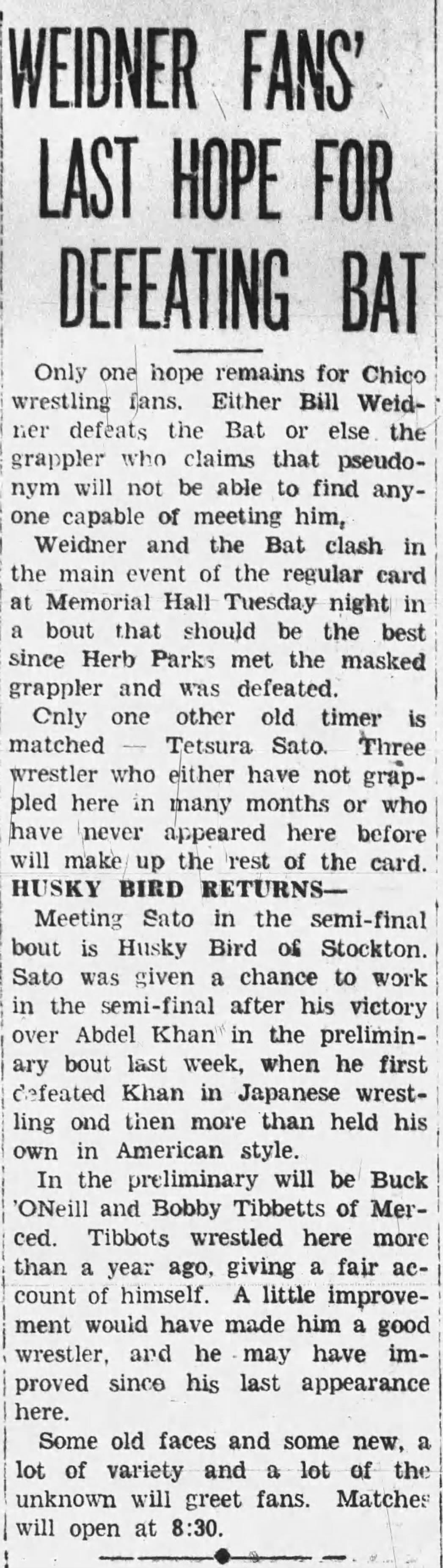
This was the pinnacle of the gimmick on February 11, 1936, when Weidner defeated Kohen’s masked alter ego, “The Bat,” in the stipulation match that resulted in his unmasking. This loss forced Kohen to reveal his identity, which would effectively end the program and it would either do or pause the gimmick in other many territoriesin the years to come. Unmaskings were very high-stakes events at this time in pro wrestling history, very often headlining cards to draw crowds eager for the suspenseful revelations.
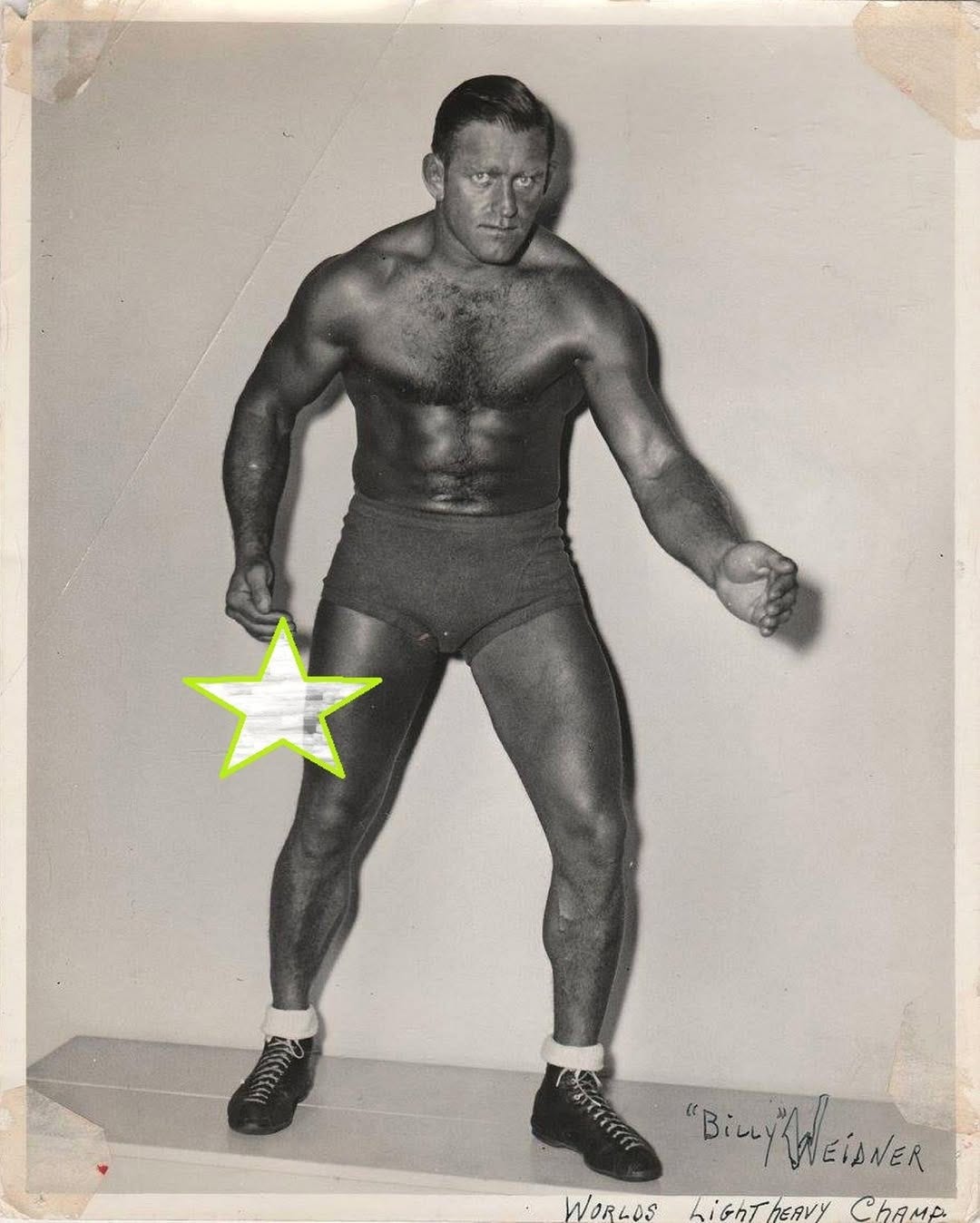
Pictured: Billy Weidner
2/11/1936: Billy Weidner defeated The Bat in two straight falls at the Memorial Hall in Chico, California, unmasking The Bat to reveal Sammy Kohen.
Post-1936, no further direct matches are documented between the two, though they shared cards indirectly. In 1938, both appeared in Abilene, Texas—Kohen losing to Billy Hickson, Weidner active nearby. By the 1940s, Weidner pinned stars like Danny McShain in Los Angeles, while Kohen feuded with Frank Hart in Oregon, including a 1946 threat-laden bout in Coos Bay.
The Life and Career of Sammy Kohen
Sammy Kohen was known under aliases like Sam Cohen and the mysterious, enigmatic masked wrestler “The Bat,” Kohen’s journey from immigrant roots to ring veteran offers a glimpse into the sport’s evolution during a time of economic hardship and global upheaval during the Great Depression.

Sammy Kohen was born on January 4, 1904, in Poland, during a period when the region was under Russian imperial control and marked by political instability. Little is documented about his early childhood, but like many Eastern European immigrants of Jewish descent, he likely sought better opportunities amid rising antisemitism and economic challenges in Europe. By the late 1920s, Kohen had relocated to the United States, where he debuted in professional wrestling in 1928. At 5’7” and weighing around 175 pounds, he competed primarily in the lightweight or middleweight divisions, relying on agility, submission holds, and endurance rather than sheer size. This physique suited the era’s emphasis on mat-based grappling, influenced by catch-as-catch-can styles from Europe and amateur wrestling traditions.
Kohen’s early career unfolded in the territorial system, where wrestlers traveled extensively, performing in small towns and major cities across the Midwest, West Coast, and beyond. Records show him competing in Ohio as early as the 1930s, with matches in venues like Toledo’s arenas. One of his most memorable gimmicks was “The Bat,” a masked persona that added mystery and flair to his performances. Masked wrestlers were a staple in the industry, drawing crowds with their anonymity and dramatic unmasking stipulations. As covered earlier in this publication, in 1936, Kohen suffered a high-profile mask loss as The Bat to Billy Weidner, a defeat that unmasked him and transitioned him back to wrestling under his real name in many territories. For example, in Northern California, after The Bat was unmaked, Kohen would then get re-matches, such as against Weidner to stretch the program out a little more after the blow-off.
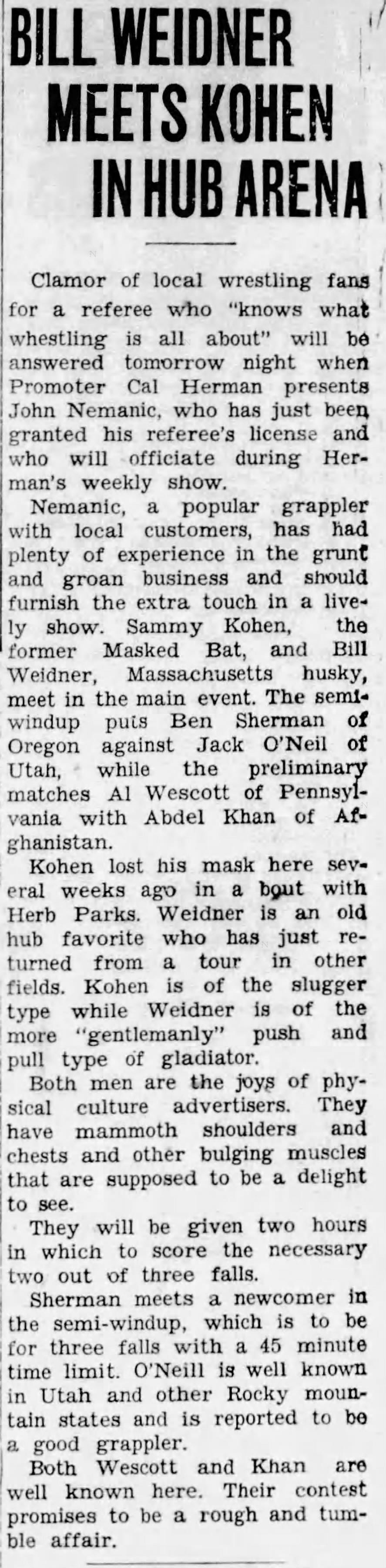
At times, he occasionally revived the gimmick, as evidenced by bouts in the late 1940s where “The Bat” secured victories to provide short term excitement to pump up crowds in the areas where he was working.
Throughout the 1930s and 1940s, Kohen became a journeyman wrestler, known for his reliability and ability to elevate opponents. He amassed an astonishing 1,246 documented matches, facing a who’s who of the era’s talent, including names like Marshall Carter, Les Fishbaugh, and Prince Nihalakis. His style was described in contemporary reports as “rough-house,” emphasizing aggressive tactics and stamina, which suited the carnival-like atmosphere of depression-era wrestling. Kohen worked for various promoters, appearing in promotions across states like Ohio, California, Oregon, and even Hawaii, where he was noted for transportation mishaps that occasionally sidelined him from events. A notable 1946 incident saw him threatened by rival Frank Hart in a Coos Bay, Oregon, bout, highlighting the personal rivalries that fueled wrestling narratives. During World War II, as wrestling adapted to wartime shortages, Kohen continued performing, often in army-related venues or smaller halls, contributing to morale-boosting entertainment.
By the late 1940s and into the 1950s, Kohen’s career began to wind down as television transformed wrestling into a more character-driven spectacle. He retired from active competition sometime in the mid-20th century, though exact details of his post-wrestling life remain sparse. Kohen lived a long life, passing away on January 25, 1997, at the age of 93.
Thank You for Reading
I’m Tony Richards, Pro Wrestling Historian, Author and Storyteller. I share pro wrestling historical items in each issue of the Time Tunnel Pro Wrestling History Newsletter. Thanks for reading! If you enjoy my information on select events, matches and insights, please share it with folks you think might like to be a subscriber!
Remember, premium investors get access to exclusive and special content such as some special issues including a multi-part deep dives on wrestling territories, wrestler bios and championship title histories, special audio and video interviews on territory pro wrestling and more available in the Pro Wrestling Time Tunnel for Premium Investors.
Happy birthday to your mother!😊
Really enjoy these short bios of 1930s wrestlers. Sammy Kohen was one of those who defied the notion about wrestlers back then being all amorphous, doughy guys. In most of his promotional photos, Sammy was ripped.