


May 15 in the Tunnel:
Happy Birthday to those who have passed on and to those great wrestlers still with us:
In Memoriam:
Mary Jane Mull 1928
Don Duffy 1932
Mario Milano 1935
Munenori Higo 1945
Happy Birthday:
Kevin Von Erich (68)
Ron Simmons (67)
"Filthy" Tom Lawlor (42)
Emmanuel Gonzalez\Dragon Lee (30)
RIP Memorial: We stop & remember those who have passed on this day and gave themselves to the business for us, the fans. We salute you and thank you.
Edwin Potvin\Tarzan Zimba 5-15-1981 at the age of 64
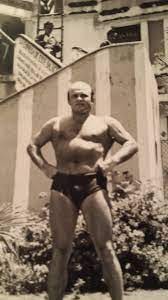
60-Year Flashback:
5-15-1965 Jack Brisco defeated Ron Garvin at the WKY-TV Studios during a taping of Championship Wrestling TV Show in Oklahoma City, Oklahoma making his professional wrestling debut
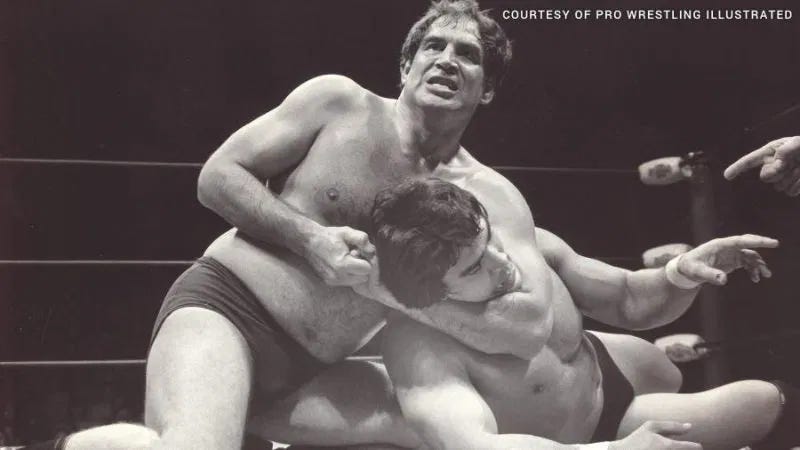
Pictured: Jack Brisco takes a headlock on Ricky Steamboat
*Tony Note: Jack Brisco was one of the most talented athletes to ever step inside the squared circle. After years and years of working to be competitive as ab amateur, collegiate wrestler, having obtained the runner-up position in 1964 and eventually becoming NCAA National Champion in 1965, Brisco always wanted to be in professional wrestling. Growing up in Oklahoma, it was only natural that another Oklahoman would be his hero, Danny Hodge. Looking back at Brisco's overall demeanor, how he carried himself and the way he presented himself in the ring, it only makes sense the other two professional wrestlers he admired were Lou Thesz and Dick Hutton. Thesz, who wore the NWA World Strap for six title reigns carried himself with dignity and prestige. While professional wrestling had its gimmicks and unusual circumstances that bordered on bizarre at times, Thesz walked and talked like a champion should. He arrived wearing suits and carrying a briefcase. From a clothing standpoint, Thesz was Flair before Flair in appearance. And his work in the ring? Beyond immaculate.
When Thesz wanted to take a break from the grueling schedule of the NWA World Champion in the late 1950s, his candidate and choice was Dick Hutton. Although born in Amarillo, Texas, Hutton went to college in Oklahoma and he was NCAA Champion for three years in 1947, 1948 and 1950. He lost in the finals to Verne Gagne in 1949 on a controversial ending to the match and he also competed in the 1948 Summer Olympic Games. He was a consummate wrestler and that is what gained Thesz' attention. While Hutton was a tremendous wrestler, in the late 1950s, television was changing the wrestling business, after the amazing success of flamboyant Gorgeous George. Hutton was not made for television not hyping up matches. Thesz, while one of the greatest workers of all time, was also not the most charismatic, neither was Hodge for that matter. So, Brisco, whose personality was more exciting than all three of his favorites, it was still somewhat serious and muted when it came to "stick work". However, even though he was not loud and over the top, when he delivered his interview, it was serious and direct with the aura of a World Champion. When Brisco talked, he talked straight, and people listened.

Pictured: Jack Brisco being interviewed by Gordon Solie
In the days of Thesz and still in Brisco's era, when it came to the NWA World Championship, it was wrestling ability that mattered most. The Champion had to be able to wrestle a different opponent every night and the match had to be good, regardless of your opponent's ability and the overall goal was to make your opponent look credible and on the verge of winning the match and the title. This way, the local opponent could still work on top in that territory or town, sell lots of tickets and flourish because they almost beat the World Champion. This psychology worked so well; it still works on fans today who believe their favorite wrestler should have been World Champion. Brisco used that mixture of Thesz, Hodge and Hutton in his approach to his work in the wrestling business. Dressing the part, carrying himself like a Champion, and everyone in the dressing room knew he was more than capable of having the match turn into a shoot, if that were the direction his opponent decided to take. However, Brisco's reputation and his ability discouraged the majority of guys from taking that road.
It all started fifty years ago today at the WKY television station in Oklahoma City, Oklahoma. Like many studio wrestling shows of the era, the show was done live, with the matches being broadcast on Saturday night from 7pm to 10pm. The studio audience was small due to the small confines of the room and large spaces required for the floor cameras needed for the production, but the audience watching at home was huge. Also, when you have a small group of people in a small room, they look like a larger crowd. Consequently, if you have a big room with a small number of people, they look miniscule, so there was some wisdom and fortuity in having a small studio with a small crowd, because when they got excited, it was like mayhem was taking over.
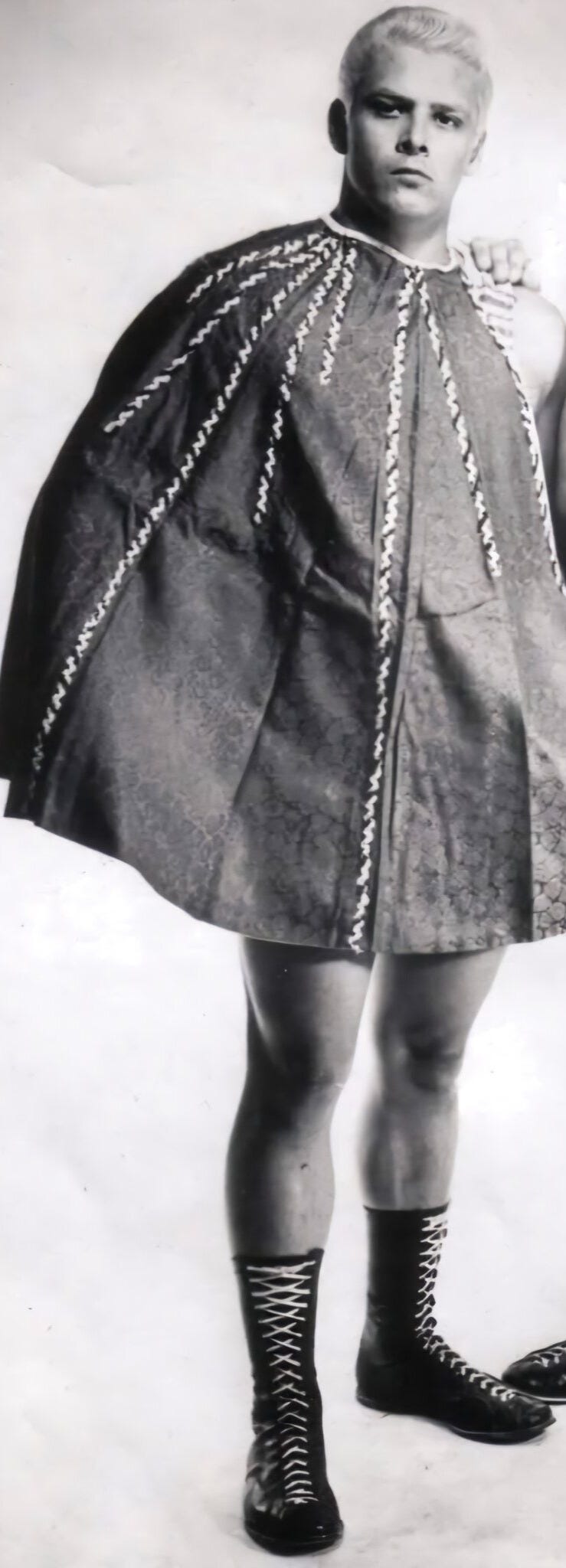
Pictured: Ron Garvin
LeRoy McGuirk matched Brisco in his first match with Ron Garvin, a young wrestler from Montreal, Quebec. Ron hadn't been in the business that long, around three years, having made his own debut in 1962. Brisco remarked in his autobiogrphy, “I was a little put off by Ronnie, he had bleached-blond hair and that was not something I had ever seen in Blackwell, Oklahoma, so i was a little concerned about being confined in a 20x20 ring with a guy who bleached his hair. There probably wasn’t anything about the match I wasn’t afraid of”1. “One thing I always admired about Ronnie was, he agreed to put me over in the match” said Brisco.2
McGuirk having been quite the amateur wrestler himself, winning the NCAA Championship at the 155-pound weight class in 1931 and also becoming the first NWA World Junior Heavyweight Champion. He loved Jack's amateur background and achievements, so he figured the best way for Jack to debut would be on television in his home state of Oklahoma, and in a match booked to be an "amateur rules style" professional match giving Brisco a chance to make a splash and shine the first time many people had ever actually seen him, even though they had heard of him for years in college, in addition to winning the NCAA Championship the previous year.
Typically, in these types of matches, the two wrestlers would start the match in the set position with one guy behind the other with the referee starting the match and the two workers doing catches, switches and go-behinds. Each wrestler trying to take the other down to score. The two work with each other trying to adhere to a form of amateur wrestling and creating match with a story inside amateur moves and switches. Jack later said in his autobiography that he was very nervous about the match, due to Garvin having a lot more pro matches than him, that Ron would take advantage of him and rough up substantially. That didn't happen. Garvin carried the match better than Jack could have hoped, working with Brisco to get the story over to the television audience that Jack was the real deal.
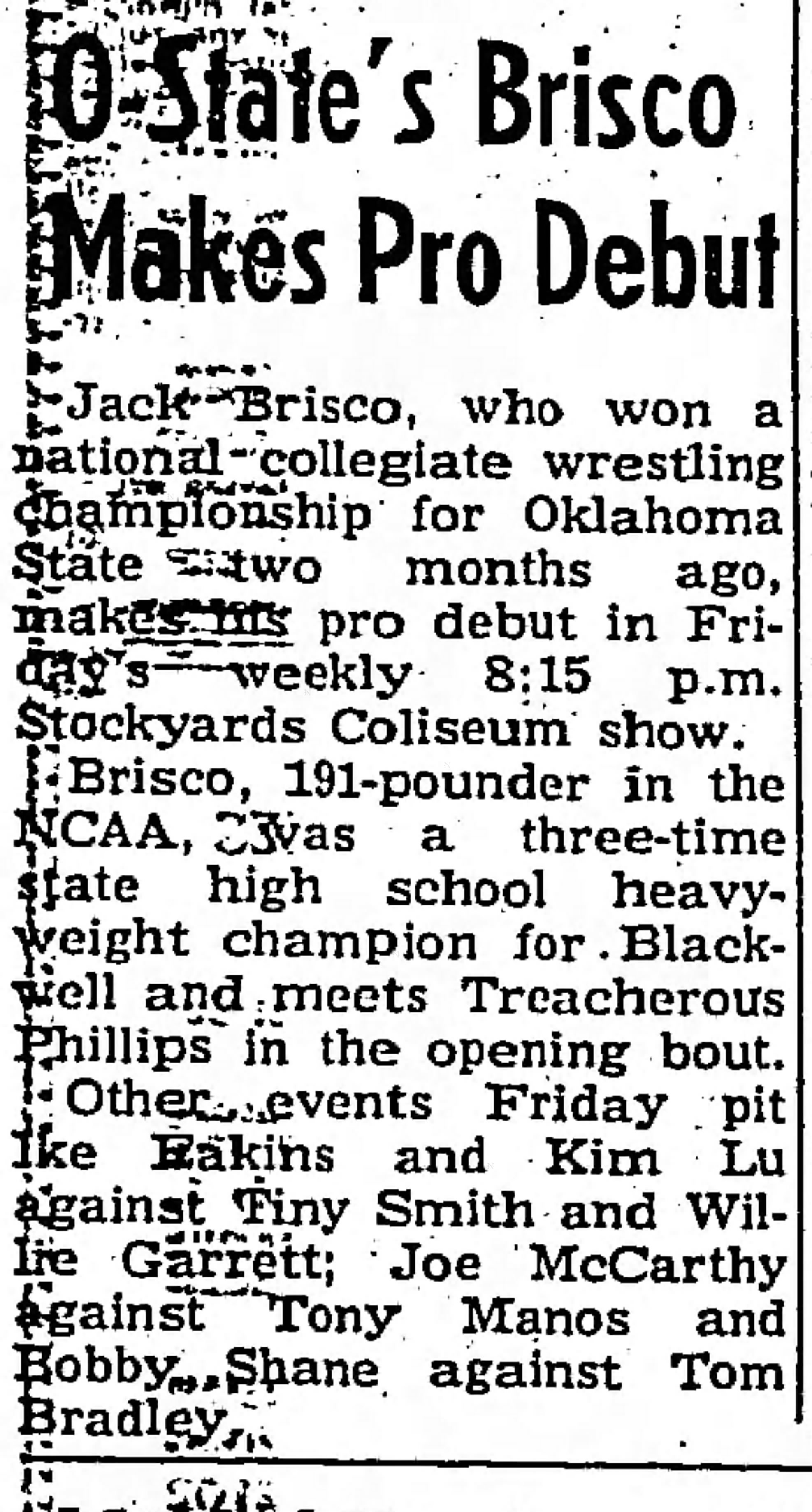
There were a couple of glitches in the match, though, as both men went at it with a lot of energy and enthusiasm. For one thing, Garvin caught Jack over his eye with a stray elbow, opening Jack up hard way and Brisco started bleeding on television, which wasn't part of the original plan of the match. The match came off great to the fans, Brisco won the match. According to Jack, he got $15 for the match and his new professional career was on its way. Jack made his first house show debut several days later on May 28th, 1965, at the Stockyards in Oklahoma City against a more seasoned veteran, Treach Phillips in which Brisco scored another win.
50-Year Flashback
5-13-1975 Dominic DeNucci & Victor Rivera defeated Jimmy & Johnny Valiant to win the WWWF World tag Team Championship at the Arena in Philadelphia, Pennsylvania
*Tony Note: The Valiant Brothers had been on a great run, having won the tag titles almost a year earlier to the day on May 8th, 1974, having defeated Dean Ho and Tony Garea. That program with the babyface champs feeling cheated by the Valiant heel brothers carried forward almost the entire year. The matchmakers of the WWWF would also split Jimmy and Johnny Valiant up into singles matches against the top babyfaces, having the faces go over on them and they never lost their heat and momentum. In the last month to six week of the tag team feud, Gorilla Monsoon would be call upon to function as the special troubleshooting referee to keep things more even and fair for Garea and Ho against the cheating Valiants. The booking in WWWF was typically opposite the NWA. While the NWA typically had heel World Champions, the WWWF had perennial babyface World Titleholders. The NWA had several regional World Tag Champs, while due to its smaller geographic size, the WWWF had one set of tag champs, and they were typically heels in longer programs. The babyface champs would be ultimately victorious over the longer-term heels but then only hold the tag belts for a shorter period anywhere from a few weeks to a couple months.
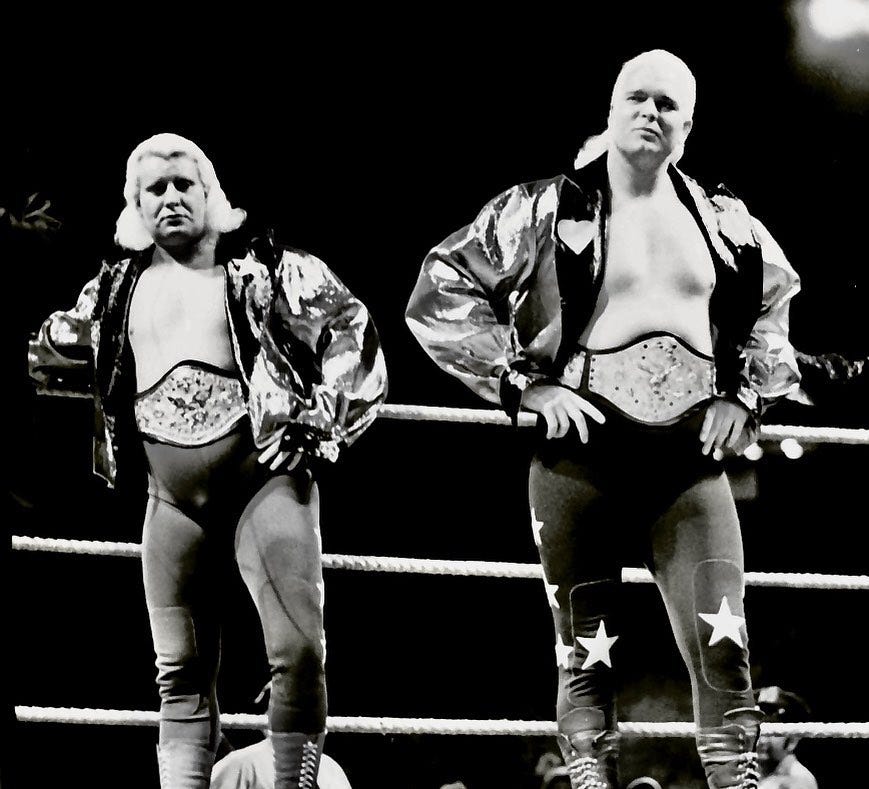
Pictured: Jimmy and Johnny Valiant
**Photo credit:
For fans who are conditioned to seeing Jimmy Valiant as "the boogie woogie man" in Tennessee or the Carolinas in the 1980s, you owe it to yourself to find video of the Valiant Brothers working in WWWF. Jimmy reduced himself to a small set of moves and selling in the 80s and fairly short matches. That's not a knock on him for it, the dude is still over in the Carolinas to this day, Memphis too. But, in those days, the Valiants were faster-paced and dynamic, working together so smoothly as a team to get heat on the babyface team. It's like you took a 1980s Jimmy Valiant match and held your thumb on the fast forward button. This match was televised as it was booked as part of the television taping in Philadelphia and the fans were into the match due to DeNucci and Rivera being fresh new challengers to the titles. The Valiants take the first fall after a flip press by the babyfaces. The brothers get color in the second fall and lose after an airplane spin and pin. Meanwhile, manager Captain Lou Albano is going nuts at ringside, as well as the crowd. Going toward the finish, DeNucci puts Jimmy in an Abdominal Stretch, but Johnny makes the save knocking DeNucci crazy, who then stumbled to make the tag to Rivera, while Jimmy takes Johnny into the match. Rivera does the crazy babyface house of fire swinging punches on Johnny, whose selling it like crazy. Johnny stumbles to the corner where Jimmy and the Captain are on the floor outside the ring and Rivera follows him in. While the crowd thinks the heels will get River down in the corner for a triple team on him, River quickly small packages Johnny to get the fall and the tag titles.
You can see from the footage available that the crowd goes nuts with the pin and the title change, which tells you how hot and over the Valiants were when fans are so excited to see a heel, or a heel team get beat. Not sure how long the original plan was for DeNucci and Rivera to keep the title, but Rivera left the WWWF for the IWA not long after this and they did an angle on television where Rivera gave up his title belt to DeNucci who had to find a new partner. He eventually chose "Irish" Pat Barret who teamed with DeNucci and true to form within a couple months from winning from the Valiants, DeNucci and Barrett lost the championships to the next big and bad heel team, The Blackjacks in August of 1975. We'll cover that event when we get there.
Not being as familiar with the WWWF at this time period because we didn't get it on television in the South and I only was barely introduced to it through magazines, I asked my good friend, Evan Ginzburg who, is roughly the age as me and did grow up watching WWWF in New York City what his opinion was of DeNucci and Rivera as a team. "DeNucci was a likeable, reliable pro and fan favorite who was also Bruno's buddy and thus the perennial tag push and being relatively high on the card" said Ginzburg. "Rivera was extraordinary for his day but I assume Pedro was more favored as a top guy with the power brokers there" he remarked. Which explains why Rivera didn't wan to hang around and gave notice for greener pastures in the IWA, even though he was the guy they really put over in the finish of the match. The ironic thing is that he never left the territory and could have finished out the tag team title run if he had waited to give notice a few weeks later or perhaps the spot in the IWA never worked out, for what reason I’m not certain.
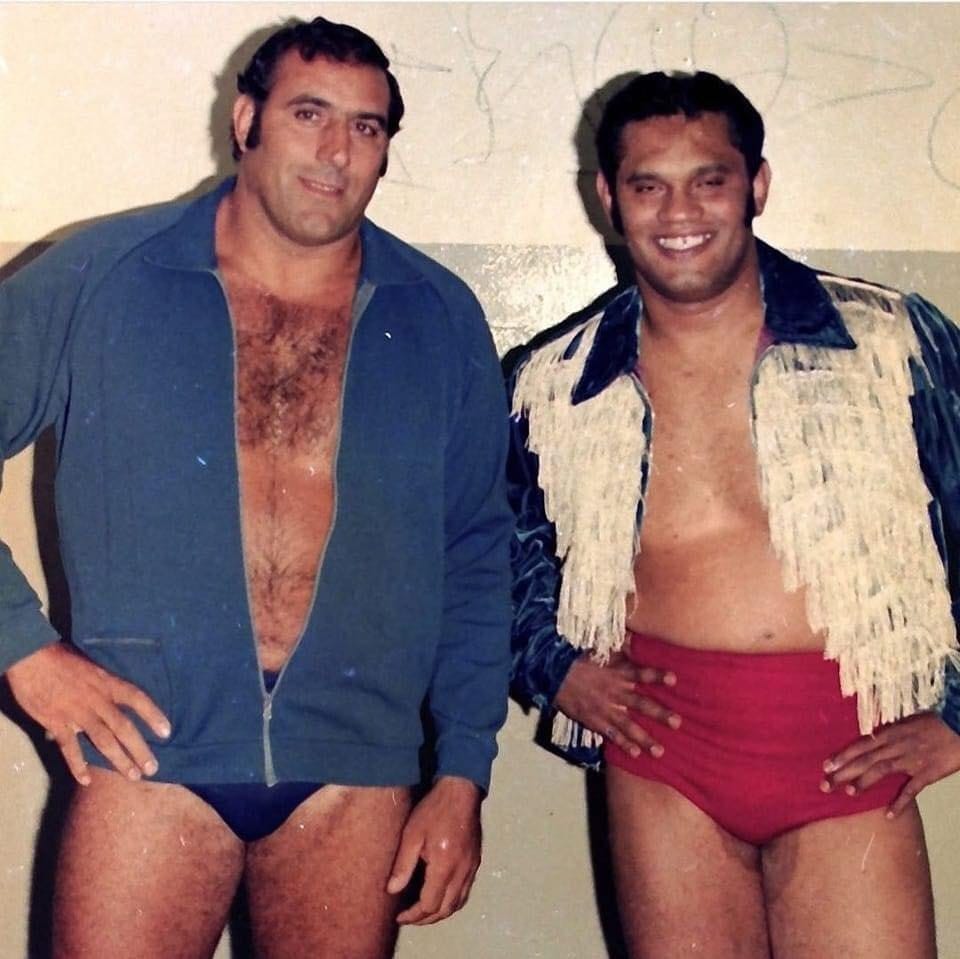
Pictured: Dominic DeNucci and Victor Rivera
One Thing I Learned Today About Pro Wrestling History:
Ron Garvin actually started wrestling in 1962 using his real name of Roger Barnes.
Thank You for Reading
I'm Tony Richards, Pro Wrestling Historian, Author and Storyteller. I share pro wrestling historical items in each issue of the Time Tunnel Pro Wrestling History Newsletter. Thanks for reading! If you enjoy my information on select events, matches and insights, please share it with folks you think might like to be a subscriber!
Remember, paid subscribers get access to exclusive and special content such as to commemorate his induction to the WWE Hall of Fame, I'll be publishing some special issues including a multi-part flashback on the Georgia Championship Wrestling Territory in May 1975 including all the recorded cards for the month, some special audio and video interviews on territory pro wrestling and more.
Brisco: The Life and Times of National Collegiate and World Heavyweight Champion, Jack Brisco by Jack Brisco and William Murdock
ibid