


Happy Birthday to those who have passed on and to those great wrestlers still with us:
In Memoriam:
Freddie Blassie 1918
Jim Neidhart 1955
Sherri Martel 1958
Black Jack Heddon 1944
Kat LaRoux 1965
Happy Birthday:
Misty Blue Simmes (67)
Paul Wight\Big Show (54)
Royce Isaacs (37)
Duke Hudson (36)
Darrel Vidor\Xylon Quinn (36)
RIP Memorial: We stop & remember those who have passed on this day and gave themselves to the business for us, the fans. We salute you and thank you.
Irish Jackie 2-8-2000 at the age of 70

Bob Luce 2-8-2007 at the age of 78

Ricky Hunter 2-8-2022 at the age of 86

50 Year Flashback
January-March 1976 Atlanta, Georgia Territory Analysis
The Atlanta Booking Office was operated by Georgia Championship Wrestling (GCW) under Atlanta promoter Jim Barnett and partners Eddie Graham, Jack & Jerry Brisco and Bill Watts, the territory centered on Atlanta but extended to cities like Augusta, Macon, Columbus, Griffin, and Marietta. Shows aired on WTCG (later TBS), hosted by the legendary Gordon Solie, drawing fans with a mix of athleticism, drama, and bloodshed. The first three months of 1976 exemplified this era’s intensity, featuring heated feuds, title changes, and special stipulations that kept crowds packed into venues like the Atlanta Municipal Auditorium and Macon Coliseum. Key stars included babyface heroes like Dusty Rhodes, Dick Slater, and Mr. Wrestling II, pitted against villainous heels such as The Spoiler, Abdullah the Butcher, and Moondog Mayne. This period highlighted ongoing rivalries, managerial interference, and the physical toll of the business, setting the stage for GCW’s eventual rise to national prominence.

Pictured: Mr. Wrestling II
January 1976 kicked off with a bang, as GCW maintained a rigorous schedule of weekly events, often three or more per week. The Georgia Heavyweight Championship was the focal point, held by The Spoiler (Don Jardine), a masked enforcer managed by the cunning Gary Hart. The Spoiler’s reign, which began in late 1975, saw him defend the belt against fan favorites like Bob Armstrong in brutal encounters. On January 2 at the Atlanta Municipal Auditorium, The Spoiler retained against Armstrong in a Georgia Heavyweight Title match, with Hart’s interference a constant threat. The card also featured international flavor with wrestlers like Skandor Akbar facing Tony Garea, and tag team action pitting Les Thornton and Tony Charles against Luke Graham and Otto Von Heller. Special matches added excitement: a Brass Knuckles bout between Mr. Wrestling II and Rock Hunter, and Dick Slater versus the sadistic Abdullah the Butcher.
As the month progressed, feuds intensified. In Augusta on January 5, The Spoiler again bested Armstrong, while Slater clashed with Abdullah in a no-holds-barred style that drew blood and cheers. Macon’s January 6 show included a Texas Death Match between Slater and Hunter, with Moondog Mayne barred from ringside to prevent interference. Dusty Rhodes, the charismatic “American Dream,” began emerging as a top contender, teaming with Slater against Abdullah and Mayne in tag matches that showcased their resilience. By mid-January, crowds swelled for stipulations like Lumberjack and Taped Fist matches. On January 23 in Atlanta, Slater faced Abdullah in a Lumberjack Match, ensuring no escapes, while Rhodes battled The Spoiler in a Taped Fist encounter. The month’s climax came on January 30 at the Atlanta Municipal Auditorium, where Rhodes defeated The Spoiler in a Steel Cage Match to capture the Georgia Heavyweight Title. This victory, amid Hart’s futile attempts to intervene, marked Rhodes’ first reign of the year and electrified fans, symbolizing the triumph of grit over villainy.

Pictured: Abdullah The Butcher
February 1976 built on January’s momentum, with GCW introducing new talent and escalating rivalries. Rhodes’ title reign was short-lived; on February 6 in Atlanta, The Spoiler reclaimed the belt in a high-stakes Mask vs. Title Match, unmasking threats adding psychological drama. The card featured Mike Graham defending the US Junior Heavyweight Title against Ken Mantell, highlighting the territory’s mid-card depth. The Oates brothers—Ted and Jerry—debuted prominently, facing teams like Mitsu Hata and Taru Hayashi in Griffin on February 7. Feuds persisted: Slater and Mr. Wrestling II teamed against Stan Stasiak and The Spoiler in Augusta on February 9, often under Taped Fist rules to amplify violence.
Mid-February saw guest appearances elevate the product. On February 20 in Atlanta, André the Giant made a rare visit, squashing The Spoiler in a spectacle that drew massive crowds. Abdullah and Stasiak continued terrorizing faces like Bob Armstrong and Slater in tag bouts. Battle Royals added variety; on February 22 in Macon, André won a multi-man melee, his size dominating the field. Managerial antics, particularly Hart’s cageside suspensions during title defenses, prevented cheap wins and heightened fairness themes. Women’s wrestling made a brief splash on February 16 in Augusta, with The Fabulous Moolah defending her World Title against Joyce Grable. Overall, February emphasized tag team dynamics, with Thornton and Charles holding the Georgia Tag Team Titles amid challenges from emerging duos like the Oates brothers.
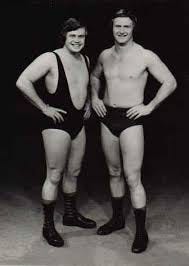
Pictured: Ted and Jerry Oates
March 1976 saw title turmoil and fresh matchups, maintaining GCW’s relentless pace. On March 1 in Augusta, Dusty Rhodes recaptured the Georgia Heavyweight Title from The Spoiler, underscoring their ongoing blood feud. The card included Mr. Wrestling II versus Skandor Akbar, and tag action with Armstrong and Skip Young against Stasiak and Mayne. New faces like Dino Bravo and Bob Backlund injected athleticism; on March 5 in Atlanta, Bravo defeated Rocket Monroe, while Backlund faced Rip Hawk. Thunderbolt Patterson substituted for Rhodes in a tag match against Stasiak and The Spoiler, showcasing the territory’s adaptability to injuries or scheduling.
The month featured diverse venues: Griffin’s March 6 show had Slater versus Abdullah ending in a no-contest, chaos spilling into the crowd. Macon’s March 7 event continued the pattern, though details are sparse. A pivotal shift occurred on March 19 at the Atlanta Municipal Auditorium, where Ted and Jerry Oates dethroned Les Thornton and Tony Charles for the Georgia Tag Team Titles, signaling a new era for tag wrestling. Feuds like Slater’s with Abdullah persisted, often in no-disqualification settings, while young talents like Skip Young gained exposure against veterans. By month’s end, GCW’s storylines teased bigger spectacles, with Rhodes’ title defenses drawing top attendance.
One Thing I Learned About Ricky Hunter
Ricky Hunter (real name Charles B. Sprott) had a ring name change suggested to him by promoter Don Owen from Buddy Sprott to Ricky Hunter because “Sprott” sounded like a disease.
Thank You for Reading
I’m Tony Richards, Pro Wrestling Historian, Author and Storyteller. I share pro wrestling historical items in each issue of the Time Tunnel Pro Wrestling History Newsletter. Thanks for reading! If you enjoy my information on select events, matches and insights, please share it with folks you think might like to be a subscriber!
Remember, premium investors get access to exclusive and special content such as some special issues including a multi-part deep dives on wrestling territories, wrestler bios and championship title histories, special audio and video interviews on territory pro wrestling and more available in the Pro Wrestling Time Tunnel for Premium Investors.