


Happy Birthday to those who have passed on and to those great wrestlers still with us:
In Memoriam:
Tony Stecher 1889
Hans Schmidt 1925
Ruth Boatcallie 1934
Chavo Guerrero 1949
Randall Buchanan\Mighty Wilbur 1957
Rusty Brooks 1958
Happy Birthday:
Tiger Chung Lee\Kim Duk (78)
Mark Sciarra\Rip Rogers (72)
Devil Masami (65)
Hikuleo\Talla Tonga (35)
RIP Memorial: We stop & remember those who have passed on this day and gave themselves to the business for us, the fans. We salute you and thank you.
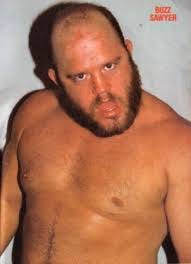
Mad Dog “Buzz” Sawyer 2-7-1992 at the age of 32
The Life and Career of Mario Galento
Bonnie Lee Boyette was born into a family of sharecroppers, one of five children in rural Tennessee. His childhood was far from idyllic; economic hardship forced him to drop out of school after the sixth grade, leading to a transient life as a hobo during his teenage years. Compounding these difficulties, Boyette’s father introduced him to moonshine at a young age, fostering a lifelong struggle with alcohol addiction. Before entering wrestling, he worked various jobs, including as a butcher, which later influenced one of his early ring names. In 1936, he married Marie, and the couple had a son, Robert, who tragically died in infancy in 1937, followed by daughters Barbara (born 1940) and Terry. These early hardships built the resilience that would define his wrestling persona.
Galento’s life took a structured turn during World War II when he served in the U.S. Navy Seabees from 1942 to 1945. As part of the Naval Construction Battalions, he contributed to building infrastructure in war zones, an experience that honed his toughness and discipline. After his discharge, Boyette returned to civilian life but soon found his calling in professional wrestling. Trained by Al “Spider” Galento, he made his debut in the early 1950s, initially under names like Maurice Boyette and Butcher Boyette— the latter nodding to his pre-wrestling occupation. By 1954, he wrestled as The Masked Flash in Mobile, Alabama, before being unmasked and adopting the ring name Mario Galento, inspired by his trainer. Standing at 6’2” and billed at around 150 pounds (though likely heavier given his junior heavyweight competitions), Galento’s style was that of a brawler, complete with long hair, earrings, and a tough-talking demeanor that made him a natural heel.

He debuted with the Welch family promotion in Tennessee and quickly became known for his villainous antics, though he occasionally turned babyface to the delight of fans. His finishing moves, such as the Hangman’s Hold and reverse neckbreaker, combined with creative gimmicks—like using a towel as makeshift brass knuckles or a clothespin hidden in his hair—added to his unpredictable reputation.
Championship success defined much of his tenure. Galento captured the NWA Gulf Coast Heavyweight Championship (also known as the Mississippi Heavyweight in some contexts) six times between 1957 and 1968, defeating opponents like Eduardo Pérez, Yvon Roberre, and Rocket Monroe. In Georgia, he won the NWA United States Junior Heavyweight Championship five times from 1965 to 1966. His tag team accolades included the NWA Southern Tag Team Titles (Gulf Coast version) twice in 1955 with Red Roberts, the NWA Mid-America World Tag Team Titles with Lee Fields in 1957, and the NWA Western States Tag Team Championship with Sputnik Monroe. He also held various other regional titles, showcasing his versatility in both singles and tag competition.
Galento’s family played a role in his career; his wife, Smokey, competed in matches and once pulled a gun on opponents, while his daughter Barbara became a wrestler herself. He participated in mixed tag matches and was known for his real-life toughness, including carrying a gun and once shooting a rival.
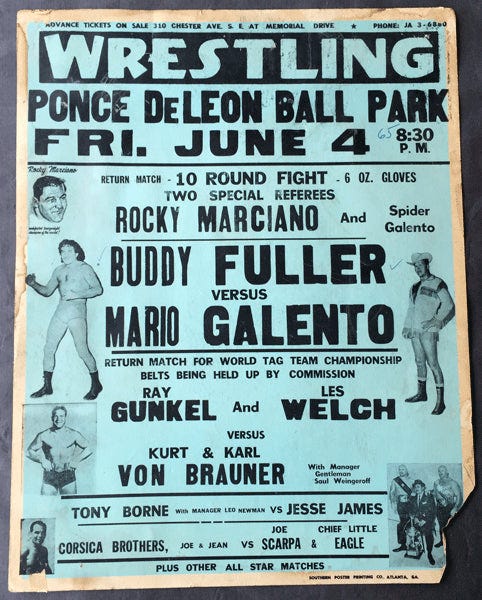
Galento’s career was punctuated by violent, headline-grabbing incidents that blurred the lines between kayfabe and reality. In 1965, he was nearly arrested after striking Billy Hines with a roll of coins during a match. Also in 1965, Galento and Buddy Fuller re-created in Atlanta, Georgia some of the incredible box office magic they had wielded in Mobile, Alabama and the Gulf Coast Territory. The feud between Fuller and Galento ignited in early 1965, building on earlier encounters dating back to 1958 in Mobile, Alabama, where they drew massive crowds. In April 1965, they clashed in a title match at Ponce de Leon Park that ended in a no-contest. The rivalry culminated in Fuller defeating Galento for the Georgia Heavyweight Title on May 28, 1965, in Atlanta. However, the June 4 event was positioned as a heated rematch, stipulated as a boxing match to differentiate it from standard wrestling bouts and capitalize on the involvement of boxing legend Rocky Marciano as a special referee.

Pictured: Buddy Fuller jabs at Mario Galento in their boxing match, June 4, 1965, Atlanta, Georgia
The atmosphere at Ponce de Leon Park was electric, with the outdoor venue amplifying crowd noise and the summer evening adding to the spectacle. Wrestling in the 1960s was a family affair in the South, where promotions like Georgia Championship Wrestling thrived on local heroes versus outsiders. The boxing stipulation involved gloves and rounds, though it retained wrestling’s dramatic flair, including potential interference and crowd-pleasing spots. Buddy Fuller emerged victorious in the main event, defeating Mario Galento in what was described as a hard-fought boxing match. This win solidified Fuller’s status as a top babyface and extended the feud’s momentum, leading to further encounters. The involvement of Marciano added legitimacy, as his refereeing ensured “fair play” in the scripted narrative. For Galento, the loss reinforced his heel persona, setting up potential revenge angles. Contemporary newspaper reports, such as from the Atlanta-Constitution, pegged the crowd at 11,428.
One of the most infamous events involving Galento occurred in 1973 when, after a match, Galento attacked Jerry Jarrett with a nightstick, sparking a brutal brawl involving Jerry Lawler. Galento, a tough brawler with a reputation as a “shooter” (a legitimate fighter), had been a main eventer but saw his role diminish as younger talents rose. Accounts suggest that Roy Welch, feeling threatened by Jarrett’s growing influence and fearing he might “steal” the business, and suffering from early stages of Alzheimer’s disease manipulated Galento into action.
Welch allegedly convinced Galento that attacking Jarrett would expose Lawler’s supposed lack of toughness and restore Galento’s prominence. Galento, known for his mean streak—including a past incident where he blinded an opponent—and his personal struggles, including alcoholism, was primed for confrontation. The feud erupted dramatically on March 31, 1973, during a live television taping at WHBQ-TV Channel 13 in Memphis. Jarrett was in the midst of a hard-fought 15-minute match against Lawler, which ended in a draw. As the bell rang, Galento suddenly jumped into the ring and struck Jarrett from behind with what Jarrett initially thought was a foreign object from Lawler’s manager, Sam Bass. Realizing it was Galento, Jarrett—a shooter trained by Sailor Moran—fought back fiercely. In a shocking move, Jarrett grabbed Galento by the hair and attempted to gouge out his left eye, causing it to protrude from the socket (though Galento did not permanently lose the eye, which already had partial vision loss from a prior injury).
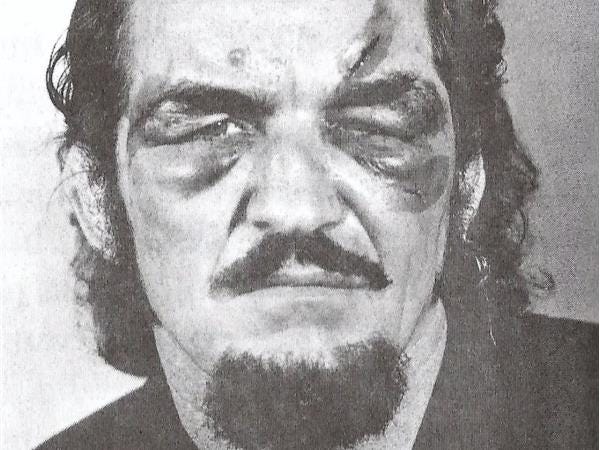
Lawler, despite being Jarrett’s on-screen rival, joined the fray to defend his partner, maintaining kayfabe (the illusion of reality) by grabbing a microphone and declaring that only he had the right to beat Jarrett. Galento retrieved a nightstick (or billy club, possibly from Lawler’s bag) and advanced again, but Jarrett disarmed him and, with Lawler’s help, beat Galento mercilessly. Other wrestlers, including Tojo Yamamoto and Jackie Fargo, piled on, turning the ring into chaos. Galento’s face was left a bloody mess, with deep gashes on his forehead requiring between 130 and 200 stitches, a closed left eye, and a swollen right eye. He was hospitalized and nearly died from a heart attack days later but recovered. The attack was intended to humiliate Jarrett and diminish his drawing power, but it backfired spectacularly.
Months passed with simmering tension, during which Galento contacted Lawler, threatening revenge and inquiring about upcoming shows. The second major confrontation occurred months later in Batesville, Mississippi, at a house show. Lawler was wrestling a squash match against a young opponent when Galento, accompanied by his wife Smokey, entered the ring wielding an open straight razor. Striking Lawler from behind, Galento aimed to exact vengeance for the TV beating. Lawler, spotting the razor, rolled out of the ring, hurled a chair at Galento to create distance, and fled to the locker room. There, he alerted fellow wrestlers, including Jim White, who pulled a .38 revolver from his bag and pressed it against Galento’s nose as he pursued. Galento dropped the razor, halting the assault. The local sheriff of Panola County, who was in the audience, intervened amid the chaos, arresting Galento, Lawler, and White. While in jail, stories were exchanged, with Galento claiming retribution for the Memphis incident. Jerry Jarrett later contacted the FBI, noting Galento’s suspicious possession of $1,000 in cash, suggesting external funding—possibly from Welch. Jackie Fargo warned Galento against further actions, threatening lethal consequences.
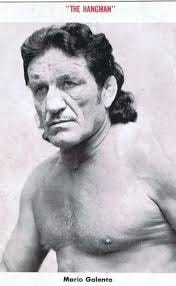
Galento retired from active wrestling in 1974 but remained involved in the industry, training wrestlers like Ken Wayne. He owned Mario’s Pizza and Italian Restaurant in Marietta, Georgia, providing a stable post-ring income. Galento also dabbled in acting, appearing as Blackjack in Frontier Woman (1956) and Turner in Natchez Trace (1960). Personally, he practiced self-hypnosis, underwent rehab for his alcohol issues, and aspired to produce inspirational films for churches. Despite heart ailments in later years, he stayed connected to his roots, enjoying music like Johnny Cash and reflecting on his family’s history, including his mother’s survival of the 1918 Influenza Epidemic.
Mario Galento passed away on February 6, 1989, at the age of 73, from complications related to liver disease and cancer and tragically, daughter Barbara succumbed to pancreatic cancer in 1994.
One Thing I Learned About Reginald Love
During an audition for the 1978 film Blood & Guts, he accidentally set his co-actor’s tie on fire with a cigar he was smoking—but still landed the role and was even hired as a choreographer for the movie.

Thank You for Reading
I’m Tony Richards, Pro Wrestling Historian, Author and Storyteller. I share pro wrestling historical items in each issue of the Time Tunnel Pro Wrestling History Newsletter. Thanks for reading! If you enjoy my information on select events, matches and insights, please share it with folks you think might like to be a subscriber!
Remember, premium investors get access to exclusive and special content such as some special issues including a multi-part deep dives on wrestling territories, wrestler bios and championship title histories, special audio and video interviews on territory pro wrestling and more available in the Pro Wrestling Time Tunnel for Premium Investors.