


Happy Birthday to those who have passed on and to those great wrestlers still with us:
In Memoriam:
Sam Avey 1895
Crazy Luke Graham 1940
Tetsuo Sekiguchi\Mr. Pogo 1951
Happy Birthday:
Doug Gilbert (57)
Madison Rayne (40)
RIP Memorial: We stop & remember those who have passed on this day and gave themselves to the business for us, the fans. We salute you and thank you.
El Santo 2-5-1984 at the age of 66

Bulldog Bob Brown 2-5-1997 at the age of 58
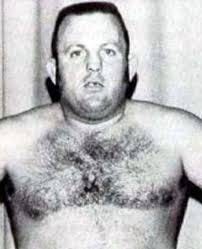
Butch Reed 2-5-2021 at the age of 66

50 Year Flashback
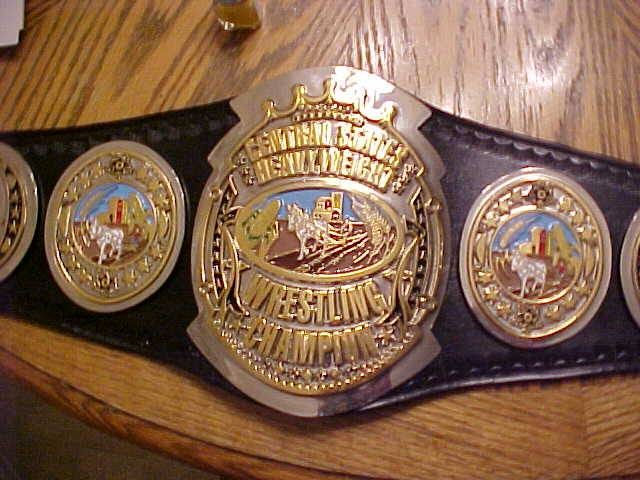
2-5-1975: Mike George defeated Ed Wiskowski (ch) by 2 falls to 1 fall for the NWA Central States Heavyweight Championship at Memorial Hall in Kansas City, Kansas
The NWA Central States territory, centered in Kansas and Missouri but extending into neighboring states like Iowa and Nebraska, was a cornerstone of Midwestern wrestling during the 1970s. Promoted by Bob Geigel, a former wrestler and NWA president, the promotion ran weekly shows at Memorial Hall, a venerable venue that hosted everything from boxing to concerts but became synonymous with Thursday night grappling extravaganzas. The office in Kansas City was owned by three partners, Geigel, Harley Race and Pat O’Connor (who was also the booker for St. Louis at the time). The weekly wrestling show was broadcast on local television as “All-Star Wrestling.” Contrary to modern narrative, these events drew passionate crowds eager for hard-hitting action featuring a mix of homegrown talent and traveling stars. The Central States Heavyweight Championship, established in 1950, was the crown jewel—a belt that symbolized dominance in a region known for its tough, no-nonsense style influenced by legends like Harley Race and Pat O’Connor. By 1976, the title had seen over 100 reigns, reflecting the volatile nature of territorial booking where championships changed hands to keep storylines fresh and attendance high.

Pictured; Mike George
Mike George, born Michael George on November 30, 1949, in St. Joseph, Missouri, was a hometown favorite with a rugged, powerhouse build at 6’1” and 265 pounds. Trained by icons like Harley Race and Hiro Matsuda, George debuted in the early 1970s and quickly became a staple in Central States, known for his brawling style, technical acumen, and ability to connect with blue-collar fans. Mike is aa regular guest on the Pro Wrestling Time Tunnel History Show and will be on with me in March to discuss this title change match in the Winter of 1976. By 1976, he had already held the Central States title once (in 1974) and was a multi-time tag team champion, often partnering with the likes of Rufus R. Jones. His persona as a straightforward, hard-working grappler resonated in the Midwest, where audiences valued authenticity over flash. George’s career would span decades, including stints in Florida, Mid-South, and even a brief run in Japan, but his roots in Central States defined him as a reliable main-eventer who could draw heat or cheers as needed.

Pictured: Ed Wiskowski
Ed Wiskowski, a big-man wrestler could could really work, born on January 10, 1945, in St. Joseph, Missouri—the same hometown as George, adding a layer of local intrigue. Standing at 6’5” and weighing around 280 pounds, Wiskowski debuted in 1972 after training under Harley Race and Lord Littlebrook. He initially wrestled as “The Polish Prince,” leveraging his heritage for a regal, heelish gimmick, before evolving into more villainous roles like Colonel DeBeers in the AWA during the 1980s. In Central States, Wiskowski was a dominant force, capturing the Heavyweight title on May 31, 1975, from Jerry Oates in Kansas City. We covered this feud in depth on a few episodes on Central States with Jerry ;last year. Wiscowski’s 257-day reign was marked by brutal defenses against challengers like Danny Little Bear and Omar Atlas, establishing him as a formidable champion who used size, power, and underhanded tactics to retain the gold. Wiskowski’s career highlights included tag team success in the Pacific Northwest and later notoriety as one of wrestling’s most controversial heels, but in 1976, he was the perfect antagonist for George’s heroic ascent.
Wiskowski, as the arrogant champion, had been dominating the region, often interfering in matches and drawing ire from fans. George, positioned as the resilient underdog, earned his shot through a series of victories, including tag team wins that showcased his grit. The card that night at Memorial Hall was stacked to draw a fervent crowd: Akio Sato and Ronnie Etchison opened with a tag victory over Tank Patton and Charlie Pullins, followed by Bob Geigel defeating Ripper Collins via disqualification. Other bouts included Ted Oates besting Percy Pringle (the future Paul Bearer) and a tag team clash where Pat O’Connor and Omar Atlas triumphed over Bob Orton Sr. and Lord Alfred Hayes. This undercard built tension, priming the audience for the main event title bout.
The match was emblematic of 1970s NWA style: a grueling, physical affair emphasizing chain wrestling, power moves, and crowd interaction. George, the smaller but more agile competitor, likely relied on suplexes, dropkicks, and submissions to counter Wiskowski’s overwhelming size advantage. The champion would have dominated early with clubbing blows, body slams, and perhaps illegal use of the ropes or foreign objects, drawing boos from the Kansas City faithful. As the match wore on, George’s comeback—fueled by fan support—culminated in a decisive pinfall or submission, securing the title change. The victory was clean, per reports, emphasizing George’s legitimacy as a champion and setting up future rematches. George’s reign lasted just 29 days before he lost the belt to “Bulldog” Bob Brown on March 12, 1976, only to regain it briefly multiple times that year, solidifying his status as a perennial contender. Wiskowski, undeterred, continued his heel run, eventually finding greater fame elsewhere.
2-5-1975: Strong Kobayashi & Seiji Sakaguchi defeated Brutus Malumba & Tiger Jeet Singh by CO to win the NWA North American Tag Team Titles (LA-version\Japan version) in Sapporo, Japan
This match not only marked a title change but also symbolized the growing global influence of Japanese wrestling, pitting local heroes against formidable foreign heels in a high-stakes encounter. Seiji Sakaguchi, a former judo champion who transitioned to professional wrestling in 1971, was already a cornerstone of NJPW. Known for his technical prowess and submission expertise, Sakaguchi had previously held the NWA North American Tag Team Titles multiple times, including stints with Antonio Inoki. His partner, Strong Kobayashi (real name Shozo Kobayashi), was another homegrown talent with an amateur wrestling background, debuting in 1972 and quickly rising through the ranks with his powerful strikes and suplexes. Together, they represented the disciplined, heroic style of Japanese puroresu, appealing to fans who valued athleticism and resilience.
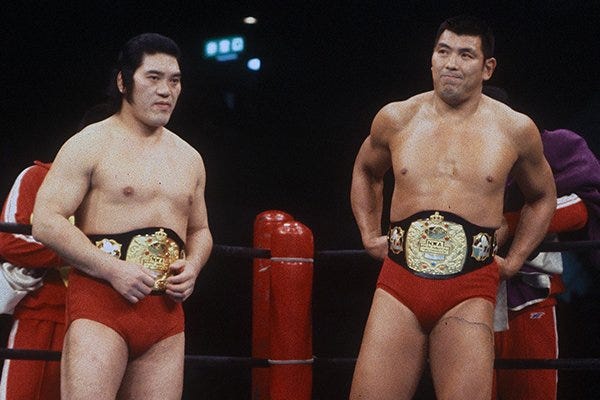
Pictured: Strong Kobayashi & Seiji Sakaguchi, NWA North American Tag Team Champions
Opposing them were the villainous duo of Tiger Jeet Singh (at the time, Inoki’s biggest rival) and Brutus Malumba. Tiger Jeet Singh, a Canadian wrestler of Indian descent, was infamous for his wild, hardcore antics, often using weapons like his signature saber to incite crowds. He had been a dominant force in Japan since the early 1970s, embodying the “foreign monster” archetype that drew massive heat from audiences. His partner, Brutus Malumba (frequently billed as Voodoo Mulumba), was a Congolese grappler known for his imposing physique and aggressive tactics. Malumba’s career included stints in various promotions, where he often played the role of a savage enforcer, complementing Singh’s chaotic energy. This pairing was designed to create contrast—brutal, rule-breaking outsiders versus honorable Japanese defenders—heightening the drama for the Sapporo crowd.

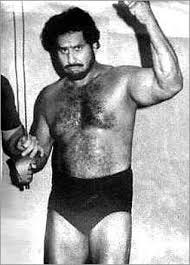
Pictured: Brustus Malumba
Pictured: Tiger Jeet Singh
The NWA North American Tag Team Titles themselves had a unique history, serving as a bridge between the National Wrestling Alliance’s Los Angeles territory and NJPW. Introduced in 1967, the belts were defended in both the U.S. and Japan, adding prestige to cross-promotional events. By early 1976, the titles were vacant after Antonio Inoki relinquished them to focus on a high-profile mixed martial arts-style match against judoka Willem Ruska. This vacancy led to a tournament or direct challenge match in Sapporo, part of NJPW’s Big Fight Series tour, where Kobayashi and Sakaguchi faced Singh and Malumba for the championships. The event drew significant attention, as NJPW was in its formative years under founder Antonio Inoki, and capturing these titles helped legitimize the promotion on an international stage.
The Nakajima Sports Center in Sapporo, a venue known for hosting intense wrestling cards amid Japan’s harsh winter. While full play-by-play accounts are scarce in surviving records, the contest was reportedly a hard-hitting affair typical of the era’s tag team battles. Kobayashi and Sakaguchi’s synergy—combining Sakaguchi’s grappling with Kobayashi’s power moves—clashed against Singh and Malumba’s brawling style, which often bordered on disqualification. Historical sources indicate that Kobayashi and Sakaguchi emerged victorious, though some fan recollections and user queries suggest a count-out finish, where the heels may have been counted out after brawling outside the ring. Regardless of the exact method, the win initiated a 363-day reign for the duo, during which they defended the belts against teams like Umanosuke Ueda and Tiger Jeet Singh in rematches, further cementing their legacy.
For Kobayashi and Sakaguchi, it was a career highlight; they would go on to hold the titles multiple times, with Sakaguchi eventually transitioning to a backstage role in NJPW. Tiger Jeet Singh continued his reign of terror in Japan, later winning various championships, including the NWF North American Heavyweight Title from Sakaguchi in 1979. Malumba’s career, after being pushed solidly in the Vancouver Territory by Gene Kiniski in 1975, faded somewhat after the 1970s, but his role in such matches contributed to the exotic villain trope in puroresu. The bout also exemplified the NWA’s global reach, as the titles were later unified or retired in 1981 after a final reign by Riki Choshu and Seiji Sakaguchi.
40 Year Flashback
2-5-1986: Ishin Gundan (Choshu\Yatsu) defeated Jumbo Tsuruta & Genichiro Tenryu (ch) for the NWA International Tag Team Titles at the Nakajima Sports Center in Sapporo, Japan
The NWA International Tag Team Championship itself carried immense prestige. Established in 1957 and primarily defended in Japan, it was one of AJPW’s cornerstone titles, often contested in high-stakes bouts. By 1986, it had seen legendary holders like Giant Baba and Antonio Inoki. Tsuruta and Tenryu were in their second reign as a team, having won the titles earlier, and their defense against Choshu and Yatsu was the culmination of AJPW’s ‘86 New Year Wars tour—a 30-card series running from January 1 to February 5, featuring international stars like Mil Mascaras and Barry Windham. The Sapporo event drew 6,400 fans to the Nakajima Sports Center, a venue synonymous with major AJPW shows in Hokkaido.
Video: Ishin Gundan (Choshu\Yatsu_ defeated Jumbo Tsuruta & Genichiro Tenryu (ch) for the NWA International Tag Team Titles at the Nakajima Sports Center in Sapporo, Japan
The main event was a brutal, 24:01 clash that embodied puroresu’s intensity. Choshu and Yatsu, representing Ishin Gundan’s revolutionary spirit, traded stiff strikes and grapples with the champions. The match highlighted the contrasting styles: Ishin Gundan’s aggressive, NJPW-influenced offense against AJPW’s methodical pacing. In the end, Yatsu secured the victory with a German suplex hold on Tenryu, dethroning the champions and igniting the crowd. This win was Choshu and Yatsu’s first and only reign with the titles, lasting an impressive 365 days—the longest in the belt’s history at that point—before they lost them back to Tsuruta and Tenryu on February 5, 1987, in the same city, creating a poetic symmetry.
The significance of this victory extended beyond the ring. It solidified Ishin Gundan’s impact on AJPW, boosting attendance and storylines during a golden age for Japanese wrestling. The feud between Choshu/Tenryu in particular became legendary, with their brutal exchanges influencing future generations. Choshu would go on to greater fame, including multiple IWGP Heavyweight Championship reigns, while Yatsu transitioned to other promotions. Tsuruta and Tenryu continued as AJPW mainstays, with Tenryu later founding his own promotion, WAR. The titles were eventually unified in 1988 into the AJPW World Tag Team Championship.
Thank You for Reading
I’m Tony Richards, Pro Wrestling Historian, Author and Storyteller. I share pro wrestling historical items in each issue of the Time Tunnel Pro Wrestling History Newsletter. Thanks for reading! If you enjoy my information on select events, matches and insights, please share it with folks you think might like to be a subscriber!
Remember, premium investors get access to exclusive and special content such as some special issues including a multi-part deep dives on wrestling territories, wrestler bios and championship title histories, special audio and video interviews on territory pro wrestling and more available in the Pro Wrestling Time Tunnel for Premium Investors.