


Happy Birthday to those who have passed on and to those great wrestlers still with us:
In Memoriam:
Mae Weston 1923
Sailor Art Thomas 1924
Rick Harris\Black Bart 1948
Happy Birthday:
James Curran\Drake Maverick (43)
Becky Lynch (39)
RIP Memorial: We stop & remember those who have passed on this day and gave themselves to the business for us, the fans. We salute you and thank you.
(none)
50 Year Flashback
1-29-1976: The Outlaws (Dutch Mantell\Ron Bass) defeated Jerry & Ted Oates (ch) to win the NWA World Tag Team Titles in a Loser Leaves Town Match at Memorial Hall in Kansas City, Kansas
Dutch Mantel, born Wayne Maurice Keown in 1949, was a rugged grappler who cut his teeth in the Southern territories. Known for his brawling style, sharp promos, and cowboy persona, Mantel (often billed as “Dirty Dutch”) had already made waves in promotions like Southeastern Championship Wrestling and Gulf Coast before teaming with Ron Bass. Ronald Heard, better known as Ron Bass, was a towering Texan with a mean streak, frequently portraying an outlaw or rancher gimmick complete with a bullwhip. Together as The Outlaws, they embodied the heel archetype: cheating, ambushing opponents, and drawing heat from fans with their roughhouse tactics. By 1975, they had already captured the Central States version of the NWA World Tag Team Titles once, showcasing their synergy in hard-hitting, no-nonsense matches.
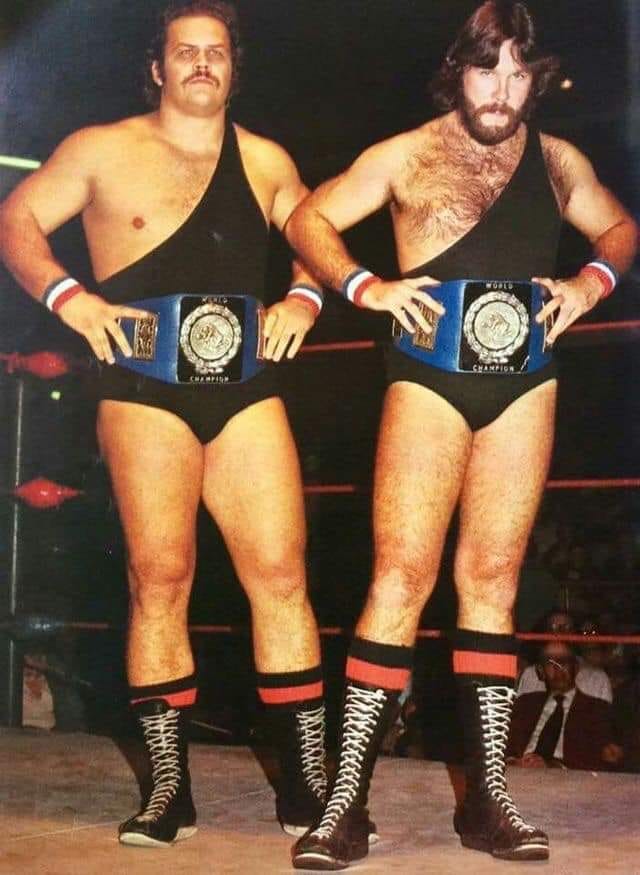
Pictured: The Outlaws (Bass\Mantell), NWA world Tag Team Champions
On the other side stood the Oates Brothers, Jerry and Ted Oates, real-life siblings from Georgia who epitomized the babyface tag team ideal. Jerry, the elder, was a technical wizard with a reputation for chain wrestling and resilience, while Ted complemented him with agility and high-flying maneuvers uncommon for the time. The Oates had been a fixture in the NWA circuits, holding various regional tag titles, including multiple reigns with the Central States belts. In fact, by early 1976, they were on their third stint as champions, having reclaimed the straps sometime in late 1975 after a series of grueling defenses. Their wholesome, brotherly bond resonated with audiences, making them fan favorites in the heartland territories. However, their reign was under constant threat from heels like The Outlaws, who saw the titles as a gateway to bigger opportunities in the NWA’s vast network.
Pictured: Ted and Jerry Oates, All Asian Tag Team Champions
The build-up to the January 29 showdown was classic territorial booking, rife with personal animosity and escalating violence. Central States Wrestling, promoted by Bob Geigel and Pat O’Connor, thrived on storylines that pitted honorable teams against dastardly villains. The Outlaws had been feuding with the Oates for months, ambushing them in non-title bouts and using underhanded tactics like Bass’s bullwhip to gain advantages. The rivalry culminated in a challenge for a Loser Leaves Town Match—a stipulation where the defeated team would be forced to vacate the territory, adding an layer of exile to the already prestigious title bout. Although the Loser Leaves Town Matches took place in various towns acrocc the territory loop, Memorial Hall, a storied venue in Kansas City known for hosting raucous crowds, was the perfect backdrop. With its intimate seating and echoing acoustics, the arena amplified the drama, drawing fans eager to see if the Oates could fend off the marauding Outlaws or if the heels would ride off with the gold. The card drew 2,500 fans on this memorable Thursday night in Kansas City.
The match itself was reportedly a brutal affair lasting over 20 minutes. It began with technical exchanges, as the Oates used their familial chemistry to outmaneuver the larger Outlaws with dropkicks, arm drags, and double-team maneuvers. Jerry Oates, the strategist, targeted Bass’s legs to neutralize his power, while Ted’s speed kept Mantel on the defensive. However, The Outlaws’ heel playbook soon emerged: illegal double-teams behind the referee’s back, eye rakes, and chokes that drew boos from the packed house. A turning point came when Bass distracted the official, allowing Mantel to introduce a foreign object—possibly a chain or boot spur— to bloody one of the Oates. In the chaotic climax, Mantel and Bass isolated Ted Oates, finishing him with a devastating double clothesline followed by Bass’s signature bulldog slam for the pinfall. The Outlaws emerged victorious, claiming the NWA World Tag Team Titles for the second time and forcing the Oates Brothers to “leave town.” or effectively leave the territory for work in another region, in this case being their home territory of Georgia. Dutch Mantell has been critical of this booking, saying it made no sense to book a Loser Leaves Town Match between the teams, when the program was the best drawing program they had at the time and it was no where near being finished. Mantell and Ted Oates had particularly good chemistry together since they had broken in together in Georgia with the Gunkel All-Star Wrestling group in 1972, being put together by then-booker, Tom Renesto. But even though the matches were working in Central States and drawing decent money, the decision was made to end the program.
For Mantel and Bass, it solidified their status as top heels, leading to defenses against teams like Bob Geigel and Akio Sato before they dropped the belts on February 19, 1976, in another Kansas City clash. This reign, though brief, propelled both men forward: Mantel would later achieve fame in Memphis and WWF as Zeb Colter, while Bass became a memorable mid-carder in WWF during the 1980s. The Oates Brothers, adhering to the stipulation, shifted to other territories like Georgia and Mid-South, where they continued their successful run, including Georgia Tag Team Title wins. The Loser Leaves Town gimmick added emotional weight, allowing fresh talent to cycle in and keeping storylines dynamic—a hallmark of NWA booking that kept fans invested.
1-30-1976: Dusty Rhodes defeated The Spoiler (ch) in a Cage Match to win the NWA Georgia Heavyweight Championship at the City Auditorium in Atlanta, Georgia
On January 30, 1976, at the Atlanta City Auditorium in Atlanta, Georgia, the wrestling world witnessed a pivotal showdown that would etch itself into the annals of history. “The American Dream” Dusty Rhodes, the everyman champion with his larger-than-life charisma and working-class appeal, faced off against the enigmatic and ruthless masked heel known as The Spoiler (Don Jardine) in a brutal cage match for the NWA Georgia Heavyweight Championship.
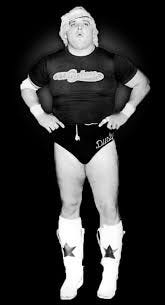
Nicknamed “The American Dream,” Rhodes embodied the blue-collar ethos, often referring to himself as the “son of a plumber” in promos that resonated with fans across the South. By 1976, Rhodes had already made waves in promotions like Championship Wrestling from Florida and Georgia Championship Wrestling (GCW), where his brawling style, signature elbow drops, and fiery interviews drew massive crowds. He was not just a wrestler; he was a storyteller, captivating audiences with his blend of athletic prowess and relatable persona. Rhodes’ path to this title shot was paved with hard-fought victories, including tag team successes and feuds that showcased his resilience.
The Spoiler, whose real name was Don Jardine, a towering Canadian wrestler born in 1940. Jardine adopted the masked persona in the late 1960s, becoming one of wrestling’s most feared heels with his signature “Iron Claw” hold—a vise-like grip that could render opponents unconscious. The Spoiler’s gimmick was shrouded in mystery; the mask concealed his identity, adding an aura of intimidation. By early 1976, he held the NWA Georgia Heavyweight Title, having defended it against top challengers in GCW, a promotion known for its intense, storyline-driven cards broadcast on Atlanta’s WTCG (later TBS). The Spoiler’s reign was marked by underhanded tactics, interference from allies, and a reputation for choking out foes, making him the perfect antagonist for a hero like Rhodes.
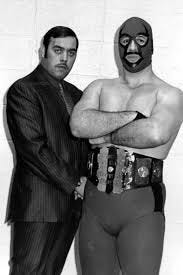
Pictured: Manager Gary Hart and The Masked Spoiler (Jardine)
In the 1970s, cage matches were reserved for the most heated feuds, designed to prevent outside interference and force a decisive conclusion through pinfall, submission, or escape (though rules varied by promotion). GCW, under promoter Jim Barnett, often used such gimmicks to heighten drama at the Atlanta City Auditorium—a historic venue that had hosted wrestling events since the 1950s and could seat thousands of fervent fans. On this winter Friday night, the cage enclosed the ring, its chain-link walls symbolizing the inescapable confrontation. The build-up on GCW’s television program hyped the match as a battle for supremacy in Georgia wrestling, with Rhodes vowing to “pay the price” and unmask The Spoiler’s dominance.
As the bell rang, the Atlanta crowd erupted, chanting for Dusty as the two behemoths collided.
Rhodes, weighing in at around 300 pounds, used his size and street-fighting savvy to counter The Spoiler’s technical prowess and claw attempts. The match was a war of attrition, with both men slamming each other into the cage walls, drawing blood in true old-school fashion. Eyewitness accounts and historical recaps describe Rhodes absorbing punishment early on, as The Spoiler locked in his Iron Claw, but the Dream’s tenacity shone through. Rallying with his famous Bionic Elbow—a series of rapid strikes that became his trademark—Rhodes turned the tide. In a climactic finish, after a grueling exchange that left both competitors battered, Rhodes pinned The Spoiler to capture the NWA Georgia Heavyweight Title. The victory was short-lived in terms of reign— The Spoiler would regain the belt just a week later on February 6—but the January 30 win electrified the audience and boosted Rhodes’ momentum.
One Thing I Learned About Mae Weston

Known for her toughness; in 1945, after a male fan kicked her in the face during a match in Little Rock, Arkansas, she retaliated by beating up both him and his wife who intervened, sending them to the hospital and earning herself a night in jail plus a fine.
Thank You for Reading
I’m Tony Richards, Pro Wrestling Historian, Author and Storyteller. I share pro wrestling historical items in each issue of the Time Tunnel Pro Wrestling History Newsletter. Thanks for reading! If you enjoy my information on select events, matches and insights, please share it with folks you think might like to be a subscriber!
Remember, premium investors get access to exclusive and special content such as some special issues including a multi-part deep dives on wrestling territories, wrestler bios and championship title histories, special audio and video interviews on territory pro wrestling and more available in the Pro Wrestling Time Tunnel for Premium Investors.
Fascinating detail on Mantell's critique of the Loser Leaves Town booking. That insight about ending the best drawing program prematurely shows how even successful territories could sabotage their own momentum with shortsighted decisions. The Oates-Outlaws chemistry sounds like it had serious legs left, especially given their Georgia training connection. I've noticed similiar patterns in Mid-South where hot angles got cut off way too early.