


Written and Produced by Tony Richards
January 15th in the Time Tunnel:
Happy Birthday to those who have passed on and to those great wrestlers still with us:
In Memoriam:
Eddie Graham 1930
Tommy Gilbert 1940
Happy Birthday:
Ken Wayne (66)
Bull Buchanan (58)
Shane McMahon (56)
Barbara Coba\Kelly Kelly (39)
Nicole Matthews (39)
Preston Vance (34)
RIP Memorial: We stop & remember those who have passed on this day and gave themselves to the business for us, the fans. We salute you and thank you.
Ricky Romero 1-15-2006 at the age of 74

Jimmy Snuka 1-15-2017 at the age of 73
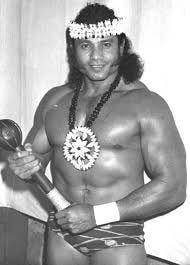
Rocky Johnson 1-15-2020 at the age of 75

The Life and Career of Ricky Romero
Spanning from the mid-1950s to the early 1980s, Ricky Romerp’s career took him across major U.S. territories and even internationally, where he became a beloved babyface hero, particularly in West Texas. As the patriarch of the Youngblood wrestling family, Romero’s legacy extended beyond his own accomplishments, influencing his sons and the broader wrestling landscape.
Born on May 24, 1931, in San Bernardino, California, Enrique Gregory Romero grew up in a Mexican-American family during an era marked by cultural and racial challenges. As a youth, he excelled in baseball, catching the eye of the San Francisco Giants, who offered him a minor league contract. However, standing at 6 feet tall—an uncommon height for someone of Mexican descent at the time—Romero was recruited into professional wrestling instead. He trained under Professor Romero and Diablo Velasco for two years before making his debut in 1955. Within weeks, the young wrestler, adopting the ring name “Rapid” Ricky Romero, was thrust into main event matches, showcasing his speed and technical skills. In the early 1960s, Romero relocated his family to Amarillo, Texas, a move that would define much of his career. This transition not only embedded him in the heart of the National Wrestling Alliance (NWA) territories but also positioned him as a trailblazer for Hispanic wrestlers in a segregated industry.
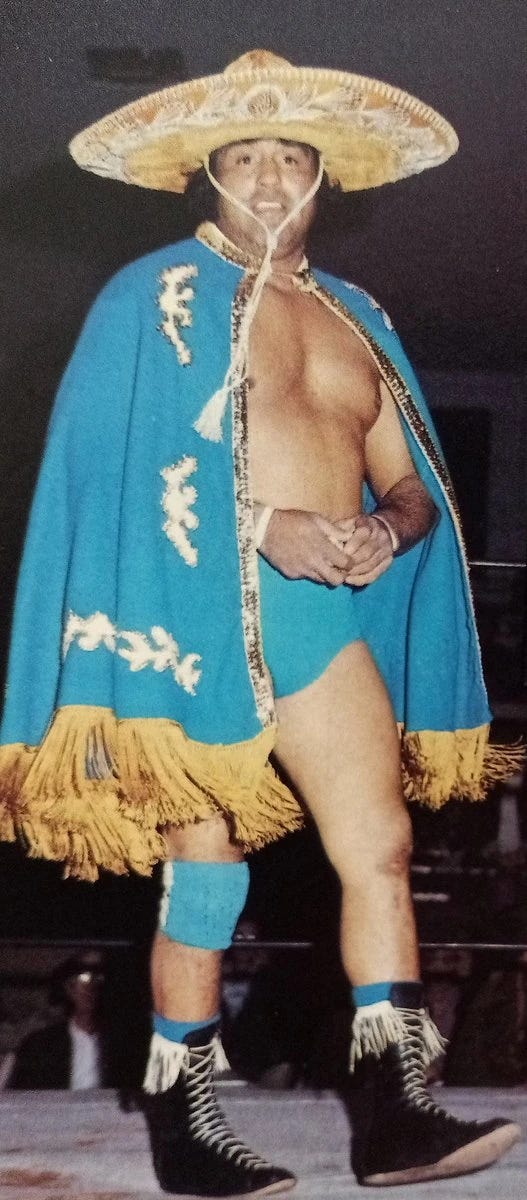
Romero’s career truly flourished in the Texas territories under promoters like Doc Sarpolis, Dory Funk Sr., Fritz Von Erich, and Paul Boesch. Brought to Amarillo by Funk Sr., he shattered attendance records and became the first Hispanic wrestler to secure a top babyface spot in the region. His popularity was immense; in 1972, he even bested Terry Funk in a “most popular wrestler” contest in Amarillo. Romero wrestled in every major market from 1955 to the 1980s, including Los Angeles, the Midwest, and even early tours in Japan under the masked heel persona “Mexico Grand.
Known as a tag team specialist, Romero thrived in partnerships that highlighted his endurance and technical finesse. He competed in high-stakes matches, including Texas Death Matches against legends like Lou Thesz, emphasizing grit over spectacle. His finishing maneuvers, such as the sleeper hold and cannonball, became signatures of his style. Romero’s contributions extended to cross-cultural exchanges, touring Japan and helping bridge wrestling styles between the U.S. and abroad.
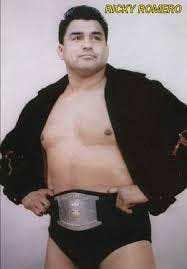
Throughout his career, Romero amassed an impressive array of titles, underscoring his status as a territorial star. He held the NWA Texas Heavyweight Championship multiple times—up to 15 reigns by some accounts—and the NWA Texas Tag Team Championship 10 times with various partners. Notable tag team successes included the Southwestern States Tag Team Titles with Dory Funk Sr. in 1965, the WWA Tag Team Titles with Pedro Morales in 1967, and the NWA World Tag Team Championship shares with Nick Bockwinkel in 1968.
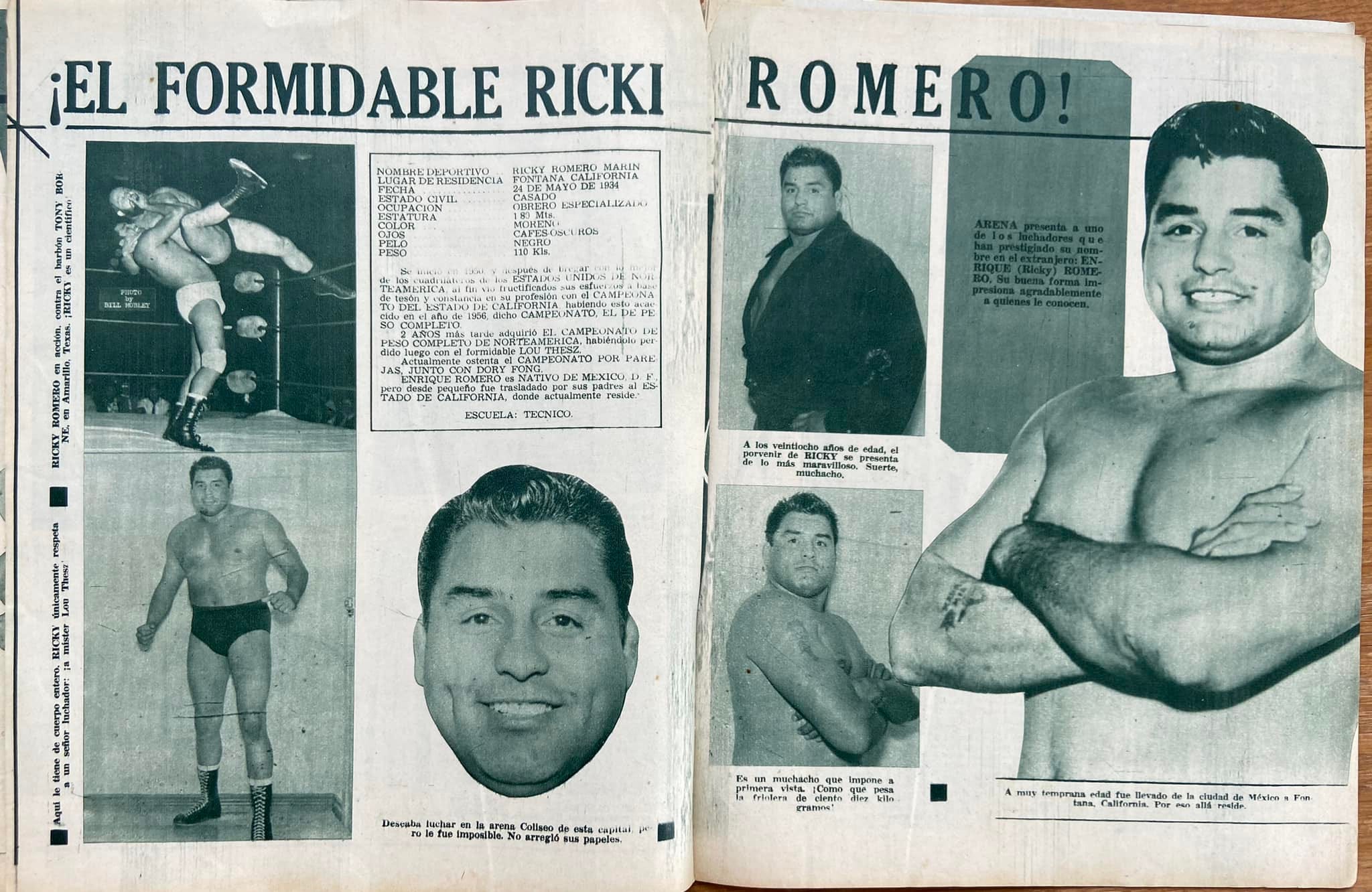
Pictured: 1963 feature on Ricky Romero in Arena de Box Lucha Magazine
In the Rocky Mountain region, Romero was so dominant that the Rocky Mountain Heavyweight Title was created for him; he held it five times from 1968 to 1980 before retiring it. Other accolades included the North American Heavyweight Title in 1968, the Western States Heavyweight Title in 1973, and multiple Western States Tag Team reigns with partners like Terry Funk (1969), Moose Morowski (1973), Dory Funk Jr. (1974), his son Jay Youngblood (as Silver Streak in 1976), Akihisa Takachiho (1979), and Eddie Gilbert for the Central States Tag Titles in 1982. In total, Romero won 17 tag titles with 11 different partners, including three members of the Funk family.
Beyond the ring, Romero was a family man who fathered a wrestling dynasty. He and his wife Stella had six children, including sons Steven (Jay Youngblood), Mark Youngblood, Chris Youngblood, and Ricky Romero Jr., all of whom pursued wrestling careers in promotions like the NWA and WWF. Jay, in particular, teamed with his father in the 1970s, continuing the family tradition. Romero’s close friendship with Dory Funk Sr. further intertwined his personal and professional life, as their families became linked through wrestling.
In his later years, Romero occasionally appeared under different personas, such as “Chief Youngblood” in Portland in 1981, and even refereed matches. Health issues, particularly diabetes, forced his retirement in the late 1980s. He passed away on January 15, 2006, in Amarillo, Texas, at the age of 74, due to complications from the disease.
40 Year Flashback
1-15-1986: Jesse Barr defeated Lex Luger (ch) to win the NWA Southern Heavywight Championship at the Spartan Sports Center in Tampa, Florida
The NWA Southern Heavyweight Title, Florida’s version, was a prestigious belt with roots dating back to 1962, symbolizing dominance in the Sunshine State’s wrestling scene. Under the National Wrestling Alliance umbrella, it was defended in grueling matches that often blended athleticism, storytelling, and crowd-pleasing antics. By 1986, the title had seen legendary holders like Dusty Rhodes and Ric Flair, but it was also a platform for up-and-comers to prove their mettle. Lex Luger, born Lawrence Pfohl, was precisely such a figure. A former college football standout with an imposing physique—standing at 6’4” and weighing over 270 pounds—Luger entered wrestling in 1985 under the tutelage of Hiro Matsuda. His raw power and charisma quickly propelled him to stardom in CWF, where he captured the Southern Heavyweight Title for the first time in late 1985. Luger embodied the “Total Package”: a heel managed by Matsuda, he drew heat from fans with his arrogant demeanor and dominant in-ring style, often relying on clotheslines, powerslams, and his signature Torture Rack submission.
In contrast, Jesse Barr, whose real name was Ferrin Barr Jr., brought a different flavor to the ring. Hailing from Oregon and part of a wrestling family—his brother Art Barr would later gain fame as Beetlejuice in WCW—Jesse had honed his skills across various territories since the late 1970s. By 1986, he was a mid-card staple in Florida, known for his technical prowess, agility, and ability to play both hero and villain. Barr had previously held the Florida Heavyweight Title multiple times and even teamed with Rick Rude to win the NWA United States Tag Team Championships. However, his program with Luger represented a step up, pitting his cunning against Luger’s brute force. Barr had recently turned babyface, endearing himself to the Tampa crowd with underdog antics and flashy maneuvers. Leading into the January 15 bout, the feud was built on classic wrestling tropes: the established powerhouse Luger dismissing Barr as a mere challenger, while Barr vowed to expose the champion’s vulnerabilities.
Video: Lex Luger (ch) vs Jesse Barr at the Spartan Sports Center in Tampa, Florida for the NWA Southern Heavyweight Title
The match, held during a standard CWF television taping, was a showcase of contrasting styles that kept the live audience on the edge of their seats. Luger, as the defending champion, started strong, using his size advantage to control the pace with powerful strikes and suplexes. Barr, ever the resilient performer, absorbed the punishment and countered with dropkicks, arm drags, and quick roll-ups, bumping dramatically to sell Luger’s offense and rally the fans. The crowd’s energy was palpable, cheering for the local favorite Barr against the cocky outsider vibe Luger projected. As the contest wore on, Barr’s experience shone through; he targeted Luger’s legs to neutralize his power base, setting up near-falls that heightened the drama. In a controversial finish that epitomized 1980s wrestling chicanery, Barr secured the victory by grabbing a handful of Luger’s tights during a pinfall, rolling him up for the three-count after a reversal. This upset not only stripped Luger of the belt but also added a layer of intrigue, as Barr’s win was tainted by the illegal leverage, fueling calls for a rematch.
Barr’s reign as Southern Heavyweight Champion was short-lived but memorable. He paraded around with the title, boasting about his clever tactics and even juggling multiple championships in the territory, including stints as co-holder of the US Tag Titles and TV Champion. This period highlighted Barr’s versatility and helped elevate his profile before he transitioned to the WWF later that year as Jimmy Jack Funk, the masked “brother” of Terry and Dory Funk Jr. For Luger, the loss was a temporary setback in an otherwise meteoric rise; he reclaimed the title from Barr just 30 days later on February 14, 1986, at the Battle of the Belts II event in Orlando, defeating him cleanly with a clothesline. This rematch, part of a larger card featuring stars like Bruiser Brody and Wahoo McDaniel, underscored Luger’s resilience and set the stage for his eventual move to Jim Crockett Promotions and national fame.
One Thing I Learned About Ken Wayne
He performed under the “Tiger Mask” persona in Central States Wrestling during late 1983 and 1984, facing opponents like Barry Orton, Roger Kirby, and TG Stone.
Thank You for Reading
I’m Tony Richards, Pro Wrestling Historian, Author and Storyteller. I share pro wrestling historical items in each issue of the Time Tunnel Pro Wrestling History Newsletter. Thanks for reading! If you enjoy my information on select events, matches and insights, please share it with folks you think might like to be a subscriber!
Remember, premium investors get access to exclusive and special content such as some special issues including a multi-part deep dives on wrestling territories, wrestler bios and championship title histories, special audio and video interviews on territory pro wrestling and more available in the Pro Wrestling Time Tunnel for Premium Investors.