



Written and Produced by Tony Richards
January 10th in the Time Tunnel:
Happy Birthday to those who have passed on and to those great wrestlers still with us:
In Memoriam:
Count Billy Varga 1919
Hoot Gibson 1940
Ed Wiskowski 1945
Pistol Pez Whatley 1951
Brian Christopher 1972
Happy Birthday:
Steve Veidor (88)
Negro Casas (66)
Marcus Bagwell (56)
Tamina Snuka (48)
RIP Memorial: We stop & remember those who have passed on this day and gave themselves to the business for us, the fans. We salute you and thank you.
Cal Eaton 1-10-1966 at the age of 57

Steve Casey 1-10-1987 at the age of 78
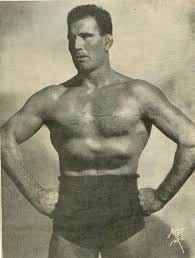
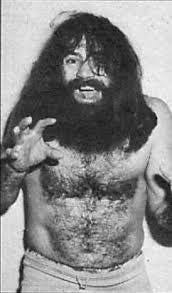
Vilmos Farkas\The Canadian Wolfman 1-10-2016 at the age of 80
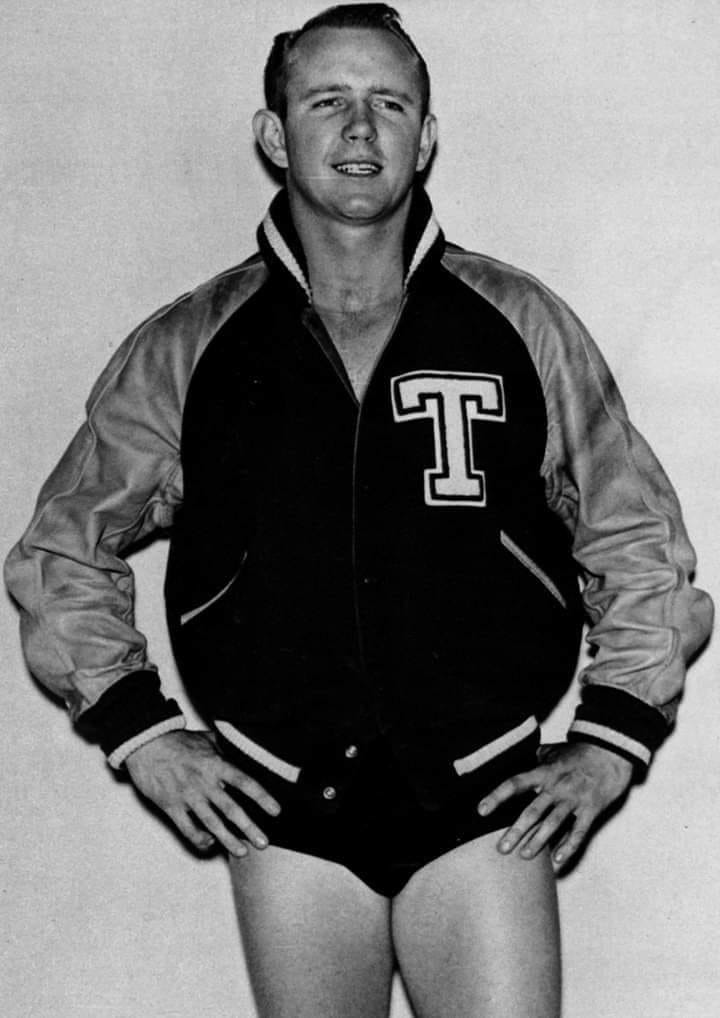
Significant Debut: January 10th, 1963; Dory Funk, Jr (21) defeated Jack Dalton (Don Fargo) in 4:30 at the Sports Arena in Amarillo, Texas
The Life & Career of Cal Eaton
Known for his sharp business acumen and promotional flair, Eaton transformed the Olympic Auditorium in Los Angeles into a premier venue for combat sports, while navigating regulatory scrutiny and industry rivalries. His roles as a promoter, former athletic commission inspector, and manager for the Los Angeles Athletic Club left an indelible mark on Southern California’s sports landscape, blending legal expertise with entrepreneurial grit. Eaton’s educational background laid a strong foundation for his multifaceted career. A graduate of law school, Eaton initially pursued a path in legal and regulatory affairs. This legal training proved invaluable when he transitioned into sports administration. Before entering promotion, he served as an inspector for the California State Athletic Commission, a role that immersed him in the oversight of boxing and wrestling events across the state.His position as a commission inspector honed his understanding of industry regulations, ethics, and the intricate balance between entertainment and governance—skills that would later define his promotional strategies.
Eaton’s entry into sports promotion came in July 1942, when he was hired by Frank Garbutt, vice president of the Los Angeles Athletic Club, to manage the Olympic Auditorium. This opportunity arose partly due to a recommendation from Aileen LeBell, the venue’s bookkeeper and secretary, who would later become his wife and business partner. At the time, the Olympic Auditorium was struggling financially, with boxing events generating modest revenues of around $900 to $1,200 per show. Under Eaton’s leadership, he quickly turned things around, elevating average boxing earnings to $11,000 per event, with standout fights like the Armstrong-Thomas bout drawing an impressive $42,000. His promotional prowess extended to wrestling, where he became a key figure in the National Wrestling Alliance (NWA) ecosystem, particularly through NWA Hollywood Wrestling. As a wrestling promoter, Eaton wielded significant influence but faced substantial challenges. In 1953, after a split with partners Hugh Nichols and Johnny Doyle, Eaton lost access to top NWA-affiliated talent, as wrestlers risked blacklisting by associating with him. He adapted by relying on independent wrestlers and forging alliances, such as with Dr. Karl Sarpolis in Texas.
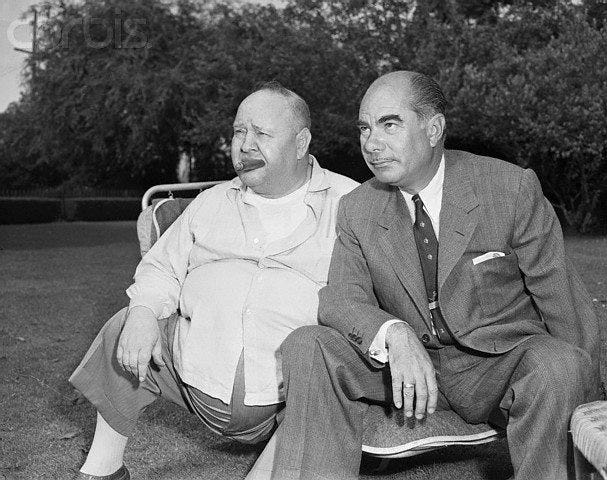
Pictured: Cal Eaton and Babe McCoy in 1955
That same year, Eaton formed a wrestling syndicate with Nichols and Mike Hirsch, which received approval from the California State Athletic Commission. His ventures were not without controversy; by 1954–1955, Eaton was embroiled in accusations of monopolistic practices and ties to organized crime, drawing investigations from the state assembly and governor’s office. Rival promoter Johnny Doyle testified against him in October 1955, alleging violations of regulations by operating both as a promoter and through a booking agency, Ring Talent, Inc. Eaton vehemently denied these claims, labeling them as character assassination. The disputes escalated, leading to a $1.2 million lawsuit filed against Eaton and his associates in November 1955 for alleged monopoly control. Further testimonies in 1957 highlighted Eaton’s influence, including claims of manipulating referees and using his son Robert as a front to circumvent laws. Despite these setbacks, Eaton’s resilience shone through; in May 1957, he was placed on two years’ probation by the commission for boxing regulation violations but continued operations.
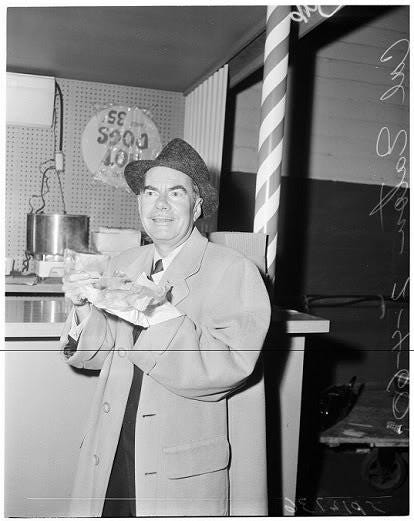
In boxing, Eaton’s achievements were equally notable. He oversaw record-breaking earnings at the Olympic Auditorium, with combined wrestling and boxing revenues reaching $356,929.70 in the 1956–1957 fiscal year. Iconic events under his watch included the May 21, 1952, heavyweight match between Lou Thesz and Baron Michele Leone, which netted $81,517.07 after taxes. Eaton also navigated legal battles in this arena, filing a $300,000 slander suit in August 1956 against a lawyer investigating boxing corruption. His licenses faced renewal threats in late 1956 but were ultimately extended. By September 1959, FBI probes into underworld connections in boxing involved Eaton’s operations, requiring financial records from fights like Don Jordan vs. Virgil Akins. Through it all, Eaton’s ability to blend showmanship with business strategy kept the Olympic Auditorium thriving.
Eaton’s personal life intertwined deeply with his professional world. He married Aileen LeBell (née Goldstein), his business partner, in 1948, following his divorce from his first wife, Katherine Eaton, in December 1947. The divorce settlement included $40,000 in property to Katherine. From his first marriage, Eaton had a son, Robert Alvah Eaton, who became involved in the family business and married Marilyn Knight, daughter of California Lieutenant Governor Goodwin Knight, in December 1948. Aileen, often handling managerial and financial duties, complemented Eaton’s promotional role, and after his death, she continued as a legendary promoter in her own right. Eaton also inherited the bulk of his sister Alzoa E. Garland’s estate upon her death in April 1951. Cal Eaton’s life came to an abrupt end on January 10, 1966, at the age of 58, leaving behind a legacy of innovation in sports entertainment amid an era of regulatory turbulence. Following his death, his wife and business partner, Aileen Eaton, took over the operations at the Olympic Auditorium and continued promoting events successfully for many years. Eaton was cremated, and his ashes were reportedly scattered in the garden of his home in Pacific Palisades, California.
His tenure revitalized the Olympic Auditorium, making it a hub for iconic fights and matches that drew massive crowds and generated substantial revenue. Despite controversies over monopolies and ethics, Eaton’s contributions helped shape the professionalization of boxing and wrestling in California. His partnership with Aileen not only sustained the business but also paved the way for women in sports promotion.
One Thing I Learned About The Wolfman
He once got in trouble at customs while touring Trinidad because officials thought his wolf skin prop might carry diseases, nearly leading to his deportation—he only had a YMCA membership card as ID, but promoter Tiger Jeet Singh pulled strings with local contacts to resolve it.
Thank You for Reading
I’m Tony Richards, Pro Wrestling Historian, Author and Storyteller. I share pro wrestling historical items in each issue of the Time Tunnel Pro Wrestling History Newsletter. Thanks for reading! If you enjoy my information on select events, matches and insights, please share it with folks you think might like to be a subscriber!
Remember, premium investors get access to exclusive and special content such as some special issues including a multi-part deep dives on wrestling territories, wrestler bios and championship title histories, special audio and video interviews on territory pro wrestling and more available in the Pro Wrestling Time Tunnel for Premium Investors.