


Written and Produced by Tony Richards
January 4th in the Time Tunnel:
Happy Birthday to those who have passed on and to those great wrestlers still with us:
In Memoriam:
Sandor Szabo 1906
Robert Pico\Pancho Villa 1914
Ray Eckert 1917
Bobby Managoff 1918
Paula Kaye 1948
Jesus Escoboza\LaParka 1966
Happy Birthday:
Jim powers (68)
J.T. Southern (62)
Derrick Dukes (61)
Chris Kanyon (41)
RIP Memorial: We stop & remember those who have passed on this day and gave themselves to the business for us, the fans. We salute you and thank you.
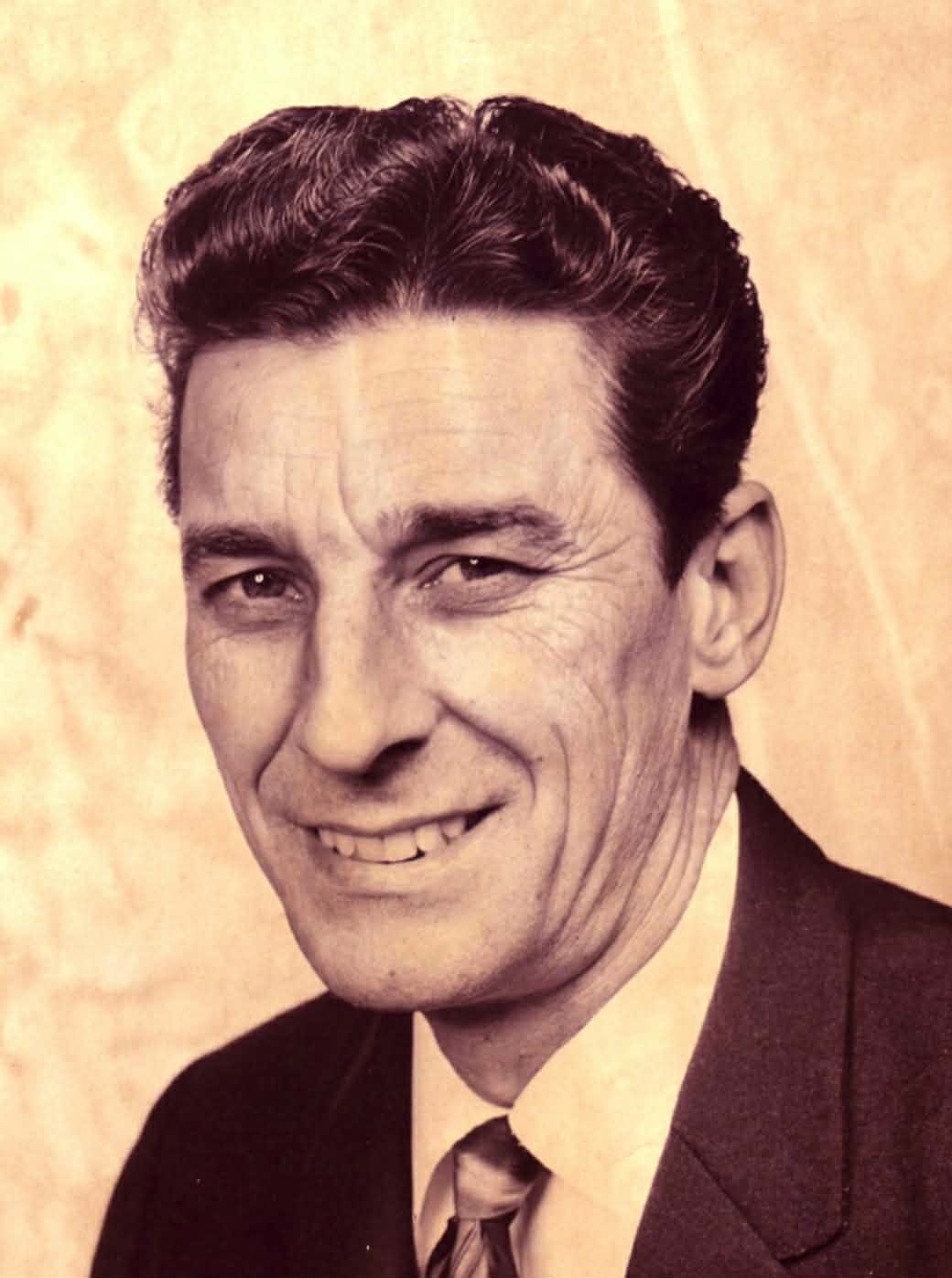
John Regus 1-4-1995 at the age of 78
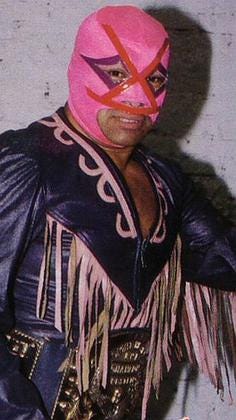
Cyclone Anaya 1-4-1999 at the age of 56

Jose Mendoza\Villano I 1-4-2001 at the age of 50
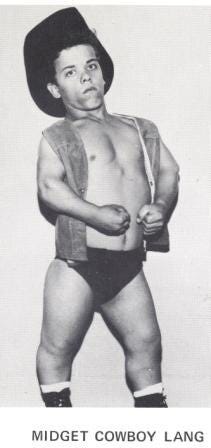
Harold “Cowboy” Lang 1-4-2007 at the age of 56
Significant Debuts:
Ernie Ladd (24) January 4th, 1963, he defeated Leon Kirilenko in 17 seconds at the Coliseum in San Diego, California
Rhonda Singh (17) January 4th, 1979 at Korakuen Hall in Tokyo, Japan
The Life and Career of John Regus
Regus’s early years were rooted in the American South. Born in Louisiana, he grew up during a time of significant social and economic change, including the Great Depression. Little is documented about his childhood, but his path took a defining turn with the outbreak of World War II. Regus served in the United States Coast Guard, contributing to the war effort in a branch known for its maritime defense and rescue operations. This service instilled in him a deep sense of duty and camaraderie, values that would shape his postwar life.
Following the war’s end in 1945, Regus relocated from New Orleans to Memphis, Tennessee, seeking new opportunities in the bustling postwar economy. Memphis, with its vibrant culture and growing entertainment scene, proved to be an ideal setting for his entrepreneurial spirit. He quickly integrated into the community, establishing roots that would last for the remainder of his life.
Regus was an entrepreneur with diverse interests. He owned Tri-State Patrol Inc., a security firm that reflected his practical business acumen. His involvement in local politics further demonstrated his commitment to public service. Regus actively participated in campaigns for figures such as former Shelby County Sheriff Gene Barksdale, Al Rickey, and David Shirley, using his influence to support community leaders.

Regus’s dedication to veterans was perhaps his most enduring legacy outside of entertainment. As a past commander of American Legion Post 1 in Memphis, as well as the 40 & 8 (an honor society within the Legion), he played a leadership role in supporting fellow servicemen. He also served as the past 10th district commander of the American Legion, where he helped establish and direct the Veterans Preference and Civil Service Committees. These initiatives provided pro bono assistance to veterans who could not afford legal representation, ensuring they received the benefits and support they deserved. His wartime service and postwar advocacy underscored a lifelong commitment to honoring those who served.
Regus was a family man, married to Ivo Williams Regus. Together, they had three children: daughter Janet Hadley of Memphis, son Michael Johnson of Collierville, Tennessee, and son John F. Regus Jr. of Houston, Texas. Regus’s most notable professional endeavor was in the world of professional wrestling, where he transitioned from an avid fan to a key promoter. His involvement in the industry began in the early 1960s, aligning with the heyday of territorial wrestling promotions under the National Wrestling Alliance (NWA). He was added to the promotional team after Buddy Fuller’s suspension by the Tennessee Athletic Commission in 1961 when the promotion needed a new face on television as the “authority figure” as Roy Welch was not one who like the television camera or being the “front man” promoter.
So, Regus partnered with established figures, Nick Gulas and Roy Welch to form a promotion team that brought high-energy wrestling events served by the powerful WHBQ-TV, Channel 13 in the Memphis area. Regus’s active role was more concentrated between 1961 and 1968, the group hosted weekly Monday night shows at the Ellis Auditorium in downtown Memphis. Regus promoted matches featuring some of the era’s most colorful and iconic wrestlers, including Tojo Yamamoto, Sputnik Monroe, and Jackie Fargo. These events extended beyond Memphis to venues in Tupelo, Mississippi, and Jonesboro, Arkansas, drawing crowds eager for the dramatic storytelling and athletic spectacle of professional wrestling. He collaborated with media personalities such as announcer Lance Russell, weatherman Dave Brown from Channel 13, and radio/television host George Klein, helping to broadcast and popularize the sport through local television and radio. Regus’s enthusiasm for wrestling was infectious; he was known not just as a promoter but as someone who enjoyed the matches as much as the fans, making him a beloved figure in the regional wrestling community. He resigned his position in Memphis in 1968 to make way for Bert Bates to be the Promoter for Gulas\Welch in Memphis.
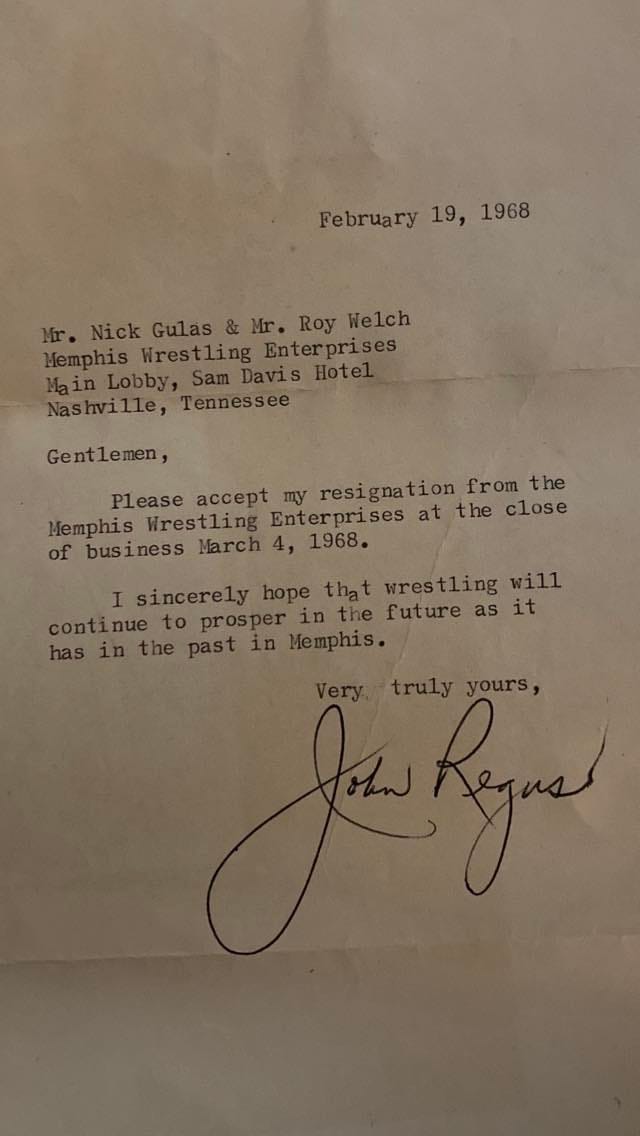
Pictured: John Regus’ resignation letter in February 1968.
By 1972, Regus had retired from active promotion, but his contributions helped lay the groundwork for Memphis wrestling’s golden era. His work with NWA Mid-America is remembered as part of a collaborative effort that sustained professional wrestling in the South during a time when territories dominated the industry. John Frederick Regus Sr. passed away on January 4, 1995, at the age of 78, due to respiratory failure at Methodist Hospital South in Memphis. At the time of his death, he was survived by four grandchildren and three great-grandchildren. A communicant of St. Paul’s Catholic Church in Memphis, Regus’s faith was an integral part of his life, and his family requested memorials be directed to the church following his passing. A mass was held at St. Paul’s Catholic Church, and he was entombed in St. Roch Cemetery in New Orleans, connecting back to his Louisiana roots. His death marked the end of an era for Memphis wrestling and veterans’ advocacy, but his influence endured through the memories of fans, colleagues, and the community he served.
40 Year Flashback: Arn Anderson Wins the NWA World Television Title in the tournament at the Coliseum in Greensboro, North Carolina
The NWA World Television Championship, vacated prior to the tournament, was a prestigious mid-card title that carried “world” status, often defended on television broadcasts to build storylines and stars. Anderson himself viewed it as his personal “world title,” a testament to its importance in an era where championships defined a wrestler’s legacy. Entering the January 4 tournament as one half of the National Tag Team Champions, Anderson was poised to make history at the Greensboro Coliseum, a venue synonymous with NWA spectacles and passionate Southern crowds.
he NWA Television Championship Tournament on January 4, 1986, was a single-elimination bracket featuring some of the era’s toughest competitors, all vying for the vacant title in front of an enthusiastic audience at the Greensboro Coliseum. The event unfolded across quarter-finals, semi-finals, and finals, with matches emphasizing technical wrestling, high-impact moves, and dramatic finishes that kept fans on the edge of their seats.

In the quarter-finals, Anderson faced Jimmy Valiant, a charismatic veteran known for his brawling style. Anderson secured the pinfall victory with a double leg pickup, controversially using the ropes for leverage—a heel tactic that foreshadowed his cunning approach throughout the night. Other quarter-final results included Tully Blanchard defeating Ron Bass by falling on top of him from the top rope while escaping a claw hold; Wahoo McDaniel pinning the Barbarian with a roll-up after a missed corner charge; and a double count-out between Black Bart and Road Warrior Animal, which likely streamlined the bracket.
Advancing to the semi-finals, Anderson clashed with Ron Garvin, a hard-hitting striker renowned for his “Hands of Stone.” The match lasted around 17 minutes, culminating in Anderson blocking a backdrop into a sunset flip and again grabbing the ropes for an illegal pin—a move that drew boos from the crowd but showcased his opportunistic mindset. Post-match tension escalated as Garvin confronted the incoming Tully Blanchard, adding layers of storyline drama. In the other semi-final, Wahoo McDaniel advanced by disqualification over Blanchard after referee Tommy Young caught Blanchard using a foreign object around the eight-minute mark. McDaniel, a Native American wrestling icon and former NFL player, cleared the ring emphatically, setting up a highly anticipated finals matchup.
The finals pitted Anderson against McDaniel in a clash of styles: Anderson’s calculated aggression versus McDaniel’s power and resilience. Anderson emerged victorious, pinning McDaniel to claim the championship and etching his name in NWA history. Anderson’s victory on January 4, 1986, launched a dominant reign lasting over nine months, until he dropped the title to Dusty Rhodes on September 9, 1986. During the year, he defended the belt frequently on television, elevating its prestige and his own status as a reliable main-event performer. Building on Tully Blanchard’s prior run, Anderson took the title to new heights, associating it closely with his career—he would win it three more times, making him synonymous with the championship.
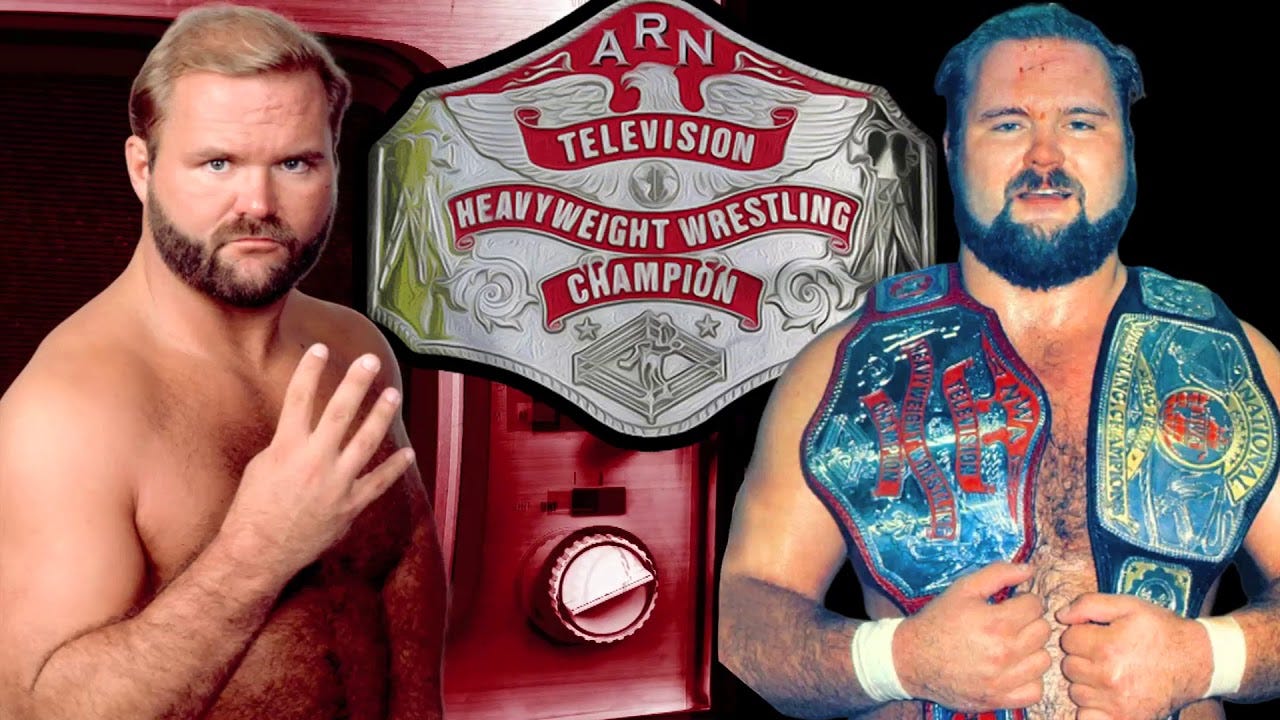
The win’s significance extended beyond the ring. It marked Anderson’s first major singles accolade, transitioning him from tag team specialist to versatile threat, all while maintaining his National Tag Team Championship until the titles were retired in March 1986. This dual-champion status amplified the Four Horsemen’s aura of invincibility, fueling feuds that defined the NWA’s final significant era.
One Thing I Learned About Paula Kaye
She served in the United States Air Force prior to starting her professional wrestling career.
Thank You for Reading
I’m Tony Richards, Pro Wrestling Historian, Author and Storyteller. I share pro wrestling historical items in each issue of the Time Tunnel Pro Wrestling History Newsletter. Thanks for reading! If you enjoy my information on select events, matches and insights, please share it with folks you think might like to be a subscriber!
Remember, premium investors get access to exclusive and special content such as some special issues including a multi-part deep dives on wrestling territories, wrestler bios and championship title histories, special audio and video interviews on territory pro wrestling and more available in the Pro Wrestling Time Tunnel for Premium Investors.