


Written and Produced by Tony Richards
January 3rd in the Time Tunnel:
Happy Birthday to those who have passed on and to those great wrestlers still with us:
In Memoriam:
Martino Angelo 1911
Eric Tovey\Lord Littlebrook 1929
Dean Hart 1954
Art Crews 1959
Jerome Young\New Jack 1963
Happy Birthday:
Jim Ross (74)
Ross Hart (67)
Izuki Yamamzaki (60)
RIP Memorial: We stop & remember those who have passed on this day and gave themselves to the business for us, the fans. We salute you and thank you.
Herbert Glen Knotts\Buddy Knox 1-3-1970 at the age of 56

The Life and Career of Buddy Knox
Standing at 5 feet 11 inches and weighing around 190 pounds, Knox embodied the agile, light heavyweight style that dominated the era’s wrestling scene, blending athleticism with dramatic storytelling in the ring. His career spanned several decades, primarily in the 1940s and 1950s, during which he competed under various aliases and left a mark on promotions from the Pacific Northwest to the Midwest and Canada. Knox’s journey from humble beginnings to regional stardom reflects the grit and mobility required of wrestlers in the pre-television boom era, culminating in his untimely death in 1970 at the age of 55.
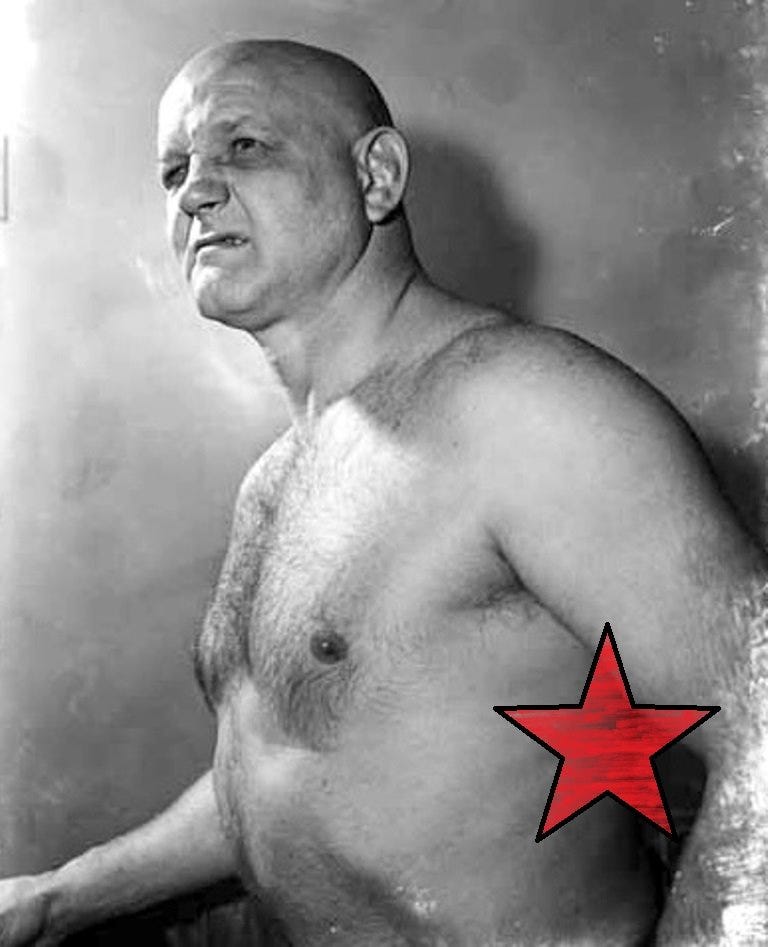
His West Virginia roots suggest a working-class background common among many wrestlers of his generation. Born in the Appalachian region, Knox likely entered the world of professional wrestling in the late 1930s or early 1940s, a time when the sport was transitioning from carnival sideshows to organized promotions under the National Wrestling Alliance (NWA) umbrella. While exact details of his debut remain elusive, records indicate he was active by the 1940s, adopting personas that capitalized on mystery and power to draw crowds. One of his most famous gimmicks was “The Masked Marvel,” a hooded heel character that allowed him to build intrigue and feud with fan favorites. Other aliases included Bob Knox, Glen Knox, Herbert Knox, Jimmy Knox, Logger Knox, Mighty Yankee #2, and Schoolboy Knox, showcasing his versatility in adapting to different regional styles and storylines.
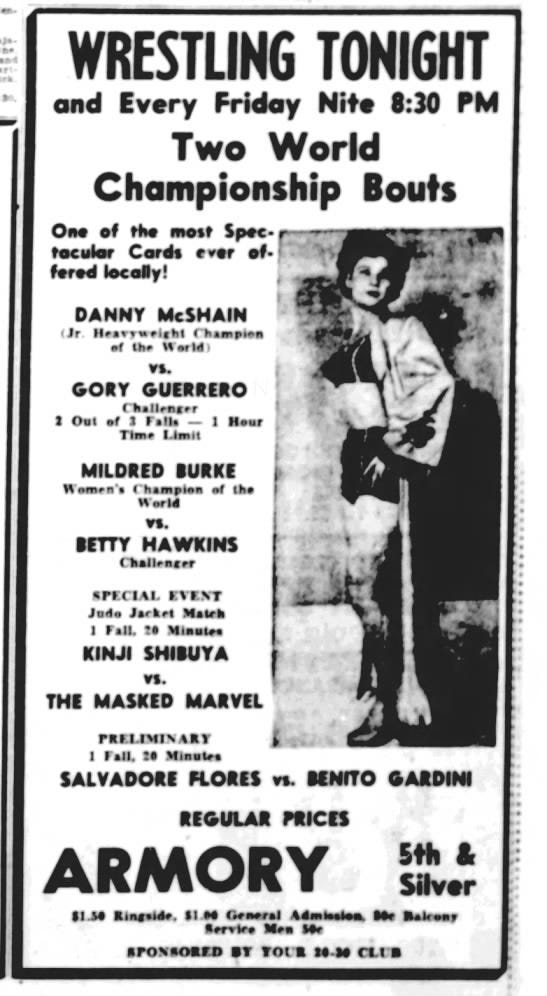
Pictured: August 15th, 1952, The Armory in Albuquerque, New Mexico with a match versus Kinji Shibuya
Knox’s career was defined by his extensive travels across numerous promotions, a necessity in an era when wrestlers often barnstormed to make a living. He worked for over 30 organizations, including key NWA affiliates such as Pacific Northwest Wrestling (Oregon/Washington), Stampede Wrestling (Canada), NWA Vancouver, NWA Hollywood Wrestling, Championship Wrestling from Florida, and Mid-Atlantic Championship Wrestling. His affiliations extended to independent outfits like Al Haft Sports (Indiana/Ohio), Fred Kohler Enterprises (Illinois), and Gulf Athletic Club (Texas), highlighting his role as a journeyman who could fill cards in both major territories and smaller venues. In the Pacific Northwest, Knox became a staple, competing in Portland and Vancouver, where he drew crowds with high-stakes matches. For instance, in 1953, as The Masked Marvel, he wrestled to a 30-minute time-limit draw against John Paul Hennig in the debut episode of Portland Wrestling on television, marking an early foray into the medium that would later explode the sport’s popularity.
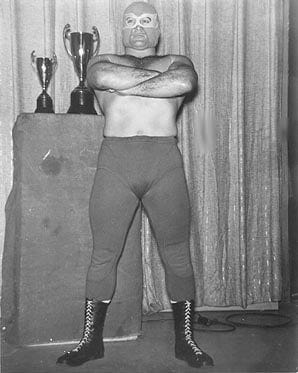
Pictured: Buddy Knox as The Masked Marvel
Throughout his career, Knox achieved notable success in the light heavyweight and junior heavyweight divisions, capturing several regional titles that underscored his in-ring skill. His accolades included the MWA (Ohio) Light Heavyweight Championship, the NWA Pacific Coast Heavyweight Championship (twice, later listed as three times under the Vancouver banner), the Pacific Coast Junior Heavyweight Championship (won by defeating Frank Stojack), and the Pacific Coast Light Heavyweight Championship (twice). In tag team competition, he held the NWA (Mid-America) Southern Tag Team Championship with partner Wild Bill Canny and the NWA Northwest Tag Team Championship alongside Buck Weaver. These victories often came in hard-fought feuds against opponents like Jack Kiser, Gordon Hessel, Danno McDonald, Farmer Jones, Cal Roberts, Cowboy Carlson, and Martino Angelo, where Knox’s technical wrestling and ability to play both hero and villain roles shone through. As Mighty Yankee #2, he teamed with Mighty Yankee #1, adding a patriotic flair to his persona during the post-World War II years.
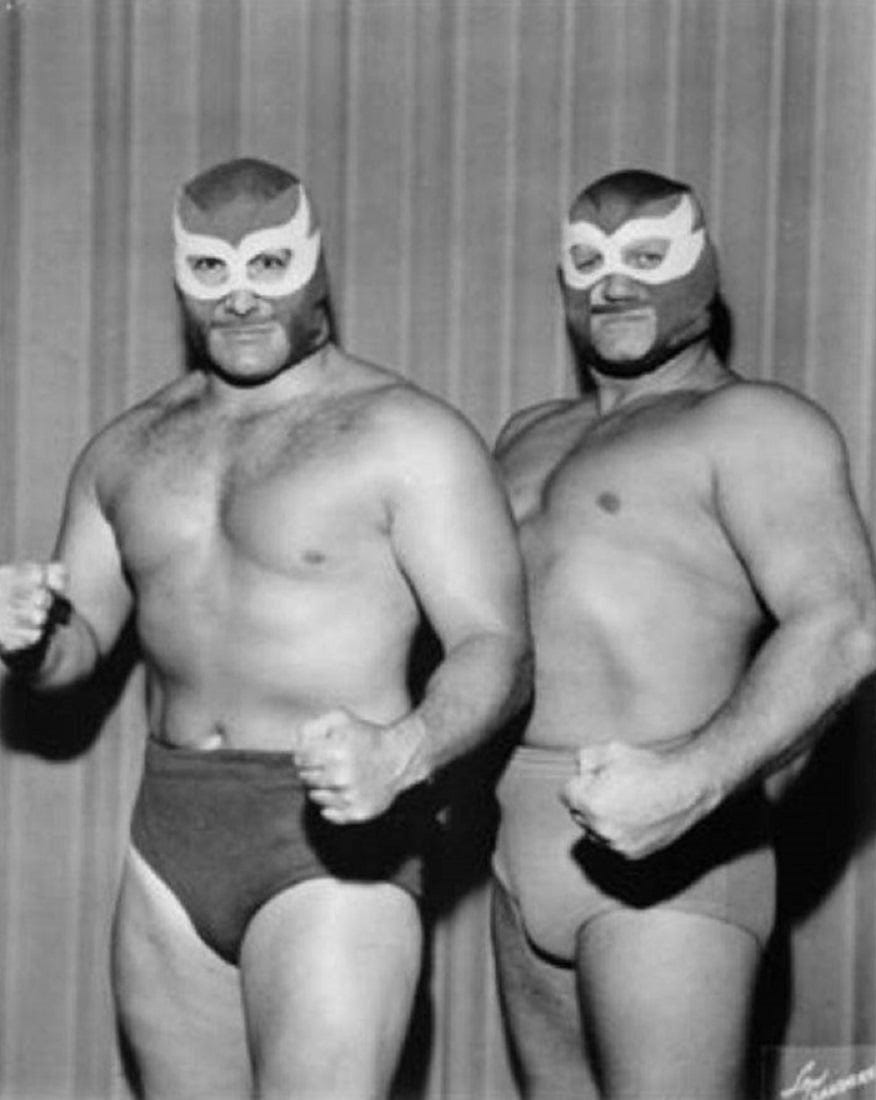
Pictured: Buddy Knox and Roger Mackey as The Mighty Yankees Tag Team (Photo furnished by CS Classic Photos, all rights reserved)
Knox’s style was emblematic of the era’s emphasis on mat-based grappling and endurance, often competing in time-limit draws or multi-fall matches that tested physical limits. His work in British Columbia and the Pacific Coast regions, particularly under the Masked Marvel gimmick, earned him a reputation as a tough, reliable performer who could elevate local talent. However, like many wrestlers of the time, Knox operated in a fragmented industry without the protections of modern unions or health safeguards, which may have contributed to the health issues that plagued him later.
In his later years, Knox continued wrestling into the 1960s, though his activity slowed as younger stars emerged and television reshaped the business. He retired sometime before his death, focusing perhaps on life outside the ring. Tragically, Knox passed away on January 3, 1970, at the age of 55, succumbing to cancer. His death occurred around the mid-point of the peak of an era for regional wrestling veterans, many of whom have faded from public memory as territorial era ended and the sport globalized.
One Thing I Learned About Dean Hart
During his time wrestling and living in Hawaii in the early 1980s, he became close to a young Dwayne Johnson (who would later become known as The Rock), through his association with Johnson’s grandparents, Peter and Lia Maivia
Thank You for Reading
I’m Tony Richards, Pro Wrestling Historian, Author and Storyteller. I share pro wrestling historical items in each issue of the Time Tunnel Pro Wrestling History Newsletter. Thanks for reading! If you enjoy my information on select events, matches and insights, please share it with folks you think might like to be a subscriber!
Remember, premium investors get access to exclusive and special content such as some special issues including a multi-part deep dives on wrestling territories, wrestler bios and championship title histories, special audio and video interviews on territory pro wrestling and more available in the Pro Wrestling Time Tunnel for Premium Investors.