


Written and Produced by Tony Richards
December 28th in the Time Tunnel:
Happy Birthday to those who have passed on and to those great wrestlers still with us:
In Memoriam:
Reginald Siki 1899
Lanny Poffo 1954
John Bedoya\Vavier 1977
Happy Birthday:
Tatsumi Fujinami (72)
Taryn Dryden\Tiffany (40)
Rachel Ellering\Rachel Evers (33)
RIP Memorial: We stop & remember those who have passed on this day and gave themselves to the business for us, the fans. We salute you and thank you.
Wild Bill Brooks\The Question Mark 12-28\1983 at the age of 82
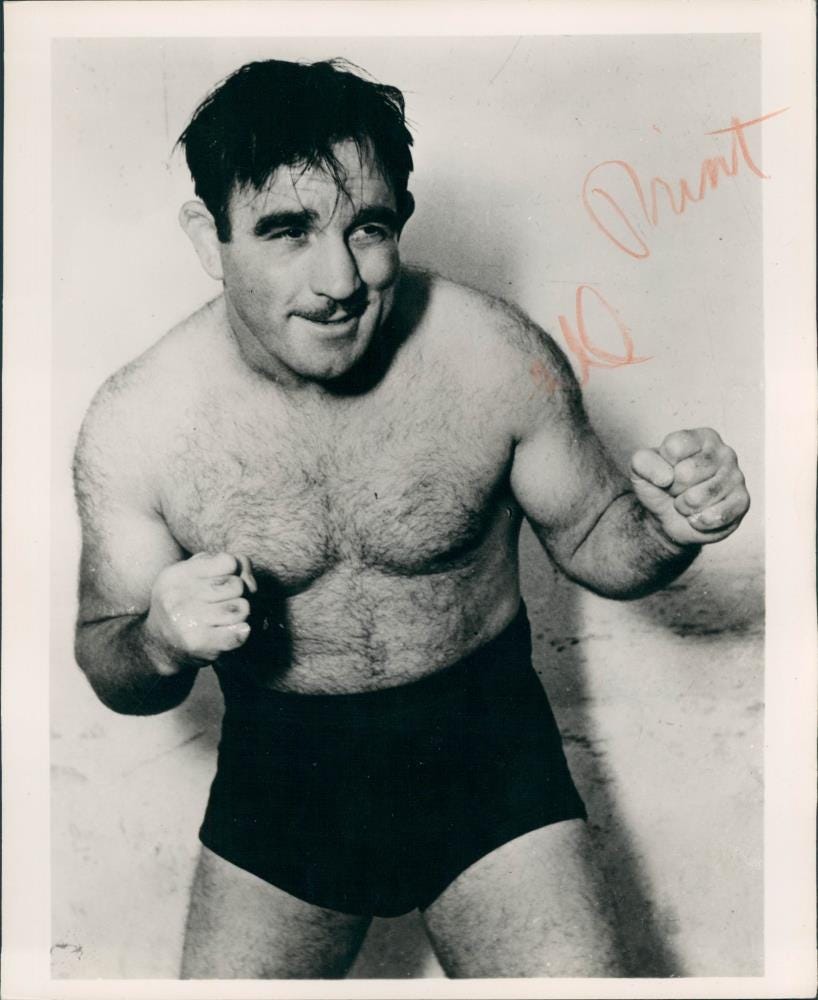
Chico Salazar 12-28-1989 at the age of 67

Andy Tremaine\The Tuccon Thunderbolt 12-28-1995 at the age of 84

Bill Dromo 12-29-2012 at the age of 75

The Life and Caareer of Bill Dromo
Bill Dromo, born William M. Dromo on June 28, 1937, in Teulon, Manitoba, Canada, was a formidable figure in professional wrestling, known for his rugged style, imposing physique, and longevity in the ring. Standing at 6 feet 3 inches and weighing around 275 pounds, Dromo—often billed as “Big” Bill or “Wild” Bill—carved out a career that spanned over two decades, primarily in North American territories but also extending to Japan. His journey from amateur athlete to pro wrestling staple reflected the grit of the territorial era, where wrestlers traveled extensively, built local fame, and endured physical punishment for the love of the sport. Dromo passed away on December 28, 2012, at the age of 75, leaving behind a legacy as a reliable worker and family man.
Dromo’s early years were rooted in rural Canada. Born to Mike and Anne Dromo, he spent his first nine years in Teulon, about 45 minutes north of Winnipeg, before the family relocated to the city. As a teenager, Dromo shied away from football, deeming it too rough, and instead gravitated toward wrestling at age 15. He began training at the Airways Community Club in St. James under the guidance of Dave Piper (sometimes referred to as Dan Piper), a key mentor who helped shape his fundamentals. Dromo also had a background in amateur boxing, which honed his toughness before he transitioned fully to wrestling.
For five and a half years, Dromo competed as an amateur at the St. Boniface Health Club (later the Madison Club), becoming a top heavyweight contender alongside notables like Gordon Nelson and George Gordienko. He won all but two of his 23 amateur matches, earning a silver medal at the British Empire Games in Manitoba, with his losses coming against Nelson—whom he would later face professionally in Florida. Under promoter Gordon Mackie at the Madison Boxing & Wrestling Club, Dromo refined his skills, leading to early professional opportunities. His pro debut came against Mitsu Arakawa, a grueling encounter where Arakawa “beat the crap out of me,” as Dromo later recalled, marking the start of his paid career in the late 1950s.
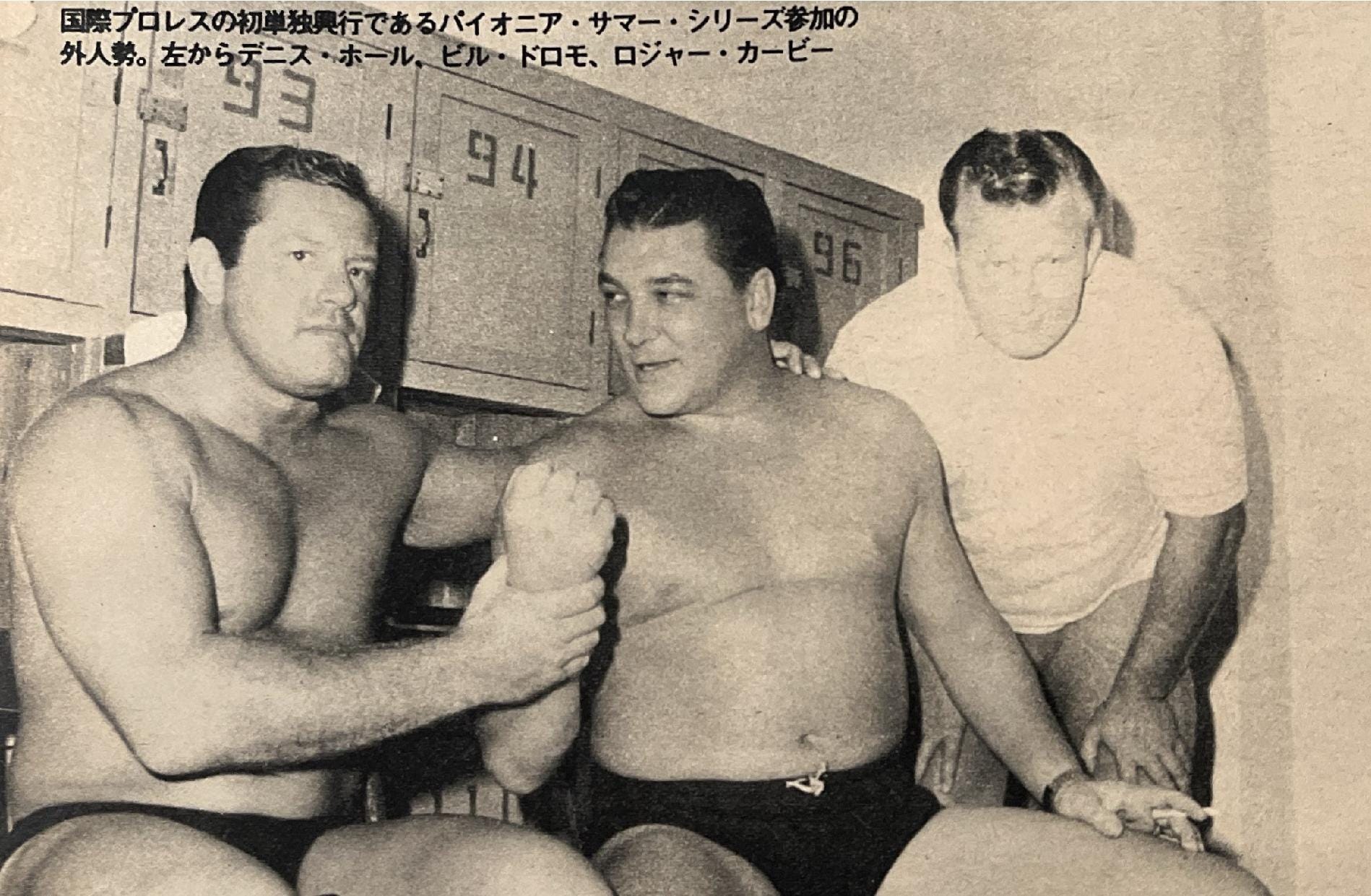
Pictured: Bill Dromo, Dennis Hall and Roger Kirby in an Indianapolis locker room
Dromo’s early professional days were spent in the Midwest, based in Indianapolis under promoter Jim Barnett, where he was treated well and shared living quarters with fellow wrestler Tex McKenzie. By 1960, he moved to Georgia, which became his lifelong home base and the epicenter of his success. Working for Georgia Championship Wrestling (GCW) under promoter Fred Ward, Dromo found consistent bookings and fair treatment, becoming a staple in cities like Macon and Columbus. His versatility allowed him to portray both babyface (hero) and heel (villain) roles effectively, using his boyish looks for sympathy and his size for intimidation.
Dromo’s career took him across various territories, including Stampede Wrestling in Canada (where he worked for Stu Hart to stay close to home), British Columbia, Texas, the American Wrestling Association (AWA), Los Angeles, Florida, and even the World Wide Wrestling Federation (WWWF), where he briefly wrestled as Bill Zbyszko—a nod to the legendary Stanislaus Zbyszko, though the name drew minor objections. Internationally, he toured Japan for promotions like Japan Pro Wrestling Alliance (JWA), International Wrestling Enterprise (IWE), and New Japan Pro-Wrestling, facing stars like Kintaro Ohki and winning the All Asia Heavyweight Championship in 1971.
Notable feuds included brutal encounters with Johnny Valentine, whom Dromo praised for their intensity: “I made sure I saw my shoelaces on his chest. There was no human being sitting out in that crowd that could have stood what we gave each other.” In Florida, he clashed with Bobby Duncum, the Zodiac (Bob Orton Sr.), and the Mongolian Stomper. Dromo was known for his believable, no-frills style, drawing comparisons to Bob Orton Sr. and Valentine from peers like Buddy Colt. Superstar Billy Graham credited Dromo in his autobiography for mentoring him on gear and lending boots during their time in Stampede, highlighting the personal sacrifices of the road life.
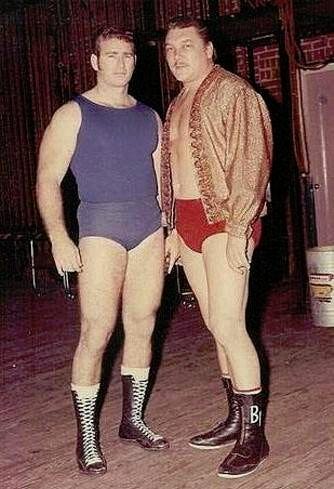
Pictured: Bill Dromo and Bob Armstrong
He frequently teamed with Bob Armstrong against duos like the Assassins and the Monroes, solidifying his status as a Macon star. Late in his career, Dromo donned masks as Mr. Griffin in Georgia and Super Destroyer in Tennessee for Jerry Jarrett, extending his in-ring tenure until his final match in 1982.
Outside the ring, Dromo’s life was marked by stability amid the chaos of wrestling. In Atlanta, he met his wife, Karin—a dental assistant and part-time woman wrestler—in a dentist’s chair, arranged by fellow wrestler Dick Steinborn. Their unique meeting led to a 52-year marriage and three daughters: Dromo cherished family, pinning photos of them to his car visor during long drives, a poignant reminder of the sacrifices noted by Billy Graham.Tanja, Kelly, and Denise. Dromo cherished family, pinning photos of them to his car visor during long drives, a poignant reminder of the sacrifices noted by Billy Graham. He was an outdoors enthusiast, involved in his church and the Shriners, and known for community spirit. Anecdotes, like catching a small alligator and stowing it in a car trunk during a trip to Miami (damaging the vehicle), showcased his adventurous side.
Post-retirement, Dromo ran a restaurant and worked as a security guard. Health challenges emerged, including a ruptured aorta in 1996 that required 15-hour surgery, followed by Parkinson’s disease. Despite these, he remained resilient, attending events like an appreciation night in his honor by Southern Extreme Championship Wrestling in 2008.
Bill Dromo’s legacy lies in his workmanlike approach—he was never a national superstar but a territorial powerhouse who earned respect through authenticity and endurance. Peers remembered him as kind and tough, with wrestling historian Rich Tate noting after his death: “He was always available with kind words even when it was obvious his health was getting the better of him.” Dromo died on December 28, 2012, in Carrollton, Georgia, where he had lived for nine years after moving from Marietta. His funeral was held on January 4, 2013, at West Cobb Funeral Home, with burial at Kennesaw Memorial Park Cemetery. Survived by his wife, daughters, six grandchildren, and extended family, Dromo exemplified the blue-collar ethos of wrestling’s territory era.
One Thing I Learned About Wild Bill Brooks
His real name was Pasquale Falletti, was actually born in Reggio Calabria, Italy, in 1901—despite his rugged, Western-sounding ring name suggesting otherwise. He was also the original masked wrestler, The Question Mark.
Thank You for Reading
I’m Tony Richards, Pro Wrestling Historian, Author and Storyteller. I share pro wrestling historical items in each issue of the Time Tunnel Pro Wrestling History Newsletter. Thanks for reading! If you enjoy my information on select events, matches and insights, please share it with folks you think might like to be a subscriber!
Remember, premium investors get access to exclusive and special content such as some special issues including a multi-part deep dives on wrestling territories, wrestler bios and championship title histories, special audio and video interviews on territory pro wrestling and more available in the Pro Wrestling Time Tunnel for Premium Investors.