


Written and Produced by Tony Richards
December 19th in the Time Tunnel:
Happy Birthday to those who have passed on and to those great wrestlers still with us:
In Memoriam:
Roy Welch 1901
Will Kurt Rutkowsky\Kurt Von Stroheim 1923
Gene Okerlund 1942
Happy Birthday:
Erik Watts (58)
Hunter Johnston\Delirious (44)
RIP Memorial: We stop & remember those who have passed on this day and gave themselves to the business for us, the fans. We salute you and thank you.
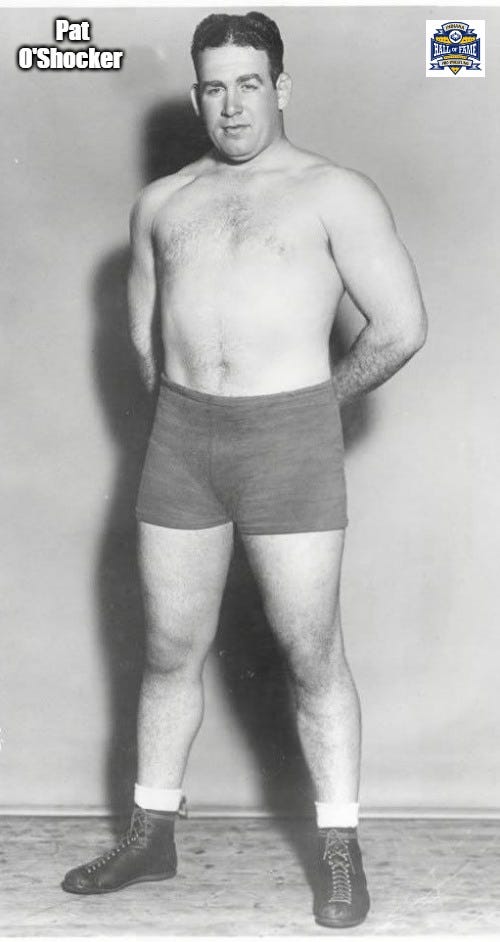
William Hayes Shaw\Pat O’Shocker 12-19-1977 at the age of 70

Sterling Blake Davis\Dizzy Davis 12-19-1983 at the age of 69

The Life and Career of Pat O’Shocker
Pat O’Shocker emerged on the professional wrestling scene in the early 1930s, competing in various regional promotions across the United States. At a time when wrestling was transitioning from legitimate contests to more entertainment-oriented bookings, O’Shocker built a reputation as a reliable performer. His matches were typically straightforward affairs, emphasizing power moves and endurance rather than flashy acrobatics. While he never ascended to the top echelons of stardom like contemporaries such as Jim Londos or Lou Thesz, O’Shocker’s size and strength made him a credible opponent for headliners, often serving in mid-card roles or as a challenger in title bouts.
The defining moment of O’Shocker’s career came in 1932, during a period of intense rivalry among wrestling promoters. On September 12, 1932, in New Haven, Connecticut, O’Shocker was scheduled to face Jim Londos, the reigning World Heavyweight Champion and one of the sport’s biggest draws. Behind the scenes, promoter Joseph “Toots” Mondt—associated with Jack Curley’s influential booking office—approached O’Shocker with a clandestine offer. Mondt, harboring a grudge against Londos for breaking away from Curley’s group, proposed a “screwjob”: O’Shocker would double-cross Londos in the match, with the referee ensuring a pinfall victory for O’Shocker, thus stripping Londos of the title. In exchange, Mondt offered O’Shocker $15,000 (later raised to $25,000) and a five-year managerial contract. This sum was enormous during the Great Depression, equivalent to years of earnings for most wrestlers.
Accounts vary slightly on O’Shocker’s initial response—some suggest he briefly considered the deal before having second thoughts—but he ultimately refused. Instead, he alerted Londos to the plot, allowing the champion to prepare. Londos, furious, threatened to no-show the event, but pressure from the Connecticut State Athletic Commission—threatening to revoke his recognition in other states—forced him to compete. The resulting match was a lackluster 22-minute affair, with Londos retaining his title via a standard victory, devoid of any drama from the thwarted scheme. Mondt later denied any involvement, claiming he wasn’t even in New Haven that night.
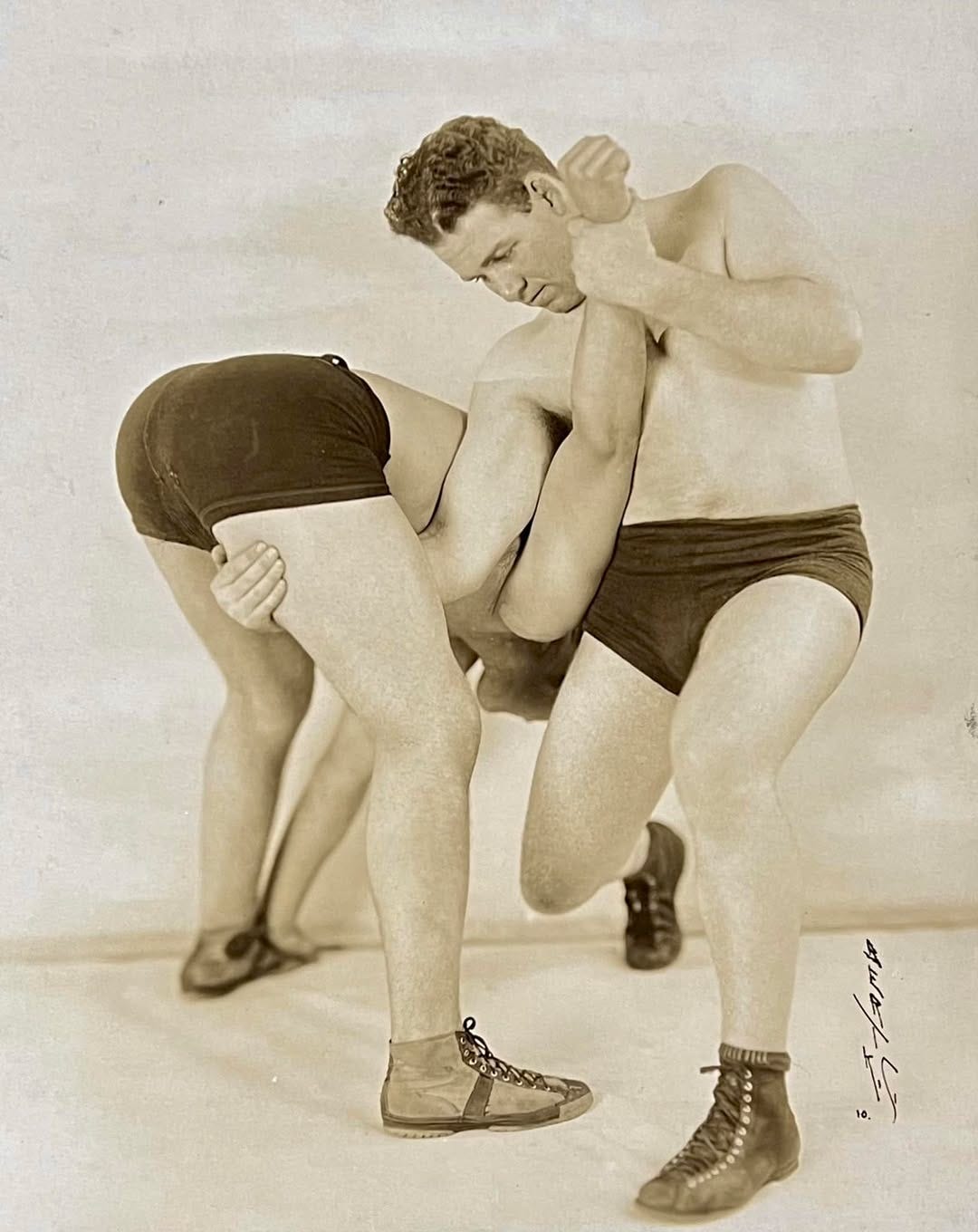
Pictured: Pat O’Shocker puts the stretch on an opponent
The incident remained under wraps until April 1933, when Mondt successfully orchestrated a similar double-cross against Londos in a match with “Jumping” Joe Savoldi. Referee Bob Managoff controversially awarded the title to Savoldi, sparking outrage and investigations by athletic commissions. Londos, armed with evidence, referenced the earlier attempt involving O’Shocker. Based in St. Louis at the time, O’Shocker was reluctant to get involved due to Mondt’s clout in the industry but eventually confirmed the details to newspapers and officials when pressed. His testimony helped expose the underbelly of wrestling politics, though it didn’t lead to major reforms. Remarkably, O’Shocker faced no significant backlash; he continued wrestling without interruption, as Mondt and Londos reconciled later that year.
Beyond this scandal, details of O’Shocker’s in-ring achievements are limited. He competed in various territories, including bouts in Missouri and Connecticut, but no major titles are recorded in available histories. His career likely spanned the 1930s, with possible involvement in wrestling into later decades— one account places him as a referee in a 1963 match in Amarillo, Texas, between Dory Funk Jr. and Gene Kiniski, suggesting he remained connected to the sport long after his prime as a performer. This transition from wrestler to official was common for veterans, allowing them to stay in the business while mentoring younger talent.
40 Year Flashback
12-19-1985: Dusty Rhodes is awarded the NWA National Heavyweight Championship after the champion, Buddy Landel is fired for missing a television taping at the Techwood Drive studio in Atlanta, Georgia for Jim Crockett Promotions at WTBS. Landel had matches during the summer of 1985 against NWA World Champion, Ric Flair that drew good money and produced good matches on the JCP circuit, but the program had been promoted in local inserts on syndicated shows but not nationally on WTBS. Rhodes had Landel beat Terry Taylor for the National Title at Starrcade 1985 as the next step forward in the plans to push him up the ladder.
Legend has it that Rhodes was going to do a program of “Battle of the Nature Boys” with an eventual title switch to give Flair some time off. It’s hard to beleive that Rhodes would have fired Landel over missing one television taping, so there must have been other frustrations with Landel and the missed taping was the final straw.
One Thing I Learned About Dizzy Davis
He orchestrated a successful 1976 jailbreak to free his son from a Mexican prison, where the son was serving time for marijuana possession—the operation involved hired accomplices who freed him and several others without firing a shot, sparking an international incident.
Thank You for Reading
I’m Tony Richards, Pro Wrestling Historian, Author and Storyteller. I share pro wrestling historical items in each issue of the Time Tunnel Pro Wrestling History Newsletter. Thanks for reading! If you enjoy my information on select events, matches and insights, please share it with folks you think might like to be a subscriber!
Remember, premium investors get access to exclusive and special content such as some special issues including a multi-part deep dives on wrestling territories, wrestler bios and championship title histories, special audio and video interviews on territory pro wrestling and more available in the Pro Wrestling Time Tunnel for premium investors.