


May 9 in the Tunnel:
Happy Birthday to those who have passed on and to those great wrestlers still with us:
In Memoriam:
Frank Andersson 1956
Mike Shaw\Norman\Bastion Booger 1957
Happy Birthday:
George Gulas (76)
Kevin Kelly 58
Oro Mensah (30)
RIP Memorial: We stop & remember those who have passed on this day and gave themselves to the business for us, the fans. We salute you and thank you.
Winona Little Heart 5-9-2020 at the age of 64

50-Year Flashback:
The 3rd Annual Champions Carnival Series Comes to A Close Today with A Title VS Title Match in 1975
*Tony Note:
The All-Japan Champions Carnival Tournament in Review
We had a quick snapshot recently in an issue on the New Japan Pro Wrestling Series "World League", which was created in 1974 by Antonio Inoki to run opposite of this tournament created by Giant Baba, originally in 1973. The Champions Carnival was another example of Baba being one step ahead of Inoki, seemingly at every turn.
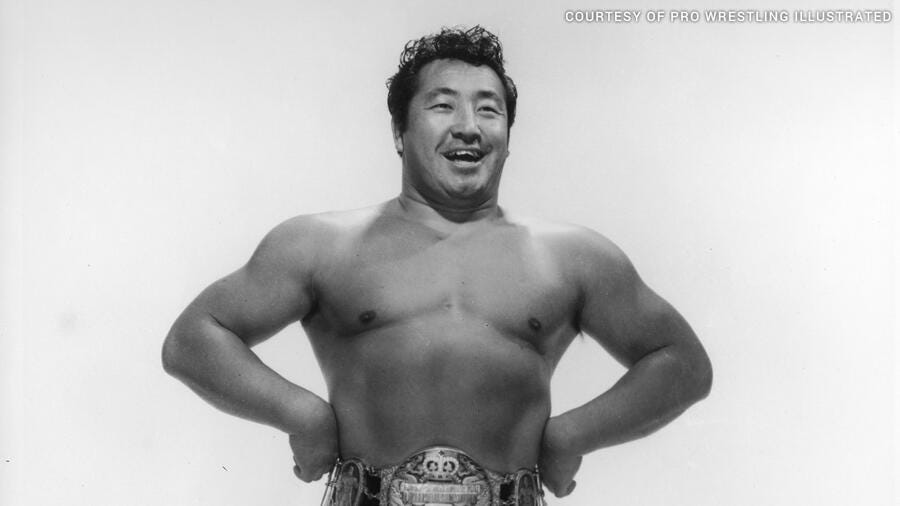
Pictured: Rikidozan
Baba and Inoki both trained and starred in Japan Pro Wrestling (JPW). JPW was the brainchild of Rikidozan, often called "the father of Japanese pro wrestling". After seeing the success wrestling promoters were having in North America in 1951, when 1953 rolled around, Rikidozan and some American peers had the idea to establish a wrestling promotion in Japan that could become a member and represent the National Wrestling Alliance. They recruited wrestlers from both sumo and judo dojos. Rikidozan put himself on top and originally did programs with other Japanese wrestlers. He soon figured out he could be successful to reverse many of the matches and angles in the United States making the Japanese star the hero and the foreign American stars the heels, not for doing any particular heel action, just by not being Japanese. The idea of Japanese wrestlers battling foreign wrestlers to re-establish Japanese pride following the crushing defeat in World War II sold a lot of tickets and became immensely popular. Rikidozan eventually brought in Lou Thesz, The Destroyer and Bobo Brazil as top non-Japanese talent.
In 1959, he established a tournament called World League (also known as Big World League) which featured the Japanese stars and top foreign stars vying to capture the tournament championship. That first World League Tournament ran from May 21st to June 15th, establishing it as a Spring festival type of annual event. They booked the first tournament with an exciting ending involving a masked wrestler named "Mr. Atomic” along with Enrique Torres, Jesus Ortega and Rikidozan. Mr. Atomic defeated Rikidozan, but it was by disqualification, which sent Rikidozan to the finals. Torres and Ortega battled in the semi-final to an exciting time limit draw, then in an overtime match, they went to a draw again, with Ortega advancing. Rikidozan defeated Ortega in the finals. This dramatic ending to an entertaining and athletic tournament got the fans excited for wrestling in Japan and also to make the World League an annual event.
Without going into all the specific details now, suffice to say after Rikidozan was tragically murdered in 1963, eventually the two young stars coming up in the promotion, Baba and Inoki left to form their own promotions in 1972. With their two top drawing cards now their competition, the JWA folded in 1973.
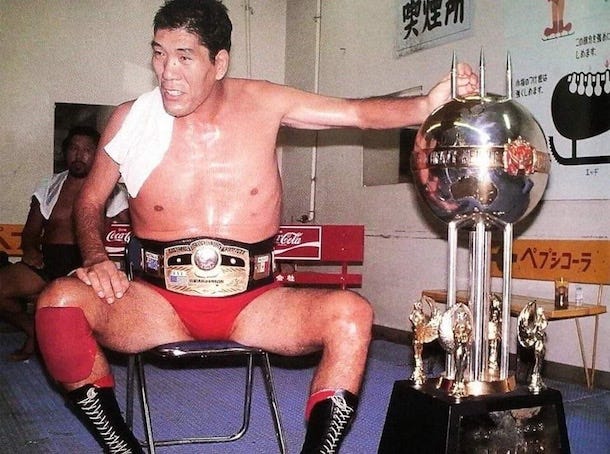
Pictured: Giant Baba
Giant Baba essentially copied the format of the tournament, branding it as the Champions Carnival in 1973. At this time, it's probably appropriate to mention that Baba won the JWA World League tournament a total of six times as part of building his image and brand as a Japanese wrestling superstar, so it's no wonder he had a particular fondness for the Spring spectacular. Baba wasted no time, six months after he formed All Japan Pro Wrestling in 1972, he held the first Champions Carnival tournament the following Spring. That first Carnival series was a single-elimination tournament and Baba used it to establish his top guys to build his company around. Besides himself, he featured Thunder Sugiyama, Samson Kutsuwada and a former NWA World Junior Heavyweight Champion, Hiro Matsuda. For the foreign heels, he brought in Mark Lewin, Baron Scicluna, The Destroyer (Dick Beyer) and King Curtis Iaukea. Baba put himself over in the finals defeating Lewin. In the second Champions Carnival in 1974, Baba featured the debut of former Olympian, Jumbo Tsuruta. Dory Funk Sr had become the booker of American wrestlers to All Japan for Baba from the start, so Tsuruta spent some time in the Amarillo West Texas Territory as part of their working agreement. Baba featured Mr. Wrestling, Tim Woods in the second tournament, a former spectacular amateur wrestler who was amazing in the ring. Baba went over Woods again in the finals to win in 1974.
This brings us to today's Time Tunnel Flashback focus, the Champions Carnival in 1975, the third of these events for All Japan. Baba changed up the format of the series a bit. The four wrestlers who advanced to the semifinals in the single-elimination tournament were then placed into a round-robin tournament, with two groups. One was a repechage-type group called “Group D”, then then a “Final League”, where the wrestler with the best overall record would be declared the winner. The initial tournament kicked off on Thursday, April 5th in Funabashi with a callback to one of the wrestlers who helped build the tournament, Baba taking on Mark Lewin with the match ending in a brawl for a No Contest, while The Destroyer defeated Mike George and Mr. Wrestling (Tim Woods) beat Akhiso Takachiho and Killer Kowalski defeated Samson Kutsuwada for a tremendous opening to the Champions Carnival. As the tournament advanced through April, all those wrestlers continued to pile up wins. Gene Kiniski arrived in Japan to join the tour on Sunday, April 13th getting a win in his first match defeating Akhisa Takachiho. Baba and Lewin continued to have wild matches that ended in No Contests and Double Count outs, which was not benefitting either man for advancement. Baba finally scored a win on Lewin by beating the count and getting back in the ring with Lewin getting counted out giving Baba the win on April 16th. When the single-elimination tournament entered the second round on April 18th, Giant Baba and Killer Kowalski had a really good match, lasting over 26 minutes before Baba got the pin on the Killer. The next night, April 19th, The Destroyer defeated Takachiho, then on April 23rd, Kiniski beat the newcomer Tsuruta and on April 27th in the last match of the D-Block second round tourney, Mr. Wrestling defeated Tsuruta.
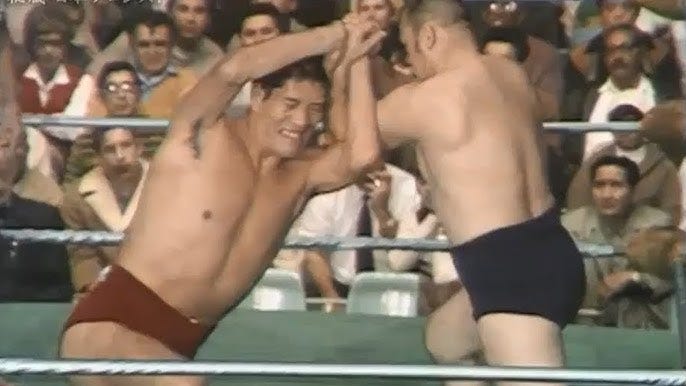
Pictured: Giant Baba vs Gene Kiniski
It should be noted that Giant Baba's intricate booking of the Carnival was held in such high regard that videotapes of the event became required viewing for up-and-coming young bookers in the United States in the second half of the 1970s and the 1980s. Also of note, is the match the fans most wanted to see in Japan was Giant Baba vs The Destroyer, and Baba did an amazing job booking the tournament in such a way that the fans would get excited that the match might potentially happen, but each year, somehow it didn't. Baba and The Destroyer did wrestle in a tag team match on April 22nd as they beat Kiniski and Steve Keirn. Baba mixed in other title matches as well. As the tournament shifted into May and the stakes became increasingly higher, The Destroyer defended his NWA United States Heavyweight Championship (yet another version, this one in Japan) by defeating Mr. Wrestling in Okayama and Baba & Tsuruta tagging together on top beating George and Kiniski. On May 3rd, the Final Champions Carnival Match took place in Wakayama between the two top wrestlers with the best records for the tournament, two former NWA World Champions, Giant Baba and Gene Kiniski. As was the case in many Japanese two out of three fall matches, the first fall was a struggle, mostly wrestling as both wrestlers struggled in a ying-yang contest, the momentum swinging back and forth for twelve minutes, before Baba scored the first pinfall. Kiniski took the offensive in the second fall, catching Baba for a pin in just around three minutes. The third fall went fairly fast as well as Baba defeated Kiniski in an excellent match to win the Champions Carnival for the third year in a row. On May 6th, Baba and Tsuruta defended their NWA International Tag Team Championship defeating Killer Kowalski and Bruno Sammartino.
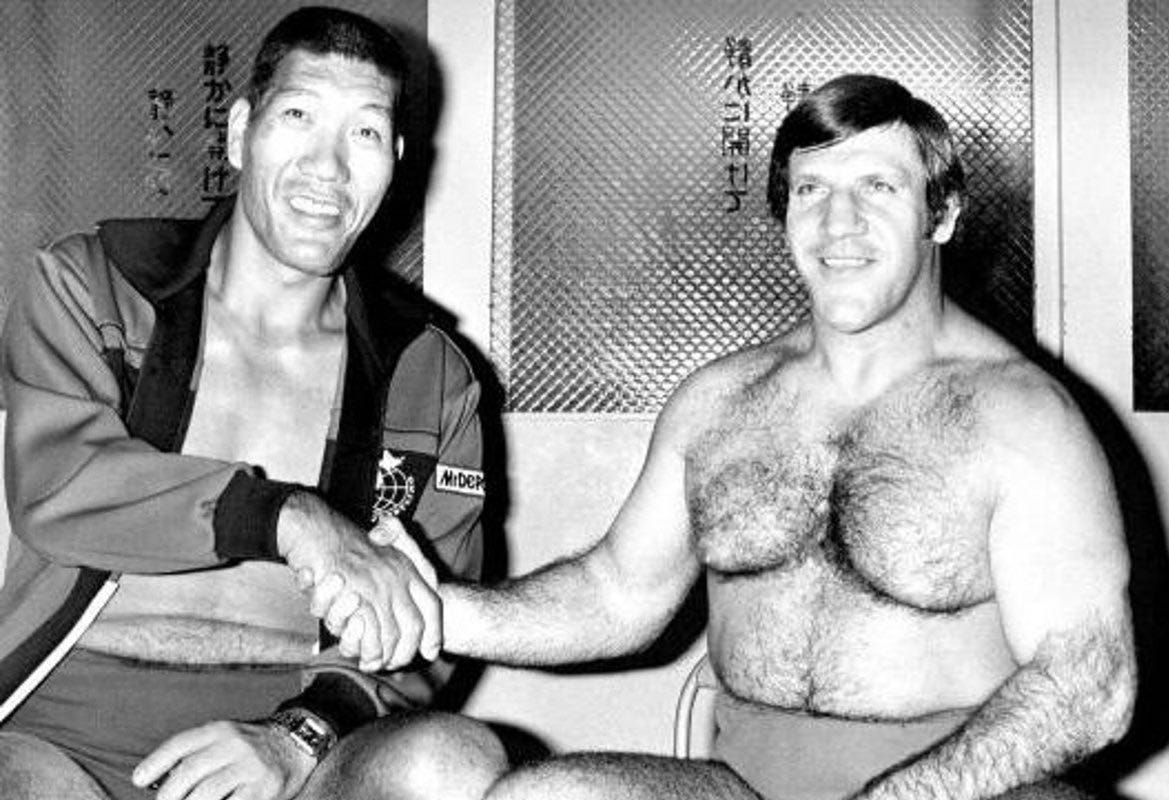
Pictured: Giant Baba and Bruno Sammartino
Then Baba put the cherry on top of his dominance with the Champions Carnival, on this day 50 years ago, May 9th, 1975 when he defended his AJPW/PWF Heavyweight Title against Bruno Sammartino and his WWWF World Heavyweight Championship in a Title vs Title Match at Nippon University Public Hall in Tokyo The undercard was strong as well with the semi being The Destroyer and Jumbo Tsuruta facing off and defeating by 2 falls to 1 Steve Keirn and Mr. Wrestling. The event drew right at 2,500, which was close to capacity for the university building. Sammartino created tense drama by taking the first fall in just over twelve minutes by pinning Baba. The crowd was nervous because in the three-fall match, Sammartino had gotten the upper hand by struggling through and pinning Japan's national wrestling hero. The American had the advantage over the native, hometown favorite. Baba fought back in the second fall and pinned Sammartino rather decisively in just under three minutes. Then, in the third and final fall, the combatants fought outside the ring, while the referee counted both men out with a DQ on both and both men retaining their Championships, thus bringing to a close an exciting third year of All Japan's now flagship Spring event. In the year to come of 1976, Baba would make one more modification to the tournament that would define the event for a generation.
One Thing I Learned Today About Pro Wrestling History:
English wrestler Joe Acton is credited with bringing catch-as-catch-can wrestling, or freestyle wrestling to the United States when he came to the country in 1881.
Thank You for Reading
I'm Tony Richards, Pro Wrestling Historian, Author and Storyteller. I share pro wrestling historical items in each issue of the Time Tunnel Pro Wrestling History Newsletter. Thanks for reading! If you enjoy my information on select events, matches and insights, please share it with folks you think might like to be a subscriber!
Remember, paid subscribers get access to exclusive and special content such as to commemorate his induction to the WWE Hall of Fame, I'll be publishing some special issues including a multi-part flashback on the Georgia Championship Wrestling Territory in May 1975 including all the recorded cards for the month, some special audio and video interviews on territory pro wrestling and more.