


November 23rd in the Time Tunnel:
Happy Birthday to those who have passed on and to those great wrestlers still with us:
In Memoriam:
Farmer Jones 1911
Angelo Martinelli 1916
Gene Kiniski 1928
Theresa Theis 1930
Happy Birthday:
Roger Smith (77)
Don Frye (60)
Nhooph Al-Areebi\Aliyeh (31)
RIP Memorial: We stop & remember those who have passed on this day and gave themselves to the business for us, the fans. We salute you and thank you.
Don McIntyre 11-23-1990 at the age of 73

Art Barr 11-23-1994 at the age of 28
92 Year Flashback
Significant Pro Debut
11-23-1932: Rube Wright defeated George Maloney at the Olympic Auditorium in Los Angeles in 10:17
Born Reuben Wright on November 6, 1907, in California, Wright emerged as a formidable figure in the ring, blending raw athleticism with a commanding presence.
Wright’s path to professional wrestling was rooted in a strong amateur background, which provided the foundation for his success in the squared circle. As a young man, he excelled in heavyweight amateur wrestling, culminating in a notable victory at the 1932 Southern Pacific AAU championship in the “over 191 lbs.” division. This achievement positioned him as a potential contender for the U.S. Olympic team, set to compete in the 1932 Summer Games hosted in Los Angeles. However, financial constraints prevented him from pursuing the Olympic trials, a common barrier for athletes during the Great Depression era. Unable to fund his aspirations, Wright turned to professional wrestling, a burgeoning industry that offered not only competition but also the allure of steady income through ticket sales and promotions. His amateur credentials—strength, technique, and endurance—made him an ideal candidate for the pro circuit, where promoters sought legitimate athletes to lend credibility to their shows.

Pictured: Rube Wright as Lu Kim, The Mongol
The choice of the Olympic Auditorium as the site for Wright’s debut was no coincidence; it was the epicenter of wrestling in Southern California during the 1930s. Opened in 1925 at 1801 South Grand Avenue, the venue had already hosted major events, including the wrestling competitions for the 1932 Summer Olympics just months earlier, where international athletes vied for freestyle and Greco-Roman medals in front of packed crowds. By November, the auditorium had resumed its role as a hub for professional cards, drawing thousands of fans eager for the drama and athleticism of pro wrestling. Promoted by figures like Lou Daro and later the Eaton family, the Olympic featured weekly shows that blended local talent with touring stars, often under the banner of the National Wrestling Alliance precursors. On November 23, 1932—a Wednesday night, typical for midweek cards—the auditorium buzzed with anticipation for a lineup that introduced fresh faces like Wright to the paying public. While exact match details from that night remain scarce in surviving records, likely due to the era’s limited documentation and focus on headliners, Wright’s debut is recorded as occurring on this date, signaling his shift from amateur hopeful to professional grappler.
Wright, at around 6 feet tall and over 200 pounds, would have been showcased for his power and grappling skills, perhaps in a preliminary bout designed to highlight his amateur prowess. The Great Depression had hit the entertainment industry hard, but wrestling thrived as affordable escapism, with tickets priced low to fill the 10,000-seat venue. Promoters emphasized storytelling, with wrestlers adopting personas that ranged from heroic everymen to villainous foreigners. Wright’s early gimmick leaned on his real-life strength, earning him the moniker “Rube” to evoke a rugged, no-nonsense style. Though opponent specifics elude modern archives—possibly a local enhancer like Al Baffert or Joe Banaski, common on LA cards around that time—the debut was a success, launching Wright into a series of matches across California and beyond.
The significance of Wright’s debut extends beyond the ring; it reflected the broader transformation of wrestling in America. In 1932, the sport was still grappling with its identity, blending legitimate contests with predetermined outcomes to maximize entertainment value. Los Angeles, with its Hollywood influence, was a hotbed for innovation, where wrestlers like Jim Londos and Ed “Strangler” Lewis drew massive gates at the Olympic. Wright’s entry came at a time when the industry was recovering from scandals and seeking new stars to replace aging legends. His performance that November night set the stage for a prolific career, including a notable run in the 1940s where he captured a version of the California World Heavyweight Title by defeating The Swedish Angel on August 19, 1942, again at the Olympic Auditorium. This victory, in front of roaring crowds, underscored his growth from debutant to champion, holding the belt amid wartime patriotism and entertainment shortages.
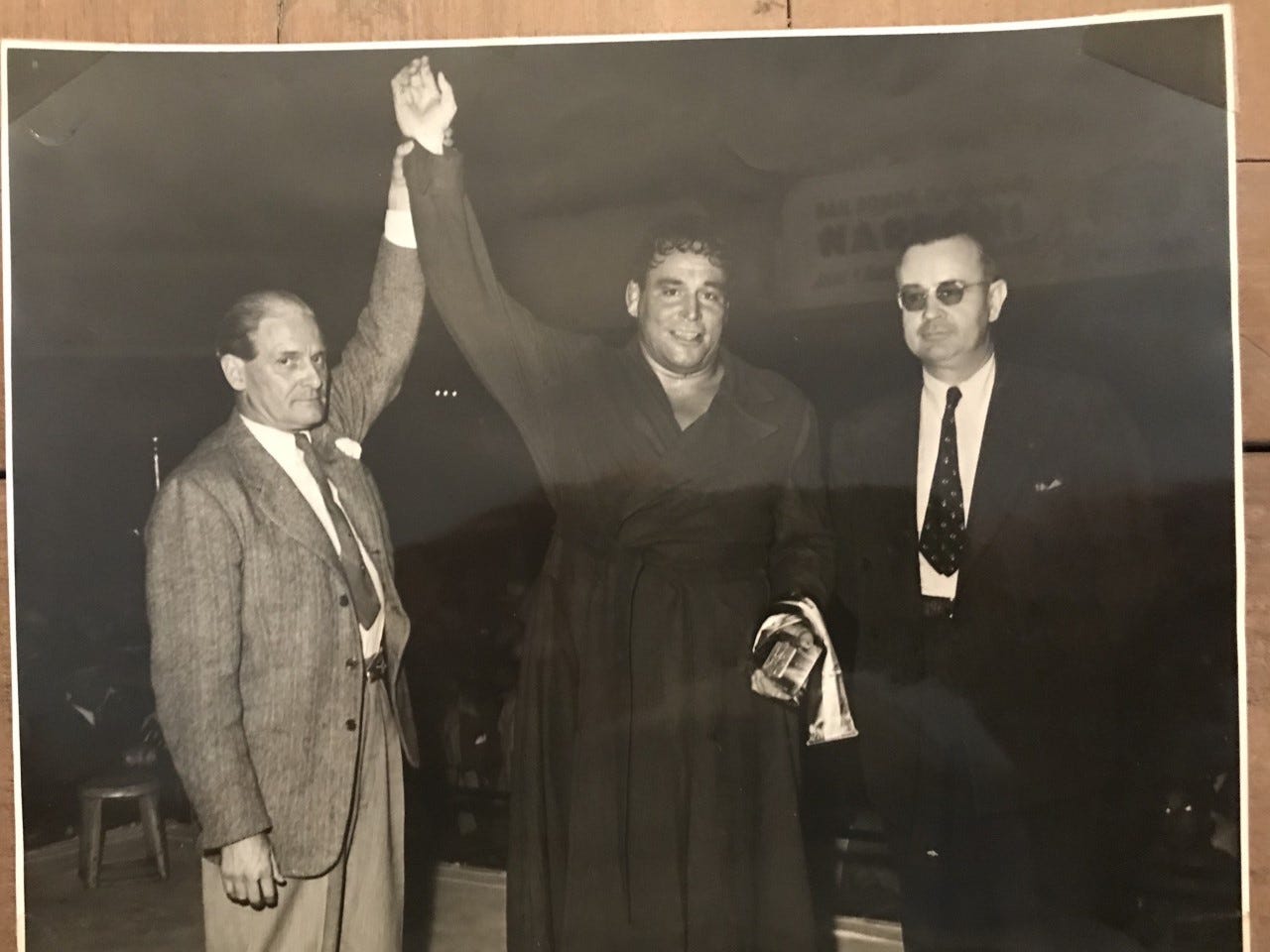
Pictured:: Los Angeles Olympic Auditorium Announcer Lloyd Berkholder raises Rube Wright’s arm as the winner of the 1942 World Title Tournament. California Athletic Commissioner Everett Sanders on the right
Tragically, Wright’s life ended on November 9, 1983, just days after his 76th birthday, but his legacy endures in wrestling lore. His debut on November 23, 1932, symbolizes the resilience of athletes during economic hardship and the enduring appeal of professional wrestling as a form of American theater. In an era without televised spectacles or global pay-per-views, nights like this at the Olympic Auditorium built the foundation for the multi-billion-dollar industry we know today. Rube Wright’s first step into the pro ring was not just a personal milestone but a chapter in the storied history of the sport, reminding us how individual ambitions intersect with cultural moments to create lasting legends.
One Thing I Learned About Don McIntyre
Don McIntyre holds the record for the most reigns as NWA Southern Heavyweight Champion (Georgia version), with an impressive 19 title wins during the territorial era of professional wrestling
Thank You for Reading
I’m Tony Richards, Pro Wrestling Historian, Author and Storyteller. I share pro wrestling historical items in each issue of the Time Tunnel Pro Wrestling History Newsletter. Thanks for reading! If you enjoy my information on select events, matches and insights, please share it with folks you think might like to be a subscriber!
Remember, paid subscribers get access to exclusive and special content such as some special issues including a multi-part deep dives on wrestling territories, wrestler bios and championship title histories, special audio and video interviews on territory pro wrestling and more available in the Pro Wrestling Time Tunnel for Premium Subscribers.