



November 20th in the Time Tunnel:
Happy Birthday to those who have passed on and to those great wrestlers still with us:
In Memoriam:
Wladek Zbysko 1891
Wild Red Berry 1906
Rex Mobley 1906
Happy Birthday:
(none)
RIP Memorial: We stop & remember those who have passed on this day and gave themselves to the business for us, the fans. We salute you and thank you.
George Bothner 11-20-1954 at the age of 87

Frank Sexton 11-20-1991 at the age of 81

JC Dykes 11-20-1993 at the age of 67

Stanley Blackburn 11-20-1997 at the age of 80
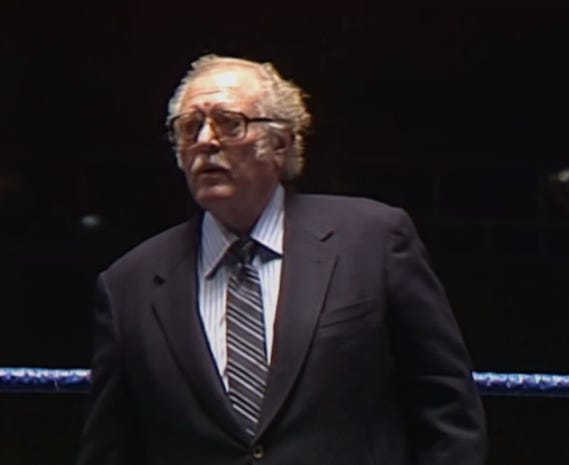
Billy Goelz 11-20-2002 at the age of 84

The Life and Career of Stanley Blackburn
Born in Amarillo, Texas, he was a lifelong resident of the city and became a prominent business and civic leader there. Blackburn served on the board of directors for the Amarillo Chamber of Commerce starting in 1956 and rose to become its president in 1960. His wrestling career spanned decades, beginning as a promoter in the Amarillo territory (part of the National Wrestling Alliance’s Western States Sports) alongside figures like Dory Funk Sr. and Doc Sarpolis. He later transitioned to national prominence as the on-air AWA President from the early 1980s until 1989, when he was replaced by Joe Blanchard. Blackburn died of natural causes in Amarillo at age 80.
Stanley Blackburn’s journey through the world of professional wrestling reflects the evolution of the industry from regional territories to national spectacles, blending behind-the-scenes promotion with on-screen authority. As a fixture in the sport for several decades, Blackburn embodied the blend of business acumen and kayfabe drama that defined mid-20th-century wrestling. His life, rooted in the dusty plains of Texas, extended far beyond the ring, encompassing civic leadership and entrepreneurial ventures, but it was his contributions to wrestling that cemented his legacy among fans and historians.
Born on December 6, 1916, in Amarillo, Texas, Stanley T. Blackburn grew up in a region that would become synonymous with rugged individualism and oil booms, influences that shaped his early worldview. As a lifelong resident of Amarillo, Blackburn immersed himself in local business and community affairs from a young age. By the 1950s, he had established himself as a respected civic leader, joining the board of directors for the Amarillo Chamber of Commerce in 1956 and ascending to its presidency in 1960. This role highlighted his organizational skills and ability to foster economic growth in the Panhandle region, qualities that would later translate seamlessly into the wrestling business. While details of his early professional life outside wrestling remain somewhat sparse, it’s clear that Blackburn’s reputation as a reliable and influential figure in Amarillo opened doors to various enterprises, including his entry into the entertainment world of pro wrestling.
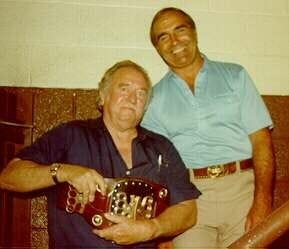
Pictured: Stanley Blackburn & Nick Kozak, Amarillo, TX
Blackburn’s foray into wrestling began in the vibrant Amarillo territory, a key outpost in the National Wrestling Alliance (NWA) system during the post-World War II era. Alongside promoters Dory Funk Sr. and Doc Sarpolis, Blackburn helped run Western States Sports, the promotion that oversaw wrestling events in the Texas Panhandle for several decades. This territory was renowned for its hard-hitting style and star-making potential, producing legends like the Funk brothers—Dory Jr. and Terry—who both captured the NWA World Heavyweight Championship while representing Amarillo. As a promoter, Blackburn handled the logistical and financial aspects of booking shows, securing venues, and managing talent in an era when wrestling was a patchwork of regional fiefdoms. His work in Amarillo not only sustained the local scene but also contributed to the NWA’s national cohesion, as territories like his fed talent and storylines into the broader alliance. This period honed Blackburn’s understanding of the industry’s inner workings, from contract negotiations to crowd-pleasing angles, setting the stage for his later high-profile role.
By the early 1980s, Blackburn’s career took a national turn when he joined the American Wrestling Association (AWA), based in Minneapolis and owned by Verne Gagne. Here, he served as the on-air president, a kayfabe authority figure who appeared on television to announce decisions, enforce rules, and advance storylines. This role made him a familiar face to fans across the Midwest and beyond, as the AWA broadcast its programming via syndication. Blackburn’s presidential persona was that of a stern, impartial arbiter—often dressed in a suit, delivering verdicts with a mix of gravitas and dramatic flair. His tenure coincided with the AWA’s peak and subsequent decline amid competition from the expanding World Wrestling Federation (WWF, now WWE).
Some of Blackburn’s most memorable moments came during high-stakes championship controversies, where his decisions fueled fan outrage and narrative tension. In 1982, after Hulk Hogan seemingly won the AWA World Heavyweight Championship from Nick Bockwinkel using a foreign object, Blackburn stripped Hogan of the title and returned it to Bockwinkel just six days later. The following year, at the AWA Super Sunday event in St. Paul, Minnesota, Blackburn again intervened in a Hogan-Bockwinkel match. Despite the no-disqualification stipulation preventing a retroactive DQ for throwing Bockwinkel over the top rope, Blackburn vacated the title and handed it back to the heel champion, further antagonizing the crowd and building Hogan’s babyface momentum. These incidents are often cited as pivotal in Hogan’s career trajectory, as his frustrations with AWA politics reportedly contributed to his jump to the WWF, where he became a global icon.
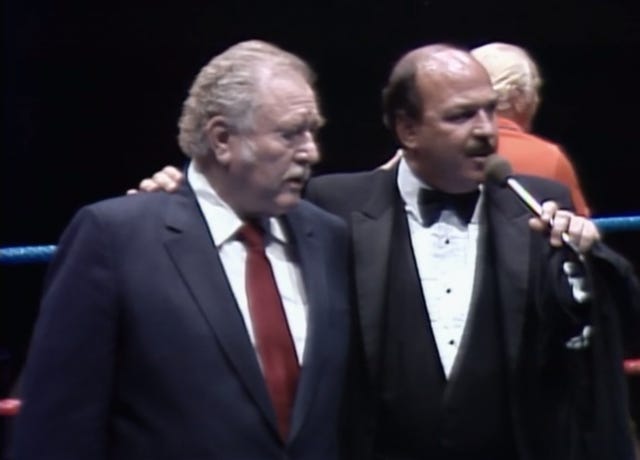
Pictured: Stanley Blackburn & Gene Okerlund, AWA Television
Blackburn’s influence extended to other title changes, such as in 1987 when he reviewed footage of Curt Hennig’s victory over Bockwinkel at SuperClash II. Despite controversy involving referee Larry Zbyszko and a roll of dimes used as a weapon, Blackburn upheld the decision, confirming Hennig as the new AWA champion. Earlier, in 1981, he awarded the AWA World Heavyweight Championship to Bockwinkel after Verne Gagne retired, maintaining continuity in the promotion’s top storyline. These actions showcased Blackburn’s role in preserving kayfabe while navigating real backstage dynamics, including talent disputes and creative directions.
Blackburn held the AWA presidency until early 1989, when he was succeeded by Joe Blanchard amid the promotion’s waning fortunes. By then, the AWA was struggling against the WWF’s national expansion and the rise of cable television wrestling. Retiring from the spotlight, Blackburn returned to his roots in Amarillo, where he continued as a respected community figure until his death on November 20, 1997, from natural causes at age 80.
50 Year Flashback
11-20-1975: The Super Destroyer defeated Terry Funk (ch) to win the NWA International Heavyweight Title at the Sports Arena in Amarillo, Texas
The NWA International Heavyweight Title, recognized primarily in the Amarillo promotion run by the Funk family, was a prestigious belt with roots in post-World War II wrestling exchanges between the U.S. and Japan. By 1975, it had become a symbol of regional dominance, often defended in brutal, no-nonsense bouts that reflected the hardscrabble ethos of West Texas. Terry Funk, the titleholder entering the match, was a homegrown hero. As the son of promoter Dory Funk Sr. and brother to former world champion Dory Jr., Terry embodied the Funk dynasty’s legacy. He had won the International Title earlier that year and was known for his fiery, resilient style— a mix of technical holds and wild brawling that endeared him to fans. At 31, Funk was on the cusp of greatness, having already toured Japan and built a reputation as a tough competitor. However, the Amarillo territory needed fresh antagonists to keep storylines alive, and The Super Destroyer provided just that.
The Super Destroyer, portrayed by the imposing Art Nelson, made his debut in Amarillo that very night. Nelson, already a seasoned veteran under his more famous Spoiler gimmick in other regions, brought a masked, mysterious aura to the ring. Towering and agile, he was the perfect foil to Funk’s scrappy underdog persona. The match itself was a classic heel vs. babyface clash, built around The Super Destroyer’s power-based offense against Funk’s tenacity. According to historical accounts, the bout culminated in The Super Destroyer applying a crushing bear hug—a simple yet devastating move that symbolized his overwhelming strength—forcing Funk to submit or be pinned. This victory was no mere upset; it was a calculated booking decision by the Funks to introduce a dominant new villain, generating heat and drawing crowds for future rematches.
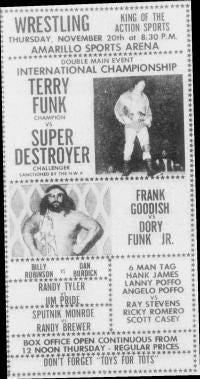
The significance of this title change extended beyond the ring. In the territorial system, where promotions traded talent to refresh rosters, The Super Destroyer’s win injected excitement into Amarillo’s scene. It positioned him as a top heel, leading to a series of defenses and feuds, including against Dory Funk Jr., who dethroned him on February 11, 1976, only for The Super Destroyer to reclaim the belt two weeks later. The finish of the match was simple but intricately planned. Funk had his back injured prior in a match with Frank Goodish, who would later become Bruiser Brody. Goodish had locked in a powerful bear hug on Funk injuring his back going into the match with The Destroyer. Destroyer lifted Funk off the mat in their match and held him aloft for minutes at a time. Terry Funk hammered away at the Destroyer’s masked face with the referee warning Terry to open his fists. Funk started losing consciousness, Destroyer lowered Funk to the mat with the ref raising Terry’s arm to check his state and Funk’s arm falling to the canvas, the referee stopped the match and gave the victory and the title to The Super Destroyer.
The next Saturday on television, Funk and commentator Steve Stack showed film of the match and commented on the strength of The Super Destroyer. Funk told the story, making no excuses. Stack pointed out the Destroyer had his foot on the top rope when he came off with a knee to Terry’s back and should have been DQ’d, but Funk simply commented that on this day The Super Destroyer was the better man, but he’d be back to face him again.
Terry Funk had been selected at the November 1st, 1975, Championship Committee Meeting in Dallas to be the next NWA World Heavyweight Champion. So various NWA promoters set about the chain events to ensure Terry drew crowds when he returned to their towns. In Jim Crockett Promotions’ Mid Atlantic Territory, Terry won the NWA United States Championship in the tournament to determine a new champion, then had Terry lose it on the Thanksgiving show to Paul Jones, setting up Jones as the number one contender in Crockett land when Terry returned with the World Title. Here in Amarillo, Terry lost the International Title to clear his waist for the World Belt but also to set up re-matches with The Super Destroyer for the World Championship when Terry came home with the title.
Thank You for Reading
I’m Tony Richards, Pro Wrestling Historian, Author and Storyteller. I share pro wrestling historical items in each issue of the Time Tunnel Pro Wrestling History Newsletter. Thanks for reading! If you enjoy my information on select events, matches and insights, please share it with folks you think might like to be a subscriber!
Remember, paid subscribers get access to exclusive and special content such as some special issues including a multi-part deep dives on wrestling territories, wrestler bios and championship title histories, special audio and video interviews on territory pro wrestling and more available in the Pro Wrestling Time Tunnel for Premium Subscribers.