


November 2nd in the Time Tunnel:
Happy Birthday to those who have passed on and to those great wrestlers still with us:
In Memoriam:
Mike Davis 1956
Archie Gouldie\Mongolian Stomper 1944
Happy Birthday:
Michael Buffer (81)
Queen Sharmell (55)
Yoshinari Ogawa (59)
Cliff Compton\Domino (46)
Frank Rosser\Darren Young 942)
Samir Singh (38)
Samil Singh (38)
Amber Nova (34)
Wes Lee (31)
RIP Memorial: We stop & remember those who have passed on this day and gave themselves to the business for us, the fans. We salute you and thank you.
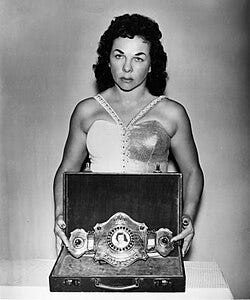
Lillian Ellison\The Fabulous Moolah 11-2-2007 at the age of 84
Significant Pro Debut
11-2-1962: Archie Gouldie (Mongolian Stomper) made his debut defeating John Dane at the Victoria Pavillion in Calgary, Alberta, Canada
Archibald Edward Gouldie, born on November 22, 1936, in Carbon, Alberta, Canada, would go on to become one of the most enduring and fearsome figures in professional wrestling, known variously as “The Stomper,” “The Mongolian Stomper,” and simply Archie Gouldie. His career spanned over three decades, marked by record-breaking title reigns, intense feuds, and a reputation for raw physicality. However, every legend has a beginning, and Gouldie’s professional debut occurred on November 2, 1962, in Calgary, Alberta, under the banner of Stampede Wrestling—a promotion that would define much of his legacy.
Stampede Wrestling, founded in 1948 by Stu Hart and based in Calgary, was a cornerstone of Canadian professional wrestling. Operating primarily in Western Canada, it was renowned for its gritty, hard-hitting matches that blended athleticism with dramatic storytelling. The promotion drew crowds to venues like the Victoria Pavilion (later known as the Stampede Corral), where fans packed the house for weekly cards featuring a mix of local talents and traveling stars. By the early 1960s, Stampede was in a transitional phase, building on its post-World War II roots and incorporating more character-driven narratives. Wrestlers like John Dane, active in Stampede from 1961 to 1962, represented the old guard—tough, no-nonsense performers who tested newcomers in the ring. Dane, whose real name remains obscure in many archives, was a mid-card staple known for his brawling style, making him an ideal opponent to introduce a fresh face like Gouldie.
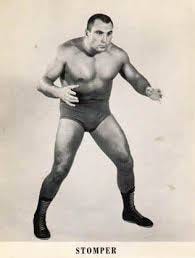
Gouldie’s path to the ring was unconventional. Hailing from a small Alberta town, he was a former bodybuilder and strongman with a physique that screamed intimidation—standing at 6’1” and weighing around 260 pounds. He trained in Stu Hart’s infamous “Dungeon,” the basement of the Hart family home in Calgary, where aspiring wrestlers endured brutal stretching sessions and submissions that weeded out the weak. Stories from the era recount Gouldie suffering a severe groin injury during one of Hart’s holds yet persevering through the pain—a testament to his toughness. This training prepared him for his debut, but as a local boy, expectations were high. On November 2, 1962, at a Stampede Wrestling event in Calgary, Gouldie stepped into the squared circle for the first time professionally. Facing John Dane, the match was reportedly a straightforward affair designed to showcase Gouldie’s power. Gouldie emerged victorious, pinning Dane after a series of stomps and body slams that would become his signature moves. Though exact details like match length or crowd size are lost to time—territorial wrestling records from the 1960s often rely on oral histories and sparse newspaper clippings—this win marked Gouldie’s entry into the business as a dominant force.
The debut’s significance extended beyond the immediate victory. In Stampede Wrestling, newcomers were often jobbed out to establish established stars, but Gouldie’s win signaled the promotion’s investment in him as a potential draw. However, his early run was not without challenges. Initially positioned as a jobber in subsequent matches, Gouldie grew frustrated with the limited opportunities and left Stampede after a short stint to seek success elsewhere. He headed south to the United States, where he reinvented himself as “The Mongolian Stomper” in promotions like NWA Kansas City, adopting a silent, monstrous heel persona managed by figures like Gorgeous George Jr. This gimmick exploded in popularity, leading to championship gold and sold-out arenas across territories from Texas to Georgia.

Pictured: Stu Hart, Ed Whalen and Archie Gouldie on Stampede Wrestling in the late 1960s
Gouldie would return to Stampede in 1967, this time as a full-time star, embracing a cowboy-themed “Archie the Stomper” character tailored to Alberta audiences. He captured the Stampede North American Heavyweight Championship a record 14 times between 1968 and 1984, feuding with legends like Billy Robinson, Abdullah the Butcher, and Harley Race. His 1962 debut laid the foundation for this success, proving his resilience and in-ring prowess. The match against Dane, while modest in scope, symbolized the raw, unforgiving nature of territorial wrestling, where local heroes like Gouldie could rise from obscurity to icon status. 1975 was a particularly good year for Gouldie as he occupied the top heel spot in the Florida Territory, The Tennessee Territory (where he held both office’s NWA Southern Heavyweight Title) and in the East Texas Dallas Territory, where he would win the NWA Texas Brass Knucks Title.
Gouldie’s journey from that night onward influenced generations of wrestlers, cementing Stampede Wrestling’s reputation as a breeding ground for talent. He passed away on January 23, 2016, but his legacy endures, a stomping reminder of wrestling’s golden territorial era.
37 Year Flashback
11-02-1998: The Original Midnight Express (Randy Rose\Dennis Condrey) stormed the WTBS Studio on Techwood Drive during a taping of Jim Crockett Promotions’ World Championship Wrestling to attack The Midnight Express with Jim Cornette
Originally formed in 1983 in Southeast Championship Wrestling as a trio consisting of Dennis Condrey, Randy Rose, and Norvell Austin, The Midnight Express evolved into one of the most iconic acts in the industry. By 1987, under the management of the sharp-tongued Jim Cornette, the team featured Bobby Eaton and Stan Lane, who achieved significant success in Jim Crockett Promotions (JCP), later rebranded as World Championship Wrestling (WCW). However, tensions arose when former members Condrey and Rose reformed as “The Original Midnight Express” under the guidance of Paul E. Dangerously (Paul Heyman), setting the stage for a heated rivalry. This feud reached a boiling point on November 2, 1988, during a taping of World Championship Wrestling at WTBS Studios in Atlanta, Georgia, when The Original Midnight Express stormed the studio to launch a brutal attack on their successors and Cornette. This incident, taped on November 2 and aired on November 5, not only marked Dangerously’s explosive debut in WCW but also ignited one of the most memorable angles in wrestling history.
To understand the significance of the November 2 invasion, one must trace the lineage and conflicts within The Midnight Express. The team’s early incarnation with Condrey, Rose, and Austin enjoyed regional success but disbanded. Condrey later paired with Eaton in Mid-South Wrestling, managed by Cornette, where they feuded intensely with teams like The Rock ‘n’ Roll Express. This version captured multiple titles, including the Mid-South Tag Team Championships, before moving to JCP/NWA in 1985. A pivotal change occurred in 1987 when Condrey departed, reportedly due to backstage issues, and was replaced by Stan Lane. The Eaton-Lane duo, still under Cornette’s management, dominated, winning the NWA United States Tag Team Titles in May 1987 and holding them for a record 12 months. They escalated their success by capturing the NWA World Tag Team Titles from Arn Anderson and Tully Blanchard on September 10, 1988, only to lose them to The Road Warriors on October 29, 1988.

Pictured: The second version of The Midnight Express with Jim Cornette (Eaton\Lane)
Meanwhile, Condrey and Rose reformed in the American Wrestling Association (AWA) as The Original Midnight Express, managed by Dangerously. They won the AWA World Tag Team Titles in October 1987 but left the promotion amid disputes in early 1988. This set the groundwork for their WCW arrival. The rivalry was personal: Dangerously, a longtime nemesis of Cornette, sought to reclaim the Midnight Express legacy. Backstage politics in WCW, including tensions with bookers like George Scott and Jim Crockett Jr., added fuel, as the company transitioned under new ownership. The stage was set for a confrontation that would blend scripted drama with real-life animosity.
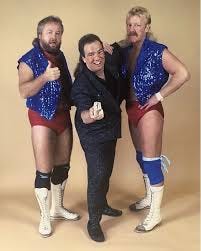
Pictured: The second version of The Original Midnight Express (Condrey\Rose) with Paul E. Dangerously
The assault unfolded during a routine taping of World Championship Wrestling, a flagship NWA program broadcast on TBS. Cornette, Eaton, and Lane were in the midst of a promo segment when Cornette received an on-air phone call from an anonymous caller. The voice ridiculed Cornette over the recent title loss to The Road Warriors, prompting Cornette to recognize it as Dangerously’s. Challenging the caller to confront him face-to-face, Cornette’s defiance was short-lived. Suddenly, The Original Midnight Express—Condrey and Rose—burst into the studio alongside Dangerously, ambushing the trio.
The attack was vicious and unscripted in its intensity. Dangerously famously struck Cornette with his oversized 1980s cellular phone, a signature prop that became legendary in wrestling lore. Eaton and Lane were overwhelmed, while Cornette was left a bloody mess after blading. Intended as a light cut, Cornette accidentally sliced too deeply, resulting in profuse bleeding that heightened the segment’s realism and turning the angle into perhaps the bloodiest angle ever airing in WTBS’ long storied wrestling history. In fact, the use of blood would be banned by Turner management in around a month’s time later due to a Dusty Rhodes “spike in the eye” angle with The Road Warriors turning heel. The invaders brutalized their targets, smashing furniture and delivering punishing blows, all while the studio audience reacted in shock. This invasion not only introduced Dangerously to WCW viewers but also symbolized a clash of eras—the “original” team reclaiming their name from the “imposters.” The segment aired on November 5, 1988, amplifying its impact and drawing widespread attention.
Video: The Original Midnight Express (Condrey\Rose) with Paul E. Dangeously (Heyman) attack The Midnight Express (Eaton\Lane) with Jim Cornette.
The studio storming propelled the rivalry into overdrive, leading to a series of high stakes matches. At Starrcade 1988: True Gritt on December 26, Cornette’s Midnight Express defeated The Original Midnight Express in a tag team bout, avenging the attack. The feud continued at Chi-Town Rumble on February 20, 1989, where Eaton, Lane, and Cornette triumphed over Dangerously’s team (now including Jack Victory after Condrey’s abrupt departure) in a “Loser Leaves the NWA” six-man tag match, forcing Randy Rose out of the promotion. The saga culminated at Great American Bash 1989 on July 23, with Cornette defeating Dangerously in a tuxedo street fight, effectively ending the angle.
Despite its potential, the feud was hampered by backstage turmoil, including booking changes incompetent corporate leadership and wrestler exits, preventing it from reaching its full narrative depth. At the same time, the November 2 invasion remains a hallmark of 1980s wrestling, showcasing the era’s blend of athletic competition and soap-opera drama. It highlighted the talents of all involved, from Cornette’s managerial prowess to Dangerously’s innovative heel tactics, influencing future storylines in WCW and beyond. The Midnight Express, in its various forms, disbanded by 1990, but this event endures as a testament to the unpredictable excitement of professional wrestling.
Thank You for Reading
I’m Tony Richards, Pro Wrestling Historian, Author and Storyteller. I share pro wrestling historical items in each issue of the Time Tunnel Pro Wrestling History Newsletter. Thanks for reading! If you enjoy my information on select events, matches and insights, please share it with folks you think might like to be a subscriber!
Remember, paid subscribers get access to exclusive and special content such as some special issues including a multi-part deep dives on wrestling territories, wrestler bios and championship title histories, special audio and video interviews on territory pro wrestling and more available in the Pro Wrestling Time Tunnel for Premium Subscribers.
My favorite Archie Gouldie story is this: When Stu Hart was wrestling and he put a guy in a submission hold he had a habit of sticking his tongue out the corner of his mouth when he was cinching up on the hold to deliver maximum pain. Lots of people have this odd habit when concentrating on a task - it's pretty common. Archie Gouldie had never really noticed Stu's tongue sticking habit as a teen watching Stu wrestle in Calgary so he certainly wasn't thinking about it early into his training with Stu in the Dungeon.
Now Stu Hart WANTED to see what kind of fight, what kind of fire, a man had in him and he would tell students "do whatever you can to get out of these holds and do it at 100% effort. The training in the Dungeon with Stu ALWAYS progressed beyond light sparring to full on shooting at 100% effort. Archie and Stu had reached this point in training one day and Stu was giving Archie the kitchen sink - all his nastiest submission holds and Archie was trying to break and counter them. At one point Stu had Archie guzzled from behind and he was cranking up the pain level to the point Archie was desperate to break the hold. He figured a good hard elbow to Stu's chin would do the trick.
Recall that I mentioned Archie hadn't really picked up on Stu's habit of sticking his tongue out when cinching up on holds. When Arch delivered a brutal elbow to Stu's Anvil-like chin Stu had half his tongue clenched outside his teeth. There was an instant shower of blood all over Archie's head, shoulders, back, and chest. Horrified at the sight of so much of Stu's blood Archie's horror instantly switched to terror and the thought of what Stu was going to do to him. As Stu got off the mat and left to examine his mouth in the mirror Archie bolted out the basement door in his trunks and barefeet and ran all the way home without stopping. All 10 miles.
Worried about injuring Stu and thinking about how much blood was shed Archie was so fearful of getting a receipt from Stu that he skipped the next five or six days of training. When he eventually did return to the Dungeon the next week it was like nothing ever happened. Stu didn't mention it and he wasn't any more vicious on the mat then usual but from that day forward Archie Gouldie was always cognizant of Stu Hart's tongue-sticking habit and he delivered no blows to Stu's face unless he could see it.