



October 30th in the Time Tunnel:
Happy Birthday to those who have passed on and to those great wrestlers still with us:
In Memoriam:
Charles Atlas 1892
Ali Pasha 1907
Danny McShain 1912
Ron Slinker 1945
Jackie Sato 1957
Happy Birthday:
George Wells (78)
Joseph D’Aquisto\Roadblock (65)
Dr. Luther (57)
Alex Porteau (56)
Adam Copeland\Edge (52)
RIP Memorial: We stop & remember those who have passed on this day and gave themselves to the business for us, the fans. We salute you and thank you.
Earl Denmore\Gypsy Joe 10-30-2002 at the age of 86

Edouard Carpentier 10-30-2010 at the age of 84
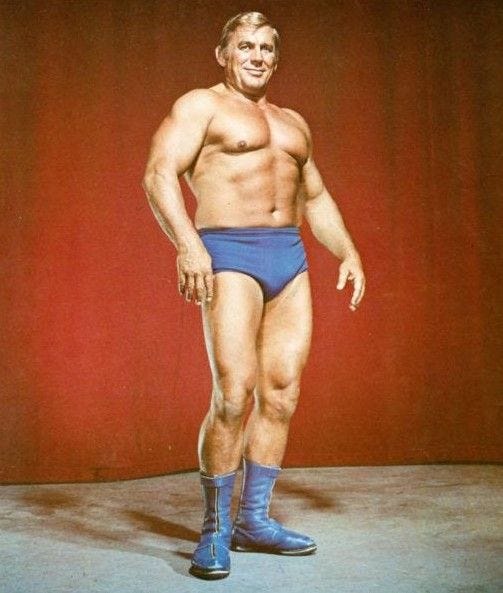
Bob Geigel 10-30-2014 at the age of 90

Victor ”Rocky” Tomayo\Joe Soto\Blue Demon #2\Blue Devil 10-30-2016 at the age of 86

Significant Pro Debut
10-30-1930 Danny McShain lost his first professional match against an unknown opponent in Little Rock, Arkansas
Danny was born Woodrow Wilson McShain on October 30, 1912, in Parkdale, Arkansas (though some sources list Little Rock as his birthplace) made his professional wrestling debut exactly on his 18th birthday, October 30, 1930. This marked the start of a storied career that spanned over three decades, during which he became a prominent figure in Southern U.S. wrestling, known for his “tough guy” persona, stiff striking style, and multiple championship wins, including ten reigns as NWA Texas Heavyweight Champion.
We don’t know the particular building location, although most matches of this period in Little Rock too place in a National Guard Armory, VFW building or Fairgrounds arena. Early 1930s wrestling in Arkansas was often promoted by independent or regional groups that were part of the freelance wrestling scene prevalent at the time. No specific opponent is recorded in wrestling databases, biographies, or newspaper archives. McShain lost the match. Contemporary accounts describe it as a quick defeat, with one source noting he “promptly lost,” implying it was a short, one-sided affair typical for a raw debutant against a more experienced grappler.
As a novice, McShain likely competed in a standard singles bout under catch-as-catch-can rules, the dominant style of the time emphasizing grappling, submissions, and amateur wrestling techniques. No details on duration, moves, or stipulations are available. The event was a low-profile local card, reflecting the carnival-circuit roots of early pro wrestling.

McShain, a 5’11”, 205-pound stocky athlete with striking good looks (often compared to Clark Gable), entered wrestling after excelling in amateur boxing and local athletics. His family moved shortly after the debut to Glendale, California, where he honed his skills. He briefly joined the U.S. Navy, winning boxing championships, before returning to full-time wrestling around 1935. By the late 1930s, he had evolved into a heel (villain) known for dirty tactics, blading (self-inflicting cuts to draw blood), and legitimate strikes—traits that may have been seeded in this humbling first outing. The lack of granular details on the opponent or match flow is common for pre-1940s wrestling, as promotions relied on word-of-mouth and local ads rather than national media. McShain’s career quickly rebounded; by 1937, he captured the National Wrestling Association’s World Light Heavyweight Championship from Wild Red Berry.
McShain is one of those legendary performers who were part of the beginnings through the early stages of the territory-era of wrestling, so when he is compared to other, more recent names, McShain usually loses the comparison. In reality, few professional wrestlers had more influence over the evolution of the sport than Danny McShain, with heavy emphasis on the Texas markets of Amarillo, Houston, Dallas and El Paso.
Danny McShain had over 5,861 professional wrestling matches, for which we have records. That is an amazing number of matches in a pro career. His last match took place on January 4th, 1969, versus John Robertson at Sam’s Sports Palace in Beaumont, Texas, making his career roughly 39 years in length.
One Thing About Pro Wrestling History
Bob Geigel spent the early part of his professional career with Doc Saprolis in Amarillo and West Texas. Geigel is a critical player during the 1950s career of Dory Funk, Sr in my biography of Dory Funk, Sr: King of the Texas Death Match. Geigel was a frequent tag team partner with Funk, Sr and had main event programs with Sputnik Monroe, Roy Shire, Ray Gunkel, Fritz Von Erich, Sir Nelson Royal and even Funk, Sr himself in a dramatic heel turn by Geigel at one point during his run. He left West Texas in 1962 to become a shareholder in Gust Karras’ office in St. Joseph, Missouri, eventually taking over as the main owner and booker in the ensuing years ahead.
Thank You for Reading
I’m Tony Richards, Pro Wrestling Historian, Author and Storyteller. I share pro wrestling historical items in each issue of the Time Tunnel Pro Wrestling History Newsletter. Thanks for reading! If you enjoy my information on select events, matches and insights, please share it with folks you think might like to be a subscriber!
Remember, paid subscribers get access to exclusive and special content such as some special issues including a multi-part deep dives on wrestling territories, wrestler bios and championship title histories, special audio and video interviews on territory pro wrestling and more available in the Pro Wrestling Time Tunnel for Premium Subscribers.