


*I made a mistake on Saturday morning, which I deeply regret. I sent out the Chronicle yesterday with Sunday the 26th’s birthdays and RIP Salute, instead of the correct ones which are reprinted in correct form below. As always, I really endeavor to get these things correct and if I make a mistake, I do try to own it and correct it.
October 25th in the Time Tunnel:
Happy Birthday to those who have passed on and to those great wrestlers still with us:
In Memoriam:
(none)
Happy Birthday:
Ata Maivia Johnson (77)
Atsushi Onita (68)
Charles Scaggs\2 Cold Scorpio (60)
Perry Satullo\Perry Saturn (59)
Rosa Mendes (46)
RIP Memorial: We stop & remember those who have passed on this day and gave themselves to the business for us, the fans. We salute you and thank you.
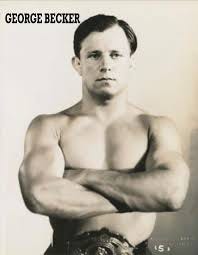
George Becker 10-25-1999 at the age of 85
The Life and Career of Troy Graham
Troy Rolland Thompson Jr., better known by his ring names Troy Graham and The Dream Machine, was born on October 26, 1949, in Memphis, Tennessee. From a young age, Thompson harbored a passion for professional wrestling, dreaming of one day stepping into the ring. His big break came when he was discovered by the charismatic manager and performer Jimmy Hart, who helped launch his career. Debuting around 1976, Thompson initially adopted the persona of Troy “The Hippie” Graham, a counterculture-inspired heel character that played into the era’s social vibes. He also wrestled under variations like Troy T. Tyler in territories such as Ron Fuller’s Knoxville promotion, honing his skills as a villainous competitor.
Thompson’s career skyrocketed in the late 1970s and early 1980s when he transformed into the masked enigma known as The Dream Machine. Managed by Jimmy Hart as part of his “First Family” stable—which included wrestlers like Kevin Sullivan, Wayne “Honky Tonk Man” Ferris, Bugsy McGraw, The Nightmares, and The Iron Sheik—The Dream Machine became a central antagonist in the explosive Memphis territory run by promoters Jerry Jarrett and Jerry Lawler. A clever angle saw Graham impersonate Dusty Rhodes (using a near-perfect vocal mimicry) to deceive fans and fuel a heated feud with “The King” Jerry Lawler, positioning him as a mysterious invader out to dethrone the local hero. This storyline, one of the most memorable in Continental Wrestling Association (CWA) history, elevated both Graham and Hart to stardom.
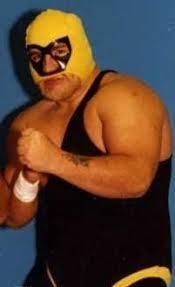
Pictured: Troy Graham as The Dream Machine
As The Dream Machine, Graham was a technical brawler with a flair for dramatic entrances and psychological warfare. He unmasked during a high-profile match against Lawler, revealing his identity and shifting dynamics in the territory.
Graham’s masked run yielded significant accolades in the Southern wrestling scene. On August 16, 1981, he won the vacant AWA Southern Heavyweight Championship by defeating Steve Keirn in the finals of a one-night tournament, with promoter Eddie Marlin officially presenting the title to him and Hart on television. He also teamed up for tag team success, capturing the AWA Southern Tag Team Championship four times: twice with Bill Dundee (including a infamous “Mask vs. Titles” match against Masa Fuchi and Atsushi Onita on April 6, 1981) and twice with Porkchop Cash (notably in no-disqualification bouts against teams like Dutch Mantel & Koko B. Ware and the Rock ‘n’ Roll Express in 1983).
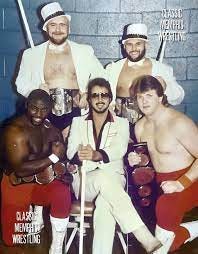
Pictured: Graham in Jimmy Hart’s First Family as one of the New York Dolls
Post-unmasking, Graham continued to thrive in Memphis. He formed the flamboyant tag team The New York Dolls with Rick McGraw, engaging in a legendary rivalry with the high-flying Fabulous Ones (Steve Keirn and Stan Lane). Later, as one-half of The Bruise Brothers with Porkchop Cash, he added grit to his resume before being replaced by Maddog Boyd in late 1984, prompting his departure from the territory. Graham also held the NWA Southeastern Television Championship in 1980 by defeating Dutch Mantel.
His promos were legendary—charismatic, quotable, and often laced with humor—earning him a reputation as one of the best talkers in the business, rivaling the likes of Dusty Rhodes in delivery. After a period away from the spotlight, Graham returned to the Memphis scene in the 1990s with the United States Wrestling Association (USWA). On June 6, 1994, he won a battle royal by last-eliminating Brian Christopher, earning a shot at the Unified World Heavyweight Championship. Shockingly, he dethroned Christopher for the title, holding it briefly before dropping it in July. This led to further matches against Christopher and his father, Jerry Lawler, showcasing Graham’s enduring draw.
Tragically, Troy Graham’s life was cut short on March 7, 2002, when he suffered a fatal heart attack at his home in Memphis at the age of 52. He was survived by his seven-year-old daughter, Charlie Sue, as well as his mother and great-grandmother. Graham’s contributions to Southern wrestling—particularly in Memphis—remain celebrated for their creativity and intensity, influencing generations of performers with his versatility, mic work, and unyielding commitment to the “dream” he chased since childhood. Fans and peers alike remember him as a true original, forever etched in the annals of territory wrestling history.
One Thing I Learned Today About Pro Wrestling History
Kevin Sullivan broke into the wrestling business without any formal training, transitioning straight from amateur wrestling in the Boston area to his debut professional match in Montreal around 1970, where he quickly defeated veteran Fernand Frechette—then adopted the ring name “Johnny West” to win his first championship, the NWA Gulf Coast Tag Team titles, just a year later.
Thank You for Reading
I’m Tony Richards, Pro Wrestling Historian, Author and Storyteller. I share pro wrestling historical items in each issue of the Time Tunnel Pro Wrestling History Newsletter. Thanks for reading! If you enjoy my information on select events, matches and insights, please share it with folks you think might like to be a subscriber!
Remember, paid subscribers get access to exclusive and special content such as some special issues including a multi-part deep dives on wrestling territories, wrestler bios and championship title histories, special audio and video interviews on territory pro wrestling and more available in the Pro Wrestling Time Tunnel for Premium Subscribers.