


October 19th in the Time Tunnel:
Happy Birthday to those who have passed on and to those great wrestlers still with us:
In Memoriam:
Tor Johnson 1903
Pat O’Hara 1919
Pedro Godoy 1920
Boyd Pierce 1928
Black Angus Campbell 1934
Peter Thornley\Kendo Nagasaki 1941
Richard Wilson\The Renegade 1965
Happy Birthday:
Julia Bevis\Seet Saraya (54)
Rick Boogs (38)
Toni Storm (30)
RIP Memorial: We stop & remember those who have passed on this day and gave themselves to the business for us, the fans. We salute you and thank you.
Mike Hegstrand\Road Warrior Hawk 10-19-2003 at the age of 46

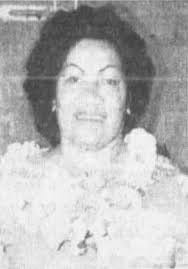
Lia Miavia 10-19-2008 at the age of 81
Mike Graham 10-19-2012 at the age of 61

The Life and Career of Lia Miavia
Ofelia “Lia” Maivia (née Fuataga) was born on August 6, 1931, in Lalomanu, Aleipata, Samoa, to parents Aulaumea Sanitoa Aulaumea and Talaleu Soesa Fuataga. Although some reports after her death suggested she was born in 1927, her headstone confirms 1931, and she was 77 at the time of her passing. She grew up in Samoa before eventually becoming involved in the world of professional wrestling through her marriage.
Pro Wrestling Wife
Maivia’s first marriage was to Sione Papali’i Fitisemanu, with whom she had a daughter, Mataniu Feagaimaleata “Ata” Fitisemanu. In 1953, she married Samoan professional wrestler “High Chief” Peter Maivia, who adopted Ata and changed her last name to Maivia. The couple had a passionate relationship, described by their daughter Ata as “wonderful and crazy and full of passion.” Peter and Lia had three children in total. Ata later married wrestler Rocky Johnson, and they had a son, Dwayne “The Rock” Johnson, making Lia his grandmother.

Early in Peter’s wrestling career, Lia was unaware of the scripted nature of the matches. In one notable incident in the early 1960s in London, England, she jumped into the ring with a stiletto heel to attack an opponent she believed was genuinely harming her husband, causing injuries and making headlines the next day. As Ata recalled, “My father was so protective of the business that for the first few years he even protected it from my mom and I. Hence during a match in London, England during the early sixties, my mom jumped in the ring, her stiletto heel in hand, to beat the pulp out of the guy that was beating my dad.” Another story from wrestler Superstar Billy Graham highlighted her toughness: “And he and his wife, Lia — The Rock’s grandmother, who could fight like a man — once got into a crazy brawl with a bunch of drunks in a bar directly across the street from the Cow Palace.”
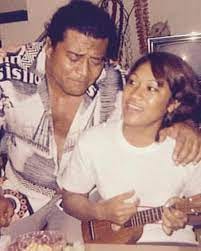
Pictured: Peter Miavia and daughter Ata
The Maivia family was part of the larger Anoa’i wrestling dynasty, which produced numerous WWE Superstars, including Roman Reigns, Yokozuna, Rikishi, Jimmy Uso, and Jey Uso. Lia’s life was later depicted in the TV series Young Rock, where she was portrayed by Ana Tuisila. She also had an uncredited role as herself in a 1982 episode of Magnum, P.I. titled “Mr. White Death.”
Pro Wrestling Promoter
Peter Maivia began promoting wrestling in Hawaii after acquiring the territory rights from Steve Rickard in 1980, following Ed Francis’s departure from the business. He ran weekly shows until his death from cancer in June 1982. Following his passing, Lia took over the promotion, renaming it Polynesian Pro Wrestling (PPW), a National Wrestling Alliance (NWA) territory in Hawaii. She became one of the few female promoters in professional wrestling history, active from 1982 until the promotion’s closure in 1988.
Lia was described as a “strong-willed businesswoman, demanding and challenging of her employees.” In the mid-1980s, PPW aired shows on the Financial News Network. Her most successful event was A Hot Summer Night on August 3, 1985, at Aloha Stadium, drawing nearly 20,000 fans. It featured top stars like Ric Flair, Andre the Giant, Dusty Rhodes, Antonio Inoki, and Bruiser Brody, and was the first-time major promoters worldwide collaborated, sending talent in memory of Peter Maivia. Ata reflected on the event: “On this show, it was the first time in wrestling history that all the big-time promoters from around the world, worked together and sent their biggest talents to make this show happen. It was also in memory of my dad.”
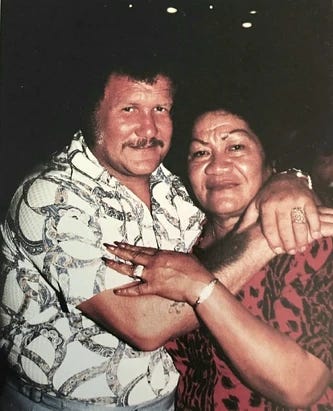
Pictured: Lia Miavia and Harley Race
The follow-up event, A Hot Summer Night II in 1986, underperformed, contributing to the promotion’s decline amid the rise of the WWF (now WWE) and challenges for regional territories. Despite hardships, including financial struggles in what The Rock called a “hippyesque lifestyle,” Lia kept the business running as per her husband’s dying wish. Her efforts helped sustain wrestling in Hawaii, though the family never achieved a sellout at the Blaisdell Arena during her tenure—a dream later fulfilled by her grandson in 2002.
Life and Business Challenges
In late 1989, at age 57, Lia, along with booker Lars Anderson (Larry Heiniemi) and partner Ati So’O, faced extortion charges for allegedly threatening a competing Hawaiian promoter, John R. “Dunbar” Wakayama, and demanding $5,000. The incident was captured on an FBI wiretap, but after a nearly six-week trial, a jury acquitted them in November 1989. Following the verdict, Maivia stated, “I love the jury. God knows I’m a lady innocent.”
After PPW closed in 1988, Lia moved to Florida to be near her daughter Ata. She remained a beloved figure in wrestling circles, known for her kindness; journalist Bill Apter recalled her buying a stuffed rabbit for his daughter at a wrestling event. Lia died of a heart attack at her home in Davie, Florida, on October 19, 2008, at age 77. Her funeral coincided with Ata’s 60th birthday, leading Ata to say in her eulogy, “You brought me into this world 60 years ago, and you leave me on the day.” The Anoa’i family established the “Lia Maivia Scholarship” in her honor.
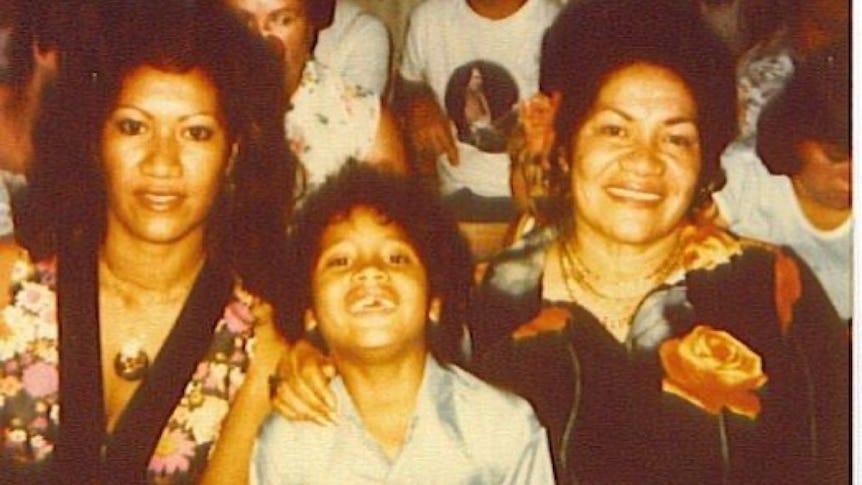
Pictured: Lia Miavia, Ata Johnson and Dwayne Johnson
In April 2024, Lia was posthumously inducted into the WWE Hall of Fame Class of 2024 by her grandson The Rock, recognizing her as a trailblazing female promoter and matriarch of the Anoa’i family. Her legacy endures through her family’s dominance in wrestling and her role in breaking barriers for women in the industry.
60 Year Flashback
10-19-1965: Len Rossi & Jackie Fargo defeated Tojo Yamamoto & Tor Kamata (ch) in a Texas Tornado Death Match for the NWA Southern Tag Team Championship at the Fairgrounds Arena in Nashville, Tennessee
This was a rematch following an earlier title change on October 2, 1965, where Yamamoto and Kamata had captured the belts from Rossi and Fargo in Nashville. This event took place during a period of frequent title swaps in the NWA Mid-America territory, promoted by Nick Gulas and Roy Welch. The card drew 5,983 paid in attendance for the show.
The two most popular babyfaces in the Tennessee Territory during the 1960s, Len Rossi and Jackie Fargo reclaimed the NWA Southern Tag Team Championship by defeating the formidable heel duo of Tojo Yamamoto and Tor Kamata, marking a pivotal moment in Southern wrestling history that underscored themes of resilience, cultural clashes, and the enduring appeal of good versus evil storytelling.
No only was this one of the hottest programs of the year of 1965 for Welch and Gulas across the territory but especially in Nashville, where two weeks prior they had moved into the new remodeled Tennessee Faairgrounds Arena in Music City, USA.
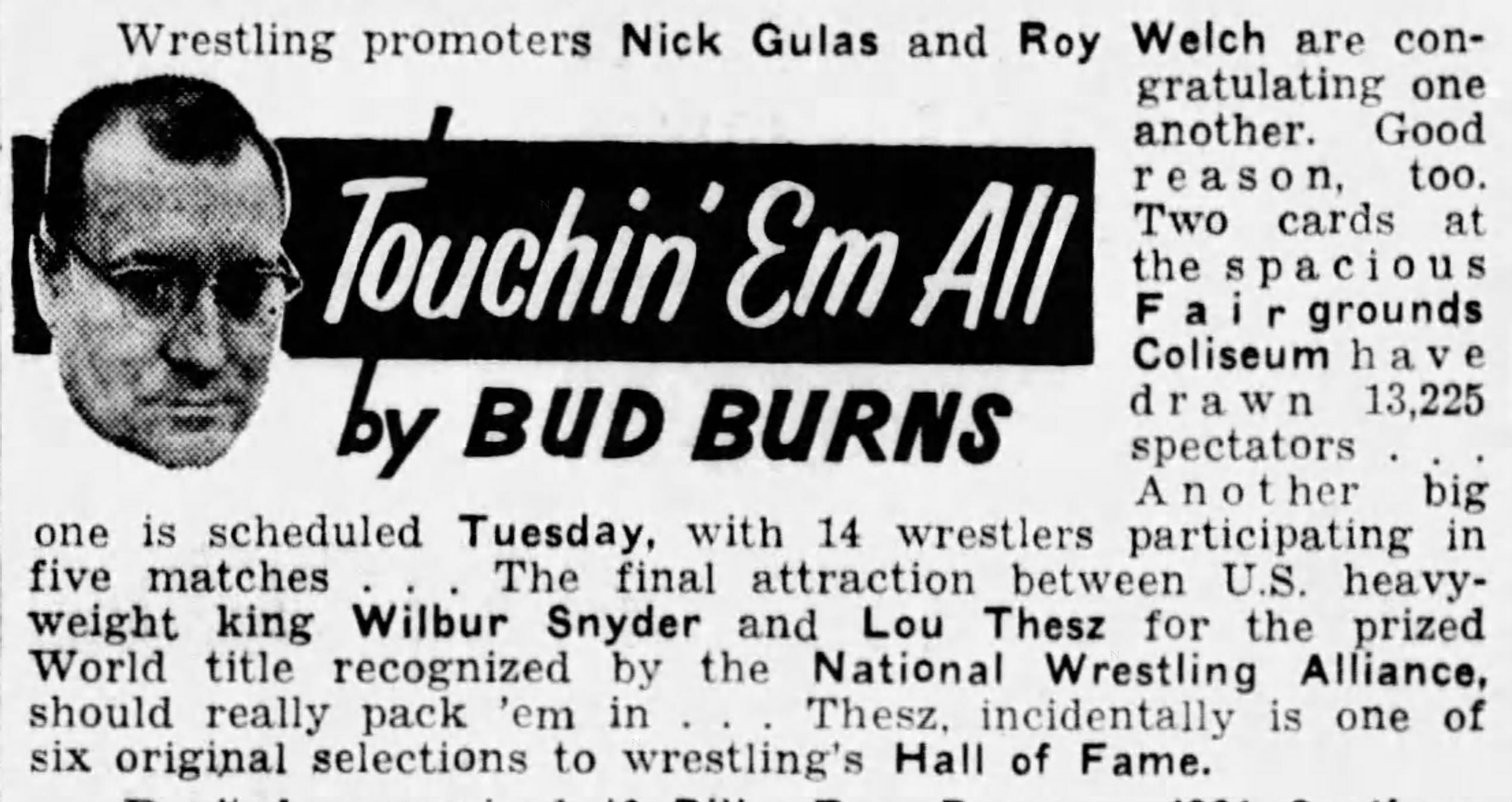
Pictured: October 17th, 1965: The Tennesseean, Nashville, Tennessee
To understand the significance of this match, one must first appreciate the backgrounds of the wrestlers involved. Len Rossi, born Rinaldo Leonard Rositani in 1929, was a quintessential babyface of the era—a hardworking, no-nonsense competitor who embodied the American dream. Starting his career in the late 1950s after a stint in the military, Rossi quickly rose through the ranks in NWA territories, known for his technical prowess, stamina, and ability to connect with audiences. By 1965, he had already secured multiple tag team titles, including reigns with partners like Tex Riley and Mario Milano, and was a staple in Mid-America, where his Italian heritage and everyman persona made him a relatable hero.
His partnership with Jackie Fargo, however, elevated him to new heights. Fargo, born Henry Faggart in 1930, was a charismatic firebrand whose “Fargo Strut” and wild brawling style made him one of the most electrifying performers in the South. Often teaming with his “brother” Don Fargo earlier in his career, Jackie had transitioned into a solo and tag team star, holding the NWA World Tag Team Championship (Mid-America version) multiple times. Together, Rossi and Fargo formed a dynamic duo: Rossi’s mat-based grappling complemented Fargo’s high-energy antics, creating a team that fans rallied behind as defenders of honor against foreign menaces.
On the opposing side stood Tojo Yamamoto and Tor Kamata, a pair of Japanese heels whose gimmicks played into post-World War II stereotypes, evoking Pearl Harbor-era animosities to generate intense heat from crowds. Yamamoto, born Harold Watanabe in 1927, was a Marine Corps veteran and judo expert who adopted the “Tojo” moniker—a nod to Japan’s wartime prime minister—to become one of wrestling’s most despised villains. In Mid-America, he was promoted as “the most hated wrestler of all time,” infamous for his wooden shoes (which he wielded as weapons), and nerve holds like “The Claw.”
By 1965, Yamamoto had already amassed an impressive resume, holding the Southern Tag Team title over 20 times with various partners, including Alex Perez and Mitsu Hirai. His alliance with Tor Kamata, born McRonald Kamaka in 1937, added a layer of brute force. Kamata, a Hawaiian powerhouse known for his massive frame and stiff chops, had debuted in the early 1960s and quickly became a go-to heel in tag scenarios. Their team represented the “Oriental” threat—a common trope in 1960s wrestling—designed to provoke patriotic outrage and pack arenas.
The buildup to the October 19 match was rooted in a heated rivalry that had simmered throughout 1965. Earlier that year, the Southern Tag Team titles changed hands frequently, reflecting the territory’s fast-paced booking. In July, Yamamoto and Perez captured the belts from Irish Mike Clancy and Frankie Cain in Nashville. By September 10, Rossi and Fargo dethroned them in Jonesboro, Arkansas, igniting a feud centered on national pride and revenge. The tension peaked on October 2 in Nashville, when Yamamoto, now paired with the imposing Kamata, ambushed Rossi and Fargo to win the titles in a controversial bout filled with underhanded tactics like eye rakes and illegal double-teams. This loss stung the babyfaces, who demanded a rematch, setting the stage for the October 19 showdown. Promotional hype painted it as a battle for American supremacy, with Rossi and Fargo vowing to “send the invaders packing” amid cheers from the partisan Tennessee crowd.
The match itself was a classic example of 1960s tag team wrestling: a best-of-three-falls affair that blended technical exchanges with chaotic brawling. Reports from the era describe a hard-hitting contest where Yamamoto and Kamata dominated early, using their “foreign” maneuvers—chops, salt throws (a Yamamoto signature), and submission holds—to wear down their opponents. Rossi, ever the resilient technician, absorbed punishment before tagging in Fargo, whose fiery comebacks ignited the audience. The turning point came in the decisive third fall, where Fargo’s signature strut distracted Kamata, allowing Rossi to lock in a sleeper hold for the pin. The victory sent the Nashville crowd into a frenzy, solidifying Rossi and Fargo as territorial icons. Here’s a first hand account of how the finish went down in the match.
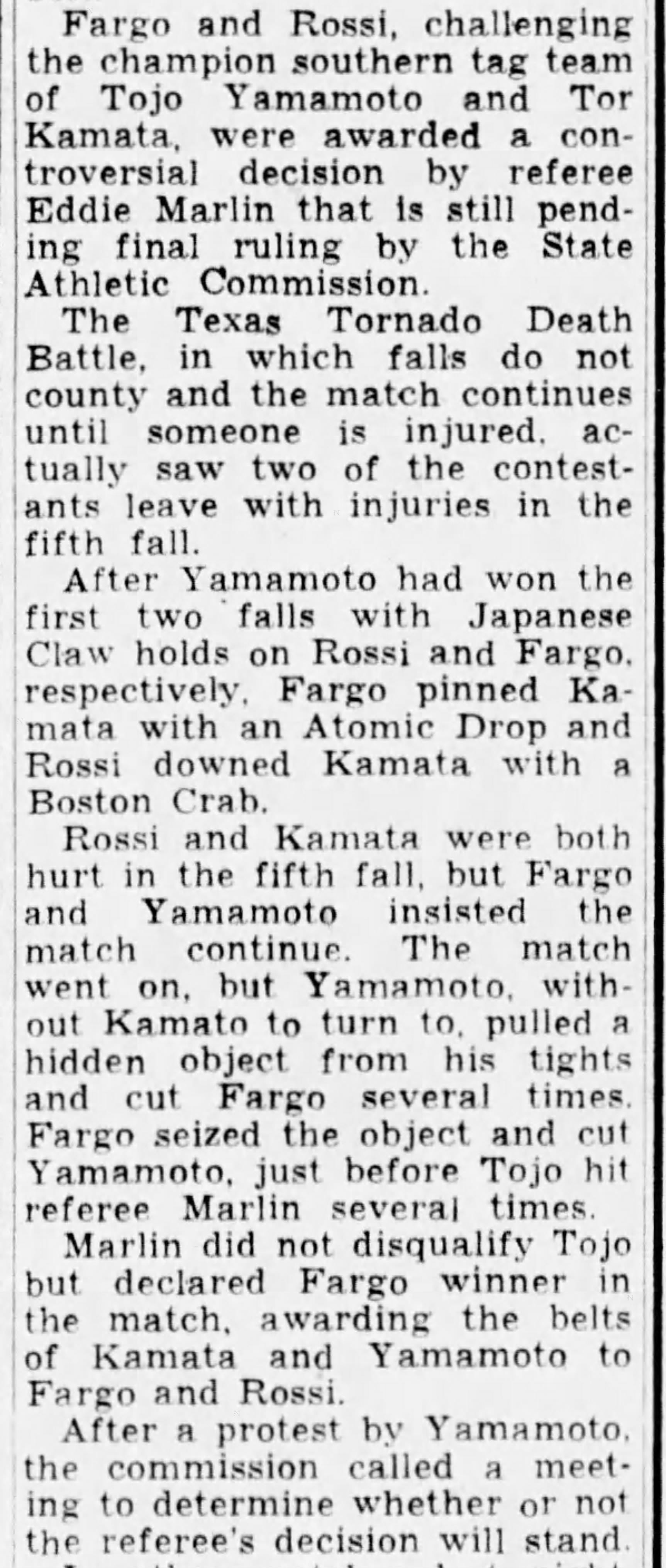
Pictured: October 20th, 1965: The Tennessean, Nashville, Tennessee
This win marked their second joint reign with the Southern Tag Team titles, though it was short-lived; they lost the belts to The Mysterious Masked Medics on November 25 in Chattanooga In retrospect, the October 19, 1965, triumph of Len Rossi and Jackie Fargo over Tojo Yamamoto and Tor Kamata stands as a microcosm of wrestling’s golden age: a time when regional territory promotions thrived on personal rivalries, crowd engagement, and larger-than-life characters. It wasn’t just a title change; it was a narrative of redemption that resonated with audiences, ensuring these wrestlers’ places in the annals of the sport.
Thank You for Reading
I’m Tony Richards, Pro Wrestling Historian, Author and Storyteller. I share pro wrestling historical items in each issue of the Time Tunnel Pro Wrestling History Newsletter. Thanks for reading! If you enjoy my information on select events, matches and insights, please share it with folks you think might like to be a subscriber!
Remember, paid subscribers get access to exclusive and special content such as some special issues including a multi-part deep dives on wrestling territories, wrestler bios and championship title histories, special audio and video interviews on territory pro wrestling and more available in the Pro Wrestling Time Tunnel for Premium Subscribers.