


October 3rd in the Time Tunnel:
Happy Birthday to those who have passed on and to those great wrestlers still with us:
In Memoriam:
Daisy Mae 1929
Don Fargo 1930
Bob Armstrong 1939
Happy Birthday:
Darryl Peterson\Maxx Payne (64)
Danny Basham (48)
John Morrison (46)
Julius Creed (31)
RIP Memorial: We stop & remember those who have passed on this day and gave themselves to the business for us, the fans. We salute you and thank you.
Rod Fenton 10-3-1976 at the age of 63

Klondike Bill 10-3-2000 at the age of 68
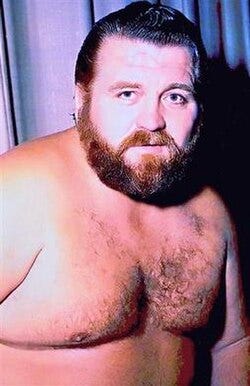
Lance Russell 10-3-2017 at the age of 91
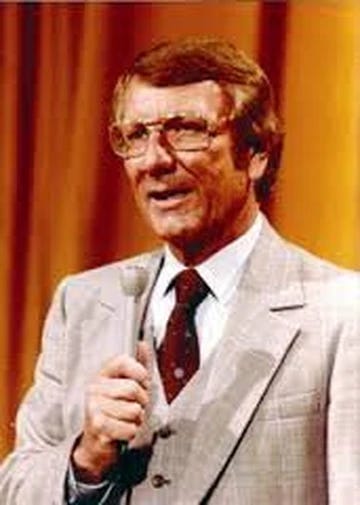
RIP Tribute to Klondike Bill
Klondike Bill, born William “Bill” Soloweyko on December 1, 1931, in Calgary, Alberta, Canada, grew up in a region known for its rugged outdoor culture, which later influenced his wrestling persona.
He was an accomplished amateur wrestler in Alberta during the 1950s, competing successfully before deciding to turn professional in the late years of that decade. Standing at 6 feet tall and weighing around 365 pounds, Soloweyko had a barrel-chested, imposing physique that made him a natural fit for the squared circle. He was trained by the legendary Stu Hart in the infamous “Dungeon” training facility in Calgary, where Hart pushed him hard due to his natural toughness—Hart once recalled that he “had to make him a wrestler” because Soloweyko was so resilient.

Pictured: Klondike Bill as “The Brute” in Calgary, Alberta, Canada 1950s
He began his professional career in Stu Hart’s Stampede Wrestling promotion in Calgary, adopting various ring names early on, including Bill “The Brute” Soloweyko (when clean-shaven) and eventually Klondike Bill (with his signature beard), along with aliases like Kodiak Bear and Brute Soloweyko. His gimmick often portrayed him as a lumberjack strongman from the Yukon, complete with a bearhug as his signature move, which helped him stand out in an era of colorful characters. From the late 1950s through the mid-1970s, he became a journeyman wrestler, traveling extensively and competing in various National Wrestling Alliance (NWA) territories across North America and beyond.
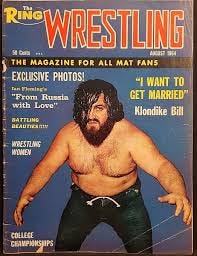
Pictured: Klondike Bill, The Ring Wrestling Magazine, August 1964
He achieved his greatest success in Canada and the Mid-Atlantic region, but also wrestled internationally, including in Japan with the Japan Wrestling Association (JWA) and briefly in the World Wide Wrestling Federation (WWWF) in 1964. Klondike Bill was known for his tag team work, partnering with stars like Whipper Billy Watson, Skull Murphy, Nelson Royal, Luke Brown, and Ron Etchison.
Notable feuds included matches against tough opponents like Bulldog Brower and Gene Kiniski, whom he considered his toughest rivals.
In his peak years, he earned $30,000–$35,000 annually while working 14–18 days a month, which he described as “big bucks” for the time, and he prioritized bookings based on pay rather than location
Outside the ring, Klondike Bill gained fame for a legendary eating feat in the 1960s: he was the only person to consume two 72-ounce steaks (along with all accompaniments) within one hour at the Big Texan Steak Ranch in Amarillo, Texas. Many veteran wrestlers from the times remembered him fondly for his humor and camaraderie; for instance, Gino Brito recalled funny backstage moments in Detroit, and Ernie “The Big Cat” Ladd shared stories of their massive breakfasts together, like eating dozens of eggs. Klondike held many NWA championships In Maple Leaf Wrestling, Florida, Central States, Hawaii, Georgia, Texas, Oklahoma and Japan along with tag team championships with Luke Brown, Nelson Royal, Skull Murphy and Whipper Billy Watson.

Pictured: Klondike Bill at The Big Texan in Amarillo, Texas
By the mid-1970s, Klondike Bill shifted from full-time wrestling to backstage work. He was hired by promoter Jim Crockett to build guard rails and construct rings for Mid-Atlantic Championship Wrestling. He drove the ring truck and ran the set-up crews in the various towns as well as the oversight of gimmicks like the Scaffold Match set-ups, WarGames and Tower of Doom cage construction and assembly. Bill also had some responsibilities at the baseball park when the Crocketts owned the minor league baseball team in Charlotte. After Ted Turner acquired the promotion in 1988, turning it into World Championship Wrestling (WCW), Bill became a road agent, handling logistics like hauling rings and setting up events. In the late 1990s, he appeared on WCW Nitro in a humorous storyline where a demoted Eric Bischoff (in kayfabe) was forced to set up the ring under Bill’s supervision, showcasing his enduring presence in the industry. Colleagues like Gerry Brisco praised him as one of the “greatest individuals” in wrestling for his operational contributions and character.
Klondike Bill passed away on October 3, 2000, at the age of 68, from a neuromuscular disorder similar to Bell’s Palsy, which had progressively affected his speech and mobility in his final months. He was survived by his wife Adrienne, daughter Thayne Brigman, son-in-law Thayne Brigman, and grandson Christopher. Funeral services were held on October 5, 2000, in Pineville, North Carolina, with memorials directed to hospice and ALS organizations. Though not a mainstream superstar, Klondike Bill left a lasting legacy as a tough, reliable performer and backstage figure in Canadian and American wrestling. Fans and peers remembered him for his humor, resilience, and contributions over more than 40 years, with tributes like a “Klondike We Miss You” sign at a WCW event underscoring his impact on those who knew him.
One Thing I Learned Today About Pro Wrestling History
Rod Fenton’s wrestling career began in the early 1930s in North America, where he competed in regions like Texas, Ohio, and the Pacific Northwest. He was celebrated for his mastery of the drop-kick, a move that was innovative and crowd-pleasing at the time, allowing him to surprise larger opponents. by the mid-1930s, he was billed as the “middleweight champ of Canada” and wrestled professionally for about 18 years. He was best known in the business for owning the booking office in Tucson, Arizona during the 1950s.
Thank You for Reading
I’m Tony Richards, Pro Wrestling Historian, Author and Storyteller. I share pro wrestling historical items in each issue of the Time Tunnel Pro Wrestling History Newsletter. Thanks for reading! If you enjoy my information on select events, matches and insights, please share it with folks you think might like to be a subscriber!
Remember, paid subscribers get access to exclusive and special content such as some special issues including a multi-part deep dives on wrestling territories, wrestler bios and championship title histories, special audio and video interviews on territory pro wrestling and more available in the Pro Wrestling Time Tunnel for Premium Subscribers.