


September 20th in the Time Tunnel:
Happy Birthday to those who have passed on and to those great wrestlers still with us:
In Memoriam:
Abe Coleman 1905
Nell Stewart 1927
Red McKim 1930
Pepper Martin 1936
Don Gaston\Don Carson 1934
Steve Ketcher\Steve Gatorwolf 1957
Happy Birthday:
Tony Garea (79)
Greg Valentine (74)
Marty Lunde\Arn Anderson (67)
Scott Hudson (61)
RIP Memorial: We stop & remember those who have passed on this day and gave themselves to the business for us, the fans. We salute you and thank you.
Handsome Johnny Barend 9-20-2001 at the age of 82
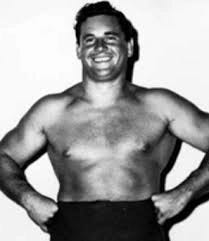
Angelo Savoldi 9-20-2013 at the age of 99
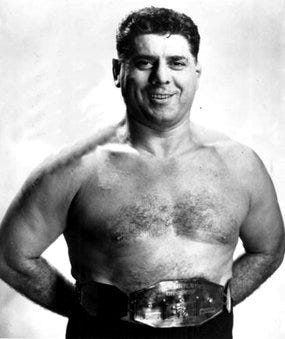
Rikki Starr 9-20-2014 at the age of 83

Luis Martinez 9-20-2013 at the age of 90
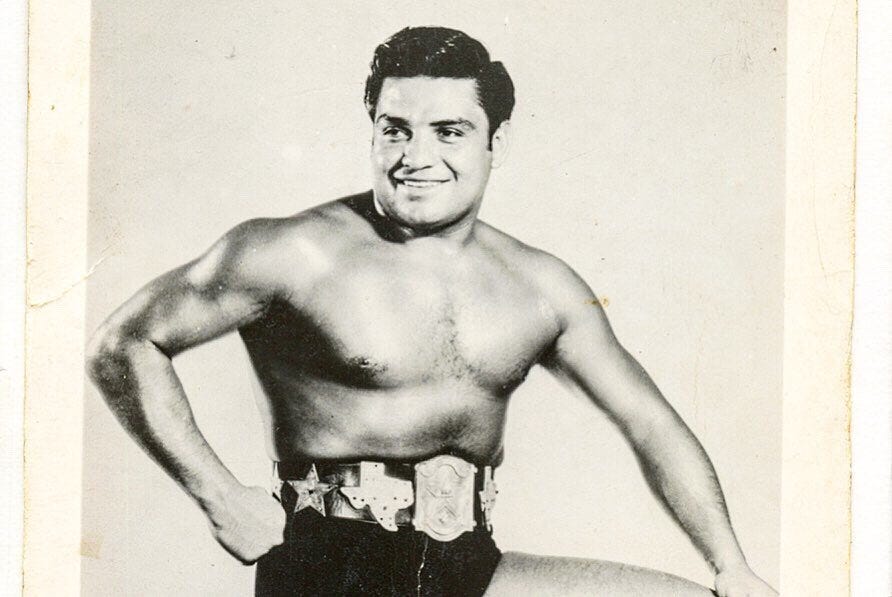
Carolyn Eschere\Marie LaVeau 9-20-2017 at the age of 65
(no photo available)
Significant Debut
9-20-1969: Animal Hamaguchi has his first professional match against Kiyokichi Hongo losing by DQ at the Takahashi City Gymnasium in Takahashi, Japan
Heigo Hamaguchi, better known by his ring name Animal Hamaguchi, was born on August 31, 1947, in Hamada, Shimane Prefecture, Japan. Before entering professional wrestling, Hamaguchi was deeply involved in bodybuilding, starting at the age of 17 in 1964. He competed in various contests and achieved notable success, including a runner-up finish at the Mr. Hyogo bodybuilding competition in 1969. This performance caught the attention of scouts from the International Wrestling Enterprise, a prominent Japanese wrestling promotion at the time that emphasized strong-style wrestling with roots in amateur wrestling. Hamaguchi, who had long harbored an interest in professional wrestling, was scouted shortly after the contest and joined IWE in August 1969.
Due to his impressive physique and athletic background, he underwent a brief but intensive training period—lasting just one month—under the promotion's representatives, including Isamu Yoshiwara, who valued wrestlers with amateur wrestling foundations. At the time, IWE was one of Japan's major promotions, founded in 1966 by former Japan Pro Wrestling executives, focusing on international talent and hardcore matches. Hamaguchi, then 22 years old, was fast-tracked to debut as part of the promotion's push to build new homegrown talent.
Kiyokichi Hongo was a veteran IWE wrestler known for his technical skills and role in breaking in rookies. Hongō was an established midcard talent with experience in tag teams and singles competition. As a complete novice with minimal ring time, Hamaguchi struggled to control his aggression. In the heat of the moment, he resorted to illegal tactics—likely excessive roughness or a blatant foul—leading to the referee's decision in Hongō's favor. This outcome highlighted his raw power but lack of experience, as he later reflected on being "clueless" and fighting instinctively without strategy.
Hamaguchi's early career in IWE solidified his reputation as a tough, reliable performer, eventually leading to stints in New Japan Pro-Wrestling (NJPW) and All Japan Pro Wrestling (AJPW). He retired in 1995 after a storied career, later becoming a trainer and gym owner. Animal Hamaguchi was one of my personal favorites in Japanese wrestling history.
60 Year Flashback:
9-20-1965: Crazy Luke Graham defeated Toyonbori by DQ two falls to one fall to unify the Los Angeles & Japanese WWA Heavyweight Titles at the Grand Olympic Auditorium in Los Angeles, California
The Worldwide Wrestling Associates (WWA) was a prominent professional wrestling promotion based in Los Angeles, California, operating primarily in the 1950s and 1960s as a territorial entity somewhat independent from the National Wrestling Alliance (NWA). The WWA World Heavyweight Championship was established on June 14, 1957, when Édouard Carpentier was recognized as the inaugural champion in Los Angeles. This title originated as an offshoot of the NWA World Heavyweight Championship during a period of controversy in the wrestling world, where regional promotions sometimes recognized their own "world" champions amid disputes over legitimate title reigns. The WWA promotion (initially known as the North American Wrestling Alliance before rebranding in 1961) used this championship to headline events at venues like the Grand Olympic Auditorium.
By 1963, the WWA title had effectively split into two versions due to international disputes and differing recognitions. The "American" version was controlled by the Los Angeles-based WWA under promoter Ed LaRue (also known as Johnny Doyle), while the "Japanese" or "International" version was recognized by the Japan Wrestling Association (JWA), a key partner in bringing Japanese talent to U.S. cards. This split arose from ongoing territorial and promotional rivalries, exacerbated by wrestlers like The Destroyer (Dick Beyer) and Giant Baba touring between the U.S. and Japan, leading to conflicting title claims. Toyonobori (real name Michiharu Toyonobori), a former sumo wrestler turned pro who had become a star in Japan after Rikidōzan's death in 1963, held the JWA-recognized version of the title. He had won it on December 12, 1964, by defeating The Destroyer in a JWA event, but this reign was not acknowledged by the American WWA. Meanwhile, Luke Graham (real name James Grady Johnson, often billed as "Crazy" Luke Graham), a wild, brawling American heel known for his unpredictable style, had captured the American WWA title earlier in 1965 and defended it in Los Angeles shows.
The split created a need for unification to resolve the "true world champion" debate, especially as WWA events frequently featured Japanese wrestlers to draw crowds. This tension built through 1965, with cross-promotional matches setting the stage for a decisive showdown. The unification match took place on Monday, September 20, 1965, at the Grand Olympic Auditorium in Los Angeles, California, as the main event of a non-televised card promoted by the WWA. It pitted Luke Graham (American WWA World Heavyweight Champion) against Toyonobori (JWA-recognized WWA World Heavyweight Champion) in a best two-out-of-three falls match to unify the divided titles. The bout was billed as ending the long-standing controversy over the legitimate world champion.
Prior to this, on September 8, 1965 (some sources note September 7 or 9 in nearby Bakersfield, CA), Toyonobori had defeated Graham via disqualification in a non-title match. It was announced in the arena that this victory unified the titles under Toyonobori, but the WWA promotion overruled it, stating that championships could not change hands on a DQ. This led to the quick booking of the rematch just 12 days later. The event drew an attendance of 9,768 fans, a solid house for a Monday night show at the 10,400-seat auditorium.
Luke Graham defeated Toyonobori in the 2/3 falls match to unify the WWA World Heavyweight Championship. Graham held the unified title until losing it to Pedro Morales on February 21, 1966. This victory solidified Graham's status as a top heel in the territory, while Toyonobori returned to Japan to focus on JWA leadership and promotion.
50 Year Flashback
9-20-1975: New Japan Pro Wrestling becomes a member of the National Wrestling Alliance
New Japan Pro-Wrestling (NJPW) was established on January 13, 1972, by legendary wrestler Antonio Inoki following a major schism in the Japanese professional wrestling landscape. Prior to this, the Japan Pro Wrestling Alliance (JWA), founded in 1953 and affiliated with the National Wrestling Alliance (NWA) since 1953, had been the dominant force in puroresu (Japanese professional wrestling). However, internal power struggles and creative differences led to the departure of key figures. Giant Baba, a star of JWA, founded All Japan Pro Wrestling (AJPW) in October 1972 and quickly secured NWA membership in 1973, which provided AJPW with international legitimacy, access to NWA championships, and talent exchanges with American promotions.NJPW, in contrast, started as a smaller operation under Inoki's leadership, focusing on a strong-style wrestling approach influenced by catch wrestling and martial arts.
To compete with AJPW and elevate its status, NJPW pursued NWA affiliation. The NWA, formed in 1948 as a cartel of independent wrestling territories, served as a governing body that sanctioned world championships and enforced territorial boundaries. Joining the NWA was a strategic move for international credibility, allowing NJPW to recognize and defend NWA titles, host cross-promotional events, and attract global talent. A key motivation was gaining control over the NWA World Junior Heavyweight Championship, which NJPW aimed to integrate into its own junior division, but the broader goal was challenging for the prestigious NWA World Heavyweight Championship to position Inoki as a world-class contender.
On September 20, 1975, NJPW officially became the 18th member promotion of the NWA during a board meeting, marking a pivotal expansion of the alliance into Japan beyond AJPW. This made NJPW and AJPW the two primary Japanese members, though their rivalry intensified competition within the NWA framework. The affiliation was approved after negotiations highlighting NJPW's growing fanbase and Inoki's star power. Unlike AJPW's smoother integration, NJPW's entry was seen as a counterbalance, with the NWA recognizing the need for multiple Japanese territories to avoid monopoly. But a key element of the acceptance by Baba for New Japan to be admitted, was that no New Japan Pro Wrestling member or associate would have a vote in the World Championship Committee's decisions.
NJPW defended and recognized several NWA-sanctioned titles, including the NWA World Junior Heavyweight Championship (which became a cornerstone of their junior heavyweight division) and the NWA World Heavyweight Championship. This opened doors for American wrestlers to tour Japan under NJPW banners, boosting event attendance. The membership lasted until 1985, when NJPW withdrew amid tensions over NWA politics and a desire for independent branding, though it briefly rejoined in 1992–1993 and later periods.
NJPW's NWA membership was transformative, propelling it from an upstart promotion to Japan's leading wrestling entity by the late 1970s. It provided financial stability through larger gates from title matches and international tours, while fostering the "strong style" that defined NJPW. The alliance helped Inoki solidify his status as a national hero and laid the groundwork for NJPW's future innovations, like the IWGP (International Wrestling Grand Prix) in 1987. However, the rivalry with AJPW sometimes strained NWA unity, as both promotions vied for dominance in title defenses. Overall, this era marked the globalization of puroresu and NJPW's enduring legacy as a powerhouse promotion.
9-20-1975: Dick The Bruiser & The Crusher defeated Sgt Goulet & Pvt. LeBeouf to win the WWA World Tag Team Championship at the Indian State Fairgrounds Coliseum in Indianapolis, Indiana
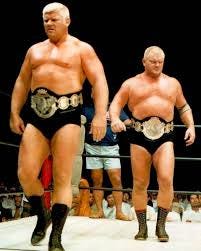
Pictured: Dick The Bruiser & The Crusher, WWA World Tag Team Champions
The World Wrestling Association (WWA) was a prominent professional wrestling promotion based in Indianapolis, Indiana, founded in 1964 by wrestlers Dick the Bruiser (William Afflis) and Wilbur Snyder. They purchased the local NWA territory from promoter Jim Barnett and rebranded it as the WWA, operating under the parent company Championship Wrestling of Indiana. The promotion was closely affiliated with Verne Gagne's American Wrestling Association (AWA), sharing talent and recognizing each other's championships. The WWA ran shows primarily in the Midwest, with Indianapolis as its hub, often at venues like the Indiana State Fairgrounds Coliseum. It was known for its hard-hitting, territorial-style wrestling and helped launch or feature stars like Bobby Heenan, Scott Steiner, and The Great Wojo. By 1975, the monthly big show was a combined card in Chicago with both WWA and AWA talent showcased for fans.
The WWA World Tag Team Championship, established in 1964, was the promotion's premier tag team title. It was defended regularly in main events and changed hands numerous times among regional and national talent. By the mid-1970s, the belts symbolized intense rivalries between fan-favorite babyfaces and ruthless heel teams, often with military or foreign gimmicks to draw heat from crowds.
The Legionnaires were a villainous tag team gimmick portraying a pair of brutal, authoritarian soldiers from a fictional "Foreign Legion." The team debuted in the WWA in 1974 as heels designed to embody a "reign of terror," using dirty tactics, interference, and military-themed personas to antagonize audiences. Sgt. Jacques Goulet was the ring name of Canadian wrestler Robert René Goulet (better known as René Goulet in other promotions like WWF/WWE). A veteran with a background in Montreal's wrestling scene, he played the stern, commanding leader of the duo, often barking orders and using power moves. Soldier Zarinoff LeBeouf was the gimmick of Pierre Lefebvre, a Quebec native who wrestled under various personas (including Lumberjack Pierre and later Igor Volkoff). Standing around 6'0" and 255 lbs, LeBeouf was the enforcer, known for his brawling style and ability to sell the military shtick with a thick accent.
Originally, the Legionnaires consisted of Goulet and Pvt. Don Fargo. They won the WWA World Tag Team Titles on September 21, 1974, in Indianapolis, defeating fan favorites Pepper Gomez and Wilbur Snyder in a high-profile match. Fargo left the team in early 1975, and LeBeouf replaced him, adopting the "Zarinoff" moniker to sound more exotic and menacing. The new iteration of the Legionnaires captured the titles in April 1975 (exact date unconfirmed in records but listed as a WWA house show). Their roughly five-month reign was marked by defenses against top teams, cheating to retain the belts, and building heat through storylines of oppression and dominance in the territory. They were positioned as unstoppable heels, feuding with WWA staples like Gomez, Snyder, and Moose Cholak.
By 1975, Bruiser and Crusher were multiple-time WWA tag champions (this would be their 10th and 5th reigns, respectively) and beloved heroes. They often headlined shows as the promotion's top draws, feuding with foreign heels to rally crowds. Earlier in 1975, they had won the AWA World Tag Team Titles (defeating Nick Bockwinkel & Ray Stevens on August 16), showcasing their dominance across territories. Their challenge to the Legionnaires was a natural storyline: the rowdy, all-American brawlers vs. the disciplined, cheating soldiers.
Bruiser and Crusher defeated the Legionnaires to win the titles. This ended the Legionnaires' reign after approximately five months (from April 1975). They would hold the belts for 175 days, defending them until losing to Ox Baker and Baron von Raschke on March 13, 1976.
One Thing I Learned Today About Pro Wrestling History
Johnny Barend was a Navy veteran and weight-lifting champion. He was known in the ring for his airplane spin and flying head scissors moves. He held the NWA world Tag Team Title in San Francisco with Enrique Torres in July of 1955.
Thank You for Reading
I'm Tony Richards, Pro Wrestling Historian, Author and Storyteller. I share pro wrestling historical items in each issue of the Time Tunnel Pro Wrestling History Newsletter. Thanks for reading! If you enjoy my information on select events, matches and insights, please share it with folks you think might like to be a subscriber!
Remember, paid subscribers get access to exclusive and special content such as some special issues including a multi-part deep dives on wrestling territories, wrestler bios and championship title histories, special audio and video interviews on territory pro wrestling and more available in the Pro Wrestling Time Tunnel for Premium Subscribers.