


April 28 in the Tunnel:
Happy Birthday to those who have passed on and to those great wrestlers still with us:
In Memoriam:
Ray Fabiani 1890
Brother Jonathan 1904
Glen Detton 1921
Billy Joe Travis 1961
Happy Birthday:
The Great Kojika (83)
RIP Memorial: We stop & remember those who have passed on this day and gave themselves to the business for us, the fans. We salute you and thank you.
Lou Thesz 4-28-2002 at the age of 86

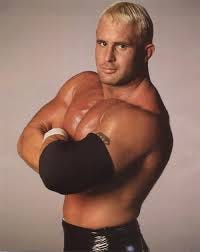
Chris Candido 4-28-2005 at the age of 33
Paul Perschmann\Buddy Rose 4-28-2009 at the age of 56

Ashura Hara 4-28-2015 at the age of 68

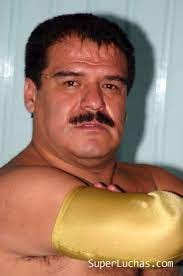
Brazo de Oro 4-28-2017 at the age of 57
Select Time Tunnel Pro Wrestling Match Flashbacks:
Special Television Retrospective Flashbacks for Jim Crockett Promotions
60-Year Flashback 4-28-1965: Television Broadcast Day in the Carolinas
*Tony Note: Jim Crockett Promotions for years, in the studio wrestling days had Wednesdays as television days in the schedule. On this day in history, one was at WRAL-TV in Raleigh, North Carolina and one was at WBTV in Charlotte. The Carolinas were noted for their tag teams, on this day in Raleigh, George Becker & Johnny Weaver, The Blond Bombers (Swede Hanson & Rip Hawk) and Aldo Bogni & Brono Lubich all appeared. There were four matches on the show in Raleigh and the 4th featured the team of Mike Clancy and Nick Kozak. Four matches, four tag teams. On the show in Charlotte, Brute Bernard & Skull Murphy were featured against Clancy & Kozak, so Clancy & Kozak made a double shot for TV that day. The Charlotte show had two singles matches for three total on the broadcast. There was also another popular babyface team in the territory at the time, the brother George and Sandy, the Flying Scotts, who would both have an amazing impact on the Crockett markets for years to come.
In the early 1950s, due to the success of Fred Kohler and the Dumont Network coming out of Chicago, the National Wrestling Alliance put together a "television committee" to keep up with and advise on happenings regarding wrestling and television. When Jim Barnett developed the first studio television wrestling program, mainly due to innovation born out of a problem, the word spread throughout the booking offices more than likely due to this television committee in the Alliance, who probably provided a report to the membership at an annual meeting about what Barnett and Johnny Doyle were doing. They were not members of the NWA at the time, and were, for all intents and purposes, spreading out nationally, so their every move was important information to the NWA offices. No doubt, Crockett Sr was paying attention and secured deals at local stations for his programs in Charlotte in 1958 on WBTV Channel 3 and in Raleigh on WRAL Channel 5 in 1959
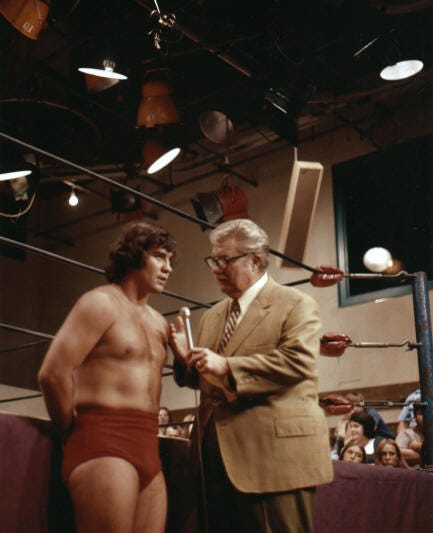
Pictured: Big Big Ward and Jerry Brisco at the WBTV Studios in Charlotte, NC
In what would become another trend for local professional wrestling programming, the host for the Charlotte show was WBTV sports personality, Big Bill Ward and in 1965, when today's flashback show aired, it was on at 7pm Saturday evenings. In Raliegh at WRAL, their sportscaster, Nick Pond was tapped to host the show with local promoter, Joe Murnick for the Raleigh show. Meanwhile, during the show, one desk over, Bob Caudle called the action for a taped program that was sent out to other markets Jim Crockett ran that didn't have their own broadcast wrestling show. Pond and Caudle were both popular sports and weather guys on WRAL-TV. Sound familiar long time Memphis wrestling fans? WRAL's Championship Wrestling show aired on 630pm Saturday nights.
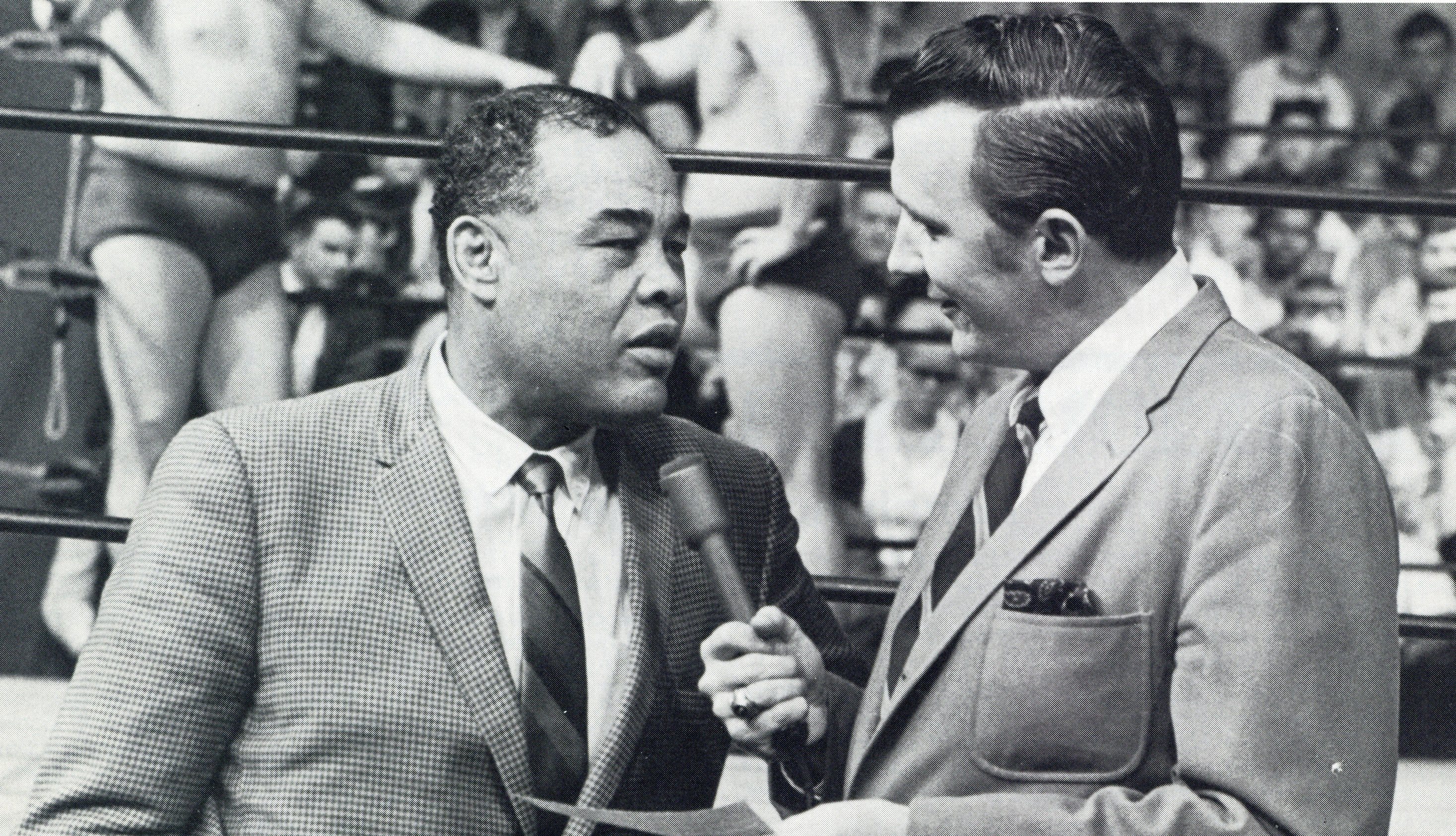
Pictured: Nick Pond interviewing Joe Lewis on WRAL-TV’s Championship Wrestling in Raleigh, NC
There was also another show in High Point, North Carolina on WGHP, Channel 8, which had debuted in February of 1964 and covered the markets of Lexington, Winston-Salem and the huge market of Greensboro, it also aired at 6:30pm on Saturday evenings. The tape of the High Point show was seen in Asheville, North Carolina on Saturday nights on WLOS channel 13. The High Point show as also hosted by a sports legend, Charlie Harville. The High Point shows were taped on the second floor of the Sheraton Hotel in a very small studio and the tapings for High Point in 1965 were on Tuesdays, again with the shows airing on Saturdays. The interesting thing about the High Point recording the day before (4-27-1965) was not only did it feature Becker & Weaver and Hanson & Hawk in separate tag matches but also a match which had The Alaskan & The Beast defeating Emile Dupre & Rudy Kay. On one team was The Beast, which was Yvon Cormier, and on the other was Rudy Kay, Yvon's shoot brother, Jean-Louis Cormier.
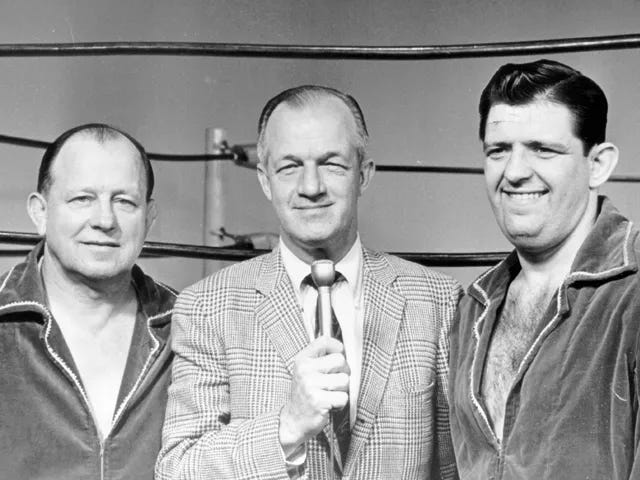
Pictured: Charlie Harville with George Becker and Johnny Weaver on WGHP-TV’s Championship Wrestling in High Point, NC
The first actual Crockett television studio show was in June of 1956 at WFBC Channel 4 in Greenville, South Carolina and it was called "Carolina Wrestling", the show lasting only three months, ending in September before fully returning in 1960. The Raleigh tape replaced the locally produced Greenville show in late 1961. There was also a locally produced show in Columbia, South Carolina at WNOK Channel 19 for a year from 1962 to 1963, before one of the taped shows replaced it. Finally, last but certainly not least, there was a live studio show at WBBJ Channel 7 in Roanoke, Virginia for most of the 1960s on Saturday afternoons at 5pm before the live event later that night at the Starland Arena. This local studio wrestling show was cancelled in 1966 after Eakins used a racial slur toward Lindsey. WBBJ's management said if Eakins did not apologize the next week on the show, they would throw the show off the air. Eakins came out and instead of apologizing, he used the slur again and that was the last wrestling show ever on WBBJ-TV. Around six months later, the tape of the Raleigh show was placed in the market with Bob Caudle's play by play on WSLS-TV 10.
The Jim Crockett Championship Sports Television Network was very similar, but not quite as geographically challenging for the wrestlers in the 1960s as the Gulas-Welch Tennessee Territory but changed greatly when it was reduced to three recorded studio shows and then tapes distributed by bus to all the other towns.
50-Year Flashback 4-28-1975: Ken Patera defeated Ric Flair at the Park Center in Charlotte, North Carolina
*Tony Note: After meeting each other in 1971 in Minneapolis, Minnesota and then moving in to become roommates together while Patera was training for the Pan American games, Flair and Patera were constant party guys. Flair taught Patera the art of chasing girls and drinking and Patera taught Flair powerlifiting to build up his body. It was also through Patera that Flair was introduced to Verne Gagne, who had befriended Ken because of his love of Olympic and amateur athletes. Patera convinces Gagne to give Flair a chance to be trained by Gagne's camp. Flair had many times where he wanted to quit early on, but between Patera and Gagne, they kept encouraging him to keep going. Flair and Patera worked for Verne in the AWA for two years before Flair left for Charlotte, where booker George Scott took a chance on him and paired him up with veteran Rip Hawk after Hawk split with his longtime partner Swede Hanson who turned face to feud with Hawk.
A couple of the things George Scott and John Ringley decided to do in 1974 was to eliminate all the studio television tapings except the one at WRAL-TV in Raleigh on Wednesday nights. The two also decided to coin the wrestling territory “Mid-Atlantic Championship Wrestling” with a distinctive regional brand on television and marketing to replace the generic “Championship Wrestling” labels. This coincided with a change in direction away from tag teams as the focus and toward singles stars such as Johnny Valentine, Super Destroyer (Don Jardine) Wahoo McDaniel, Paul Jones, Sonny King and young, new stars like Tiger Conway, Jr and Ric Flair. The first change up in this "on top" crew was in 1975, with Conway leaving for Florida, Patera coming in to replace him on the babyface side and Blackjack Mulligan arriving from Texas on the heel side to replace the soon departing Destroyer. Conway was beaten by Flair for the NWA Mid-Atlantic Television Championship on his way out opening the beginning of this program between Flair and Patera. Even though they had known and worked out together for three years before this, they had never worked a match together.
Patera, being the Olympic power-lifting strong man, typically threw Flair around the ring from pillar to post, with Flair just beginning to show the bump-taking proficiency that he would perfect in just a few years. Paters would usually win the match, but not the title, by overpowering and outmuscling Flair, either pinning him in a non-title match, or Flair getting DQ's using some tactic to survive Patera's strength onslaughts.
50-Year Flashback: 4-28-1975: Blackjack Mulligan defeated Wahoo McDaniel by DQ at the Park Center in Charlotte, North Carolina
*Tony Note: One thing George Scott was very good at doing from 1973 through his run as the matchmaker for Crockett is once he had his 3 to 4 top singles stars for each side of the ledger, he was masterful at mixing and matching them in various matches and programs, often going back to the previous strength of the territory and putting 4 of his 8 top singles in tag matches, then letting parts of the singles storylines play out during the tag match, often giving fans a look at a coming program between two stars. As I mentioned, one of the fresh new programs was the top babyface, Wahoo McDaniel paired up with the fresh new heel, Blackjack Mulligan. Two rough, tough Texans from oil patch towns, McDaniel from Midland and Mulligan (Bob Windham) from Odessa basically fought and beat the daylights out of each other, but not in quick, short rowdy matches, these were longer, prolonged heat matches. Wahoo had been fighting with Jonny Valentine and Super Destroyer for five years, first in Texas, now here in the Carolinas and he needed a new foe. Mulligan more than fit the bill.
In the 1980s, especially in the Carolinas and in Florida, these two would be formidable tag team partners, but here in the Spring of 1975, they were big time rivals and main event money for Jim Crockett Promotions. The other thing is, if you watch some of the old house show footage available from the period for each man, they both had a lot of mobility in the ring, much like a Terry Gordy, than what you would become accustomed to seeing from them in the 1980s. Being from Texas, they both worked snug in the ring, fists being thrown just a degree short of aa "potato" in the ring and both men enjoying every minutes of working that way with each other. Think of a Ric Flair and Ron Garvin type match.
40-Year Flashback 4-28-1985: Ole (CH) & Arn Anderson defeated Thunderbolt Patterson (CH) & Manny Fernandez for the NWA National Tag Team Championships at the old Charlotte Coliseum in Charlotte, North Carolina
*Tony Note: Interestingly enough, this match in the 1980s today is directly connected to another major evolution in Jim Crockett Promotions television evolution. I had been sitting in the house I had rented on Black Saturday in 1984 when I had switched over to WTBSS in Atlanta on my cable system in Paducah, KY to see Georgia Championship Wrestling. Growing up, we didn't have cable television on our farm, so I didn't get regular exposure to WTBS or cable for that matter I moved away to college in the Fall of 1981. However, my best friend in High School (one of which was the two best friends I had in H.S. who were my regular companions to ICW matches in Kentucky and Jaarrett Wrestling in Evansville, IN), his parents had a second house in Paducah, where we would go on Saturday nights to watch wrestling on TBS. So, when I got this house in Paducah in '84, I was primed to see it every weekend. Well, on Black Saturday, it was the WWF until about four weeks earlier in our Flashback timeline on the first weekend of April 1985, when the Crockett Show appeared.
At the time, I didn't know about the deal between Jim Crockett, Jr and Vince McMahon, Jr to buy the TBS Saturday night time slot, but I was a super happy man when I turned on the channel to find Dusty Rhodes, Ole Anderson and a few others I knew back on TBS. Oh, I should mention that Championship Wrestling from Georgia, which was Ole Anderson's show had been available on Saturday morning, so I was aware that Ole was doing color commentary with Gordon Solie and he and Thunderbolt Patterson were the NWA National Tag Team Champions, so I noticed there was a growing split brewing on interviews between Anderson and Patterson. It had to do with a newcomer on the scene, Ole Anderson's "nephew", Arn Anderson, who was beating prelim wrestlers convincingly and roughly. Arn also began to have issues with babyface, "Raging Bull" Manny Fernandez. Fernandez was also featured in early openings of the TBS show wearing his black ring jacket attire with "Raging Bull" in shiny rhinestones on the back. All through April, they build this split between Ole and Patterson until the split happens, but what shall we do about the tag team titles with each man having one of the belts? A "winner gets the championship" tag match between Ole and his "nephew" against Thunderbolt and Raging Bull.
The match was scheduled in the home base arena for Crockett Promotions, Charlotte, North Carolina. To me, as a fan living in Western Kentucky, this immediately established this show I was watching as a national wrestling show. They were pushing matches in the Carolinas, Virginia, Ohio, Georgia and so on, so while they were still somewhat regional, they appeared National to me, which I'm sure was the intent. Booker Dusty Rhodes was pulling the strings and pushing the buttons to build this powerhouse and with this finish in Charlotte, he now had a revival of a tag team known on Georgia television since the 1960s, the Andersons as tag team champions. I was excited as a fan at the time, and it kicked off the beginnings of my love for Jim Crockett Promotions in the 1980s, which I will very much love sharing with you as we proceed.
40-Year Flashback 4-28-1985: Tully Blanchard defeated Dusty Rhodes (CH) for the NWA World Television Championship at the old Charlotte Coliseum in Charlotte, North Carolina
*Tony Note: Not having been exposed to Mid-Atlantic wrestling in my fandom, not being an Observer reader until the next year of 1986 and with only occasional cross-promotional matches being shown on WTBS' Georgia show, I didn't realize how historic it was that the match highlights I was watching of this title change from the old Charlotte Coliseum was. The Charlotte Coliseum had been the site of so many classic matches and title changes on Mid-Atlantic television, but now this match finish was being shown on a national outlet. Blanchard had been the long time NWA Mid-Atlantic Television Title holder for most of 1984, having a long program over the belt with Ricky Steamboat, culminating with a sixty-minute match at Starrcade 1984 in November. This led to a program with Rhodes. Dusty beat Tully for the title in March of '85 right before the tapings for the WTBS premiere started.

One of the changes Jim Crockett Jr and Rhodes made with getting the time slot with Turner Broadcasting as to change the name of the Mid-Atlantic title to the World Television Championship with shiny new red and silver plates on a black leather belt. The side plates had all the national networks and logos on it. It was a new, impressive World title with a new, prestigious trophy revolving around two of the best talkers in pro wrestling history. Blanchard doesn't get near the credit as a single wrestling heel that he should. He got the TV screen hot with his interviews, which he did accompanied by his "Perfect 10" valet "Baby Doll". The match, for its time compared with what had been on WTBS with the WWF, was fast-paced and action packed with a lot of heat spots on Rhodes, and Rhodes having plenty of chances to have retained the title after a referee bump by the great Tommy Young. Rhodes had Blanchard covered twice with the roaring Charlotte crowd "counting 10". Rhodes is checking on Young, trying to help him u, when Blanchard hits Rhodes in the back of the neck for a flip. Young counts Rhodes down for the pin with his foot on the ropes behind Young's back to win the World Television Championship kicking advancing the story and kicking this program off on the Superstation that would run all through the Summer of 1985.
One Thing I Learned Today About Pro Wrestling History:
On why Ricky Steamboat never worked as a heel: Steamboat has said that while he was in the WWF in the mid-1980s that he approached Pat Patterson about turning heel because he had never done it, and he had thought about every person he knew or had heard of in the business, and they all had at least some kind of heel run. Patterson gave Steamboat feedback on the idea and was brutally honest about it. He said, "Ricky, we have to deal with the intangibles in this business and to stretch those intangibles to be successful. If you went out there and beat up somebody with the evillest approach, the people will still cheer for you. We have to work with that, not work against it. If you ever leave this company and go somewhere else, don't ever try to do it. Don't ever try to work heel, it won't work, here or anywhere else".1 Steamboat said he never forgot that and never considered it again.
Thank You for Reading
I'm Tony Richards, Pro Wrestling Historian, Author and Storyteller. I share pro wrestling historical items in each issue of the Time Tunnel Pro Wrestling History Newsletter. Thanks for reading! If you enjoy my information on select events, matches and insights, please share it with folks you think might like to be a subscriber!
Remember, paid subscribers get access to exclusive and special content such as to commemorate his induction to the WWE Hall of Fame, I'll be publishing some special issues including a multi-part career retrospective on Dory Funk, Sr, Soon a multi-part flashback on Georgia Championship Wrestling in May 1975 including all the recorded cards for the month, some special audio and video interviews and more.
Title Match Network: Ricky Steamboat video shoot interview