


Written and Produced by Tony Richards
Profile 7: Ray Morgan
Ray Morgan, born Raymond Storrs Morgan, was a prominent American radio and television announcer whose career spanned over three decades, leaving an indelible mark on both broadcasting and professional wrestling. Best known as the voice behind Capitol Wrestling Corporation’s televised events—the precursor to the modern WWE—Morgan embodied the golden era of mid-20th-century media personalities. His smooth delivery, warm demeanor, and deep involvement in sports commentary made him a household name, particularly in the Washington, D.C., area. From humble beginnings in radio during the late 1930s to becoming a key figure in wrestling’s early television boom, Morgan’s journey reflects the evolution of American media during a time of rapid technological and cultural change. His contributions extended beyond the microphone, influencing how sports entertainment was presented to audiences worldwide.
Raymond Storrs Morgan was born on May 5, 1914, in Trenton, New Jersey, to Dr. Walter Morgan and his wife. He spent his formative years in Oak Park, Illinois, before pursuing higher education at Dartmouth College, where he graduated in 1935. Morgan’s early ambitions were not initially set on broadcasting; he briefly considered a career in law but was deterred by the economic hardships of the Great Depression. Instead, he entered the workforce with McGraw-Hill, a publishing company, gaining valuable experience in communication and media. On June 26, 1937, he married Ruie Rideout in Englewood, New Jersey, in a ceremony officiated by his father. This personal milestone marked the beginning of a stable family life that would support his burgeoning professional endeavors. Alternative accounts suggest he was raised in Libertytown, Maryland, and began dabbling in radio as early as 1933 at WETL in Philadelphia, working unpaid for six months to hone his skills.
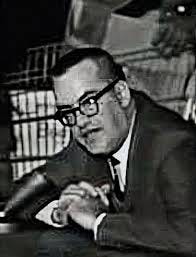
Morgan’s formal entry into broadcasting came in 1939 when he joined WPG in Atlantic City, New Jersey, as a radio announcer. He quickly advanced, serving as chief announcer and sports director until the station’s closure in 1940. This role laid the foundation for his expertise in live commentary, particularly in sports. He then moved to WCOP in Boston, followed by stints at WBAB in Atlantic City and WINX in Washington, D.C., by 1941. During World War II, Morgan contributed to the war effort through the United States Office of War Information, producing broadcasts that informed and uplifted the public. Post-war, he returned to Washington, joining WWDC where he hosted the daily program Open House from 10 to 11 a.m. until 1947.
At WWDC, Morgan’s talents shone in sports broadcasting. He became the secondary announcer for the Washington Senators baseball team alongside Arch McDonald, providing play-by-play commentary that captivated listeners. His national radio appearances included popular shows like Gang Busters, Counterspy, When a Girl Marries, and We the People, where his versatile voice handled everything from dramatic narratives to public affairs discussions. By the late 1940s, Morgan had established himself as a reliable and engaging broadcaster, blending journalistic integrity with entertainment value.
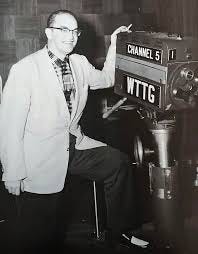
The advent of television in the post-war era opened new doors for Morgan. From 1948 to 1949, he announced for CBS’s The Roar of the Rails, a promotional program for American Flyer toy trains that combined education and advertising. He also hosted NBC’s I’d Like to See, an interactive show where viewers requested content, which later inspired DuMont’s You Asked for It. Between 1951 and 1952, Morgan fronted American Inventory, an educational NBC series produced in collaboration with the Alfred P. Sloan Foundation, featuring panel discussions styled as a “living newspaper” to address contemporary issues.
His television credits extended to announcing for high-profile programs such as Toast of the Town (later The Ed Sullivan Show), Studio One, Kraft Music Hall, Robert Montgomery Presents, and The Ted Mack Amateur Hour. Morgan even dabbled in acting, appearing as the announcer on The Magic Clown and in minor roles in films and serials like The Lawless Rider (1954) as Scar, Two Gals and a Guy (1951) as a television announcer, Desperadoes of the West (1950) as Townsman #3, and The James Brothers of Missouri (1949) as a driver. He narrated the short film ABC Pinup (1945) and appeared in the TV movie A Christmas Carol (1947) as the nephew and narrator. These diverse roles showcased his adaptability, bridging radio’s intimacy with television’s visual spectacle.
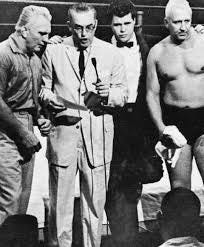
Pictured: Ray Morgan interviews Buddy Rogers, Bob Orton and manager Bobby Davis
Morgan’s most enduring legacy lies in professional wrestling. In 1958, he became the sports director at WTTG in Washington, D.C., and soon took on announcing duties for Capitol Wrestling Corporation’s Heavyweight Wrestling from Washington, a syndicated program that aired live from the Capitol Arena. This show, a forerunner to the World Wide Wrestling Federation (WWWF, now WWE), featured stars like Bruno Sammartino, whom Morgan praised as a “true gentleman” with unmatched fan loyalty due to his ability and character. Morgan’s commentary brought a professional polish to the rough-and-tumble world of wrestling, describing matches with enthusiasm and insight that appealed to a broad audience.
By 1957, he was handling regular wrestling broadcasts from Washington and Bridgeport, Connecticut, with episodes airing twice weekly and syndicated across the U.S., Europe, and Africa. His warm, engaging style earned him substantial fan mail and made him a global personality. Morgan made thousands of public appearances discussing wrestling, noting the sport’s dedicated yet sometimes unruly fans. He remained the voice of the program until 1966, when it shifted to WDCA, and continued until 1971. That year, promoter Vincent J. McMahon moved production to Hamburg, Pennsylvania, prompting Morgan to request a pay raise for travel expenses. McMahon declined and replaced him in 1972 with his son, Vince McMahon Jr., who had no prior broadcasting experience but would go on to revolutionize the industry. Morgan’s tenure helped elevate wrestling from regional entertainment to a televised phenomenon.

Pictured: Ray Morgan interviews Ivan Koloff and his manager Lou Albano
After leaving wrestling, Morgan continued in broadcasting, though his career slowed. He resided in Tenafly, New Jersey, maintaining a low profile until his health declined. On January 5, 1975, Morgan passed away from cancer at Englewood Hospital in Englewood, New Jersey, at the age of 60. He was survived by his wife, Ruie, and their daughter. His death marked the end of an era for early television pioneers.
Ray Morgan’s legacy endures as a forgotten trailblazer in wrestling commentary. Fans from the 1960s recall his voice as integral to the WWWF’s charm, providing context and excitement that drew in viewers. His career bridged radio’s golden age with television’s rise, influencing how sports and entertainment were narrated.
31 Great Territory Era Television Announcers
Profile 1: Larry Matysik, Wrestling At The Chase, St. Louis, Missouri
Profile 2: Sam Menacker, World Wrestling Association, Indianapolis, Indiana
Profile 3: Bob Caudle, Mid-Atlantic Championship Wrestling, Raleigh, North Carolina
Profile 5: Ed Whalen, Stampede Wrestling, Calgary, Alberta, Canada
Profile 6: Paul Boesch, Houston Wrestling, Houston, Texas
Thank You for Reading
I’m Tony Richards, Pro Wrestling Historian, Author and Storyteller. I share pro wrestling historical items in each issue of the Time Tunnel Pro Wrestling History Newsletter. Thanks for reading! If you enjoy my information on select events, matches and insights, please share it with folks you think might like to be a subscriber!
Remember, paid subscribers get access to exclusive and special content such as The Evolution of Pro Wrestling special issues including a multi-part deep dives on wrestling territories, wrestler bios and championship title histories, special audio and video interviews on territory pro wrestling and more available in the Pro Wrestling Time Tunnel for Premium Subscribers..