



Written and Produced by Tony Richards
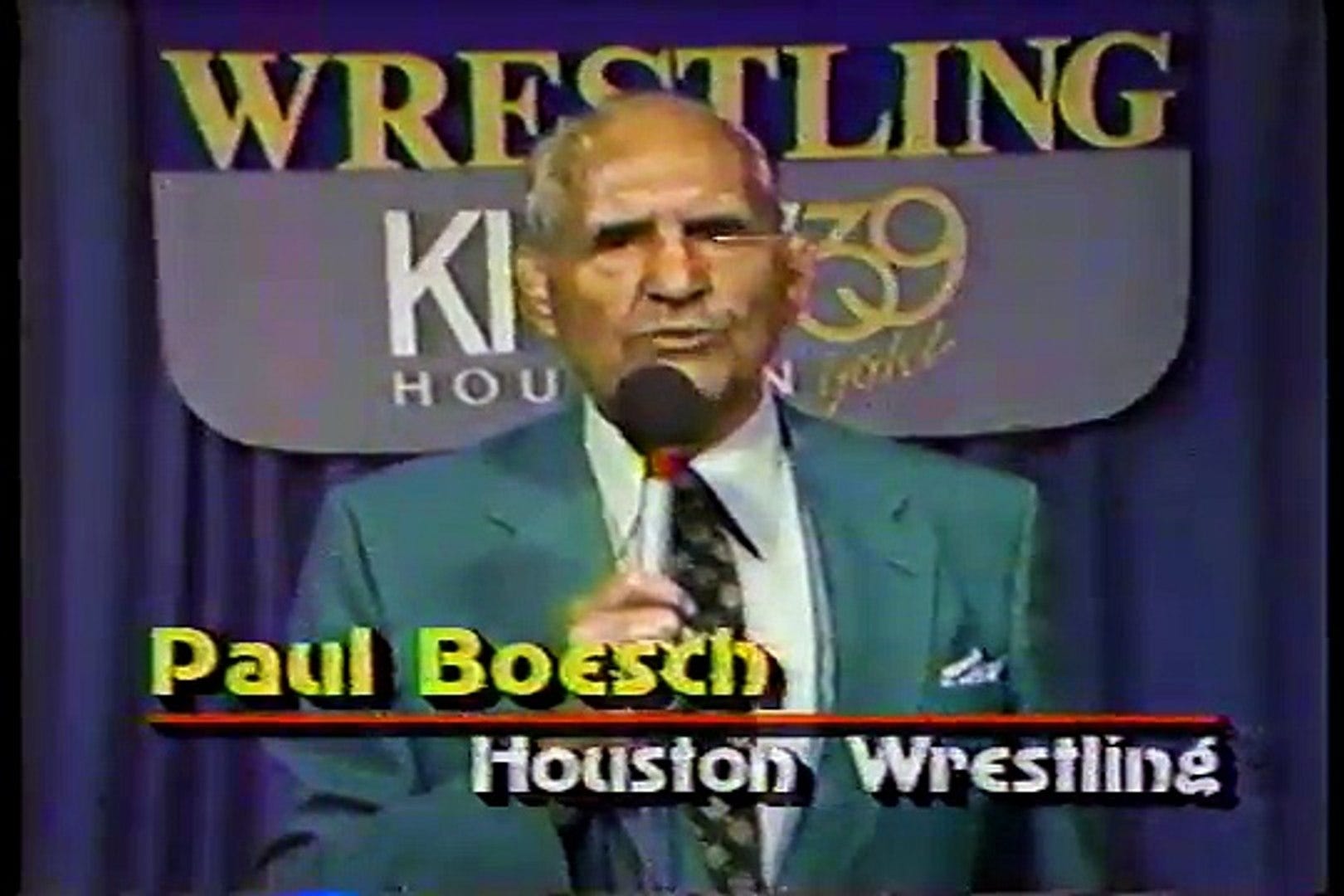
Born in the bustling streets of early 20th-century New York, Boesch transformed from a lifeguard and in-ring competitor into one of the most influential promoters and announcers in American wrestling history. His career, spanning over five decades, was particularly defined by his stewardship of Houston Wrestling, where he turned a regional promotion into a cultural phenomenon broadcast into homes across Texas. As the gravel-voiced ring announcer on local television, Boesch didn’t just call matches—he narrated dreams, rivalries, and triumphs, becoming a beloved staple of Friday night entertainment. His life story is one of resilience: from saving lives on Long Island beaches to storming Normandy’s shores, and from inventing mud wrestling to hosting world champions in the Sam Houston Coliseum. Through it all, Boesch’s commitment to honesty, community, and spectacle left an indelible mark on wrestling’s territorial era.
Paul Max Boesch entered the world on October 2, 1912, in Brooklyn, New York, though his formative years unfolded in the sun-soaked shores of Long Beach, where his family relocated. A product of a modest upbringing, young Paul excelled in athletics, particularly swimming, which led him to a summer job as a lifeguard on Long Island beaches. His prowess was no small feat; in 1932, he placed third in the North Atlantic Coast Lifeguard Competition and, over his career, saved more than 130 lives from the treacherous Atlantic currents. These early heroics foreshadowed a lifetime of bold risks, but it was wrestling that would capture his imagination.
Boesch’s entry into professional wrestling came almost serendipitously in 1932. While still lifeguarding, he caught the eye of legendary matchmaker Jack Pfefer, who saw potential in the strapping 20-year-old’s 6’5”, 300-pound frame. Boesch made his debut on October 25, 1932, in Calgary, Canada, embarking on a whirlwind tour that would take him across continents. His early opponents were no-nonsense grapplers: Ray Steele, Everett Marshall, Jim McMillen, Sammy Stein, Jumping Joe Savoldi, and the iron-fisted Dick Shikat, against whom Boesch endured grueling marathon bouts totaling over seven hours without a fall. By 1933, he was main-eventing in major East Coast cities, clashing with world champions Jim Londos and Jim Browning. These matches earned him his first “cauliflower ear,” a badge of honor in wrestling lore.
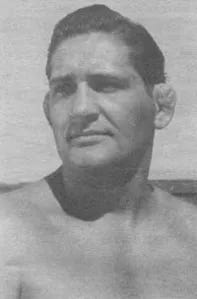
Undeterred by the physical toll, Boesch’s itinerant career led him to Canada, Los Angeles, New Zealand—where he faced Earl McCready and Lofty Blomfield—and Australia, battling Glen Wade and Tom Lurich. A back injury in 1937 sidelined him for a year in the Pacific Northwest, during which he astutely invested in a half-interest in the Seattle promotion. It was here that Boesch’s innovative spirit shone: seeking to stage a unique “Hindu Style” bout between Gus Sonnenberg and Harnam Singh, he accidentally created the first mud wrestling match in U.S. history when water mixed with the arena floor. Resuming in 1938, he toured Los Angeles, Honolulu, and Manila, facing Pedro Martinez, Danny Dusek, and Chief Thunderbird, until global tensions curtailed his travels in 1939.
Boesch’s pre-war wrestling odyssey was a testament to his endurance and adaptability, but the outbreak of World War II reshaped his path dramatically. After Pearl Harbor, he enlisted in the U.S. Army in 1942, rising through officer candidate school to become a first lieutenant in the 121st Infantry Regiment of the 8th Infantry Division. His service was nothing short of heroic: Boesch stormed the beaches of Normandy on D-Day, commanded Company G during the brutal Battle of Hürtgen Forest, and was gravely wounded by German artillery shrapnel. For his valor, he earned the Combat Infantryman Badge, Silver Star with oak leaf cluster, Bronze Star with oak leaf cluster, Purple Heart, French Croix de Guerre with star, and Distinguished Unit Citation.
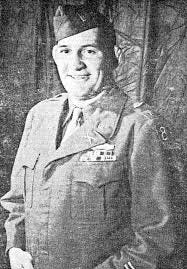
The war’s scars ran deep, both physical and emotional. In his 1962 memoir, Road to Huertgen: Forest in Hell, Boesch chronicled the horrors of combat with unflinching honesty, later receiving the Distinguished Citizens Award from the 121st Infantry Association for his postwar community service, including work with the Boys Club of America. Returning stateside, Boesch laced up his boots once more, wrestling in Texas and New Zealand. However, tragedy struck in October 1947 en route from San Antonio to Corpus Christi. A collision with an oilfield truck shattered his leg, forcing his in-ring retirement at age 35. Reflecting later, Boesch pondered, “What could a man do who had spent his life on the mat?”—a question that would propel him into wrestling’s backstage world.
Fate intervened through Morris Sigel, the promoter of Houston Wrestling under the Gulf Athletic Club. Boesch, recovering in Texas, began assisting Sigel informally—typing match card changes for newspapers—before being hired as an advisor and radio announcer in 1948. Houston’s wrestling scene, legalized in Texas since 1933, had deep roots dating to pre-WWI private matches, with the Sigel brothers—Julius starting in 1925 and Morris joining around 1929—building it into a staple. Under their tutelage, alongside trainer and booker Karl “Doc” Sarpolis, Boesch honed his promotional acumen, booking stars like Antonino Rocca, Rito Romero, Duke Keomuka, and LeRoy McGuirk.
The Debut of Television
Television’s arrival in Houston in January 1949 marked Boesch’s next evolution. With no prior broadcast experience, he became the promotion’s first TV commentator on KHTV Channel 39, calling matches live from ringside. The early days were rudimentary—”starting with ‘The Star Spangled Banner’ and winding up when the lights went out”—yet electrifying, drawing crowds to store windows and homes for Friday night broadcasts. Boesch’s deep, authoritative voice, honed from impromptu radio stints as early as 1936 in Portland, made him a natural. He even trained future stars, teaching Verne Gagne the sleeper hold that propelled him to championships and mentoring talents like Cowboy Carlson and others.
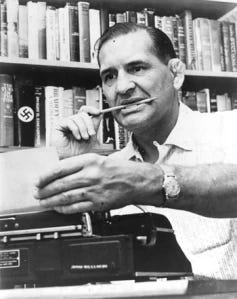
Sigel’s death on December 26, 1966, thrust Boesch into full promotion. In January 1967, he purchased the Gulf Athletic Club from Sigel’s widow, assuming control after two decades of apprenticeship.What followed was 21 years of masterful booking, elevating Houston to a “jewel” of Texas wrestling, second only to Dallas-Fort Worth in draw power. The creative and booking of Houston, however transferred to the Big Time Wrestling office in Dallas, owned by Ed McMemore and Fritz Von Erich. Houston became the “Friday night town” of the Dallas territory for approximately the next 11 or 12 years.
Although the booker in the Dallas office, whether it be Red Bastien, Leo Garibaldi, Gary Hart and others were sending their talent to Houston on Friday night each week, Boesch still had a hand in the main event matches and often the semi-mains. Boesch liked to bring in draws for one-time shots such as Johnny Valentine, Wahoo McDaniel, Mil Mascaras, El Santo, Nick Bockwinkel and The Funk Family.
Under Boesch’s helm, Houston Wrestling later flourished through strategic affiliations with promotions like Southwest Sports (later World Class Championship Wrestling), Southwest Championship Wrestling, Mid-South (later Universal Wrestling Federation), and brief stints with the WWF. He curated cards emphasizing full-contact action and top talent, selectively drawing from rosters of 30-35 wrestlers to feature 10-15 per show, supplemented by national draws like Bob Backlund, Bruno Sammartino, Stan Stasiak, and Superstar Billy Graham.
Boesch’s Houston became a hotbed for dream matches. On July 20, 1973, he orchestrated Jack Brisco’s defeat of Harley Race for the NWA World Heavyweight Championship, a coup that underscored his clout. The Sam Houston Coliseum regularly sold out, hosting icons like Jose Lothario, Mil Mascaras, Ernie Ladd (a local hero turned villain elsewhere), the Funks, the Briscos, Brute Bernard, Red Bastien, Ivan Putski, Gino Hernandez, Andre the Giant, Tony Atlas, and Al Madril. In the 1980s, Mid-South ties under Bill Watts brought monthly spectacles, including sold-out clashes featuring Junkyard Dog and Jim Duggan, where fire marshals had to manage overflowing crowds.
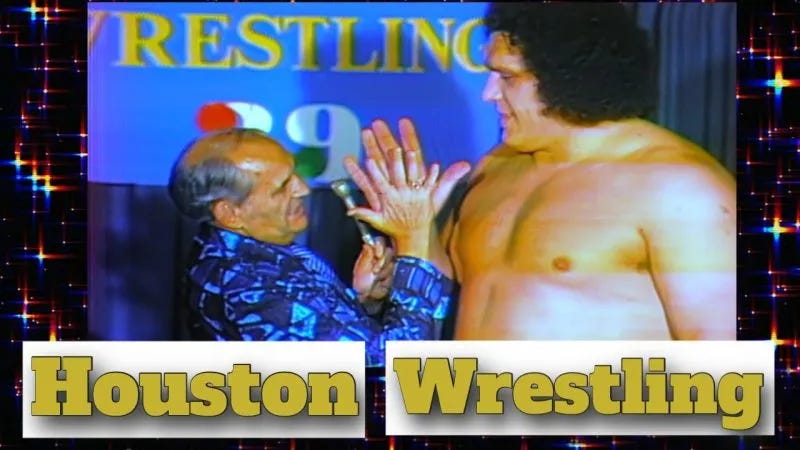
Colleagues revered Boesch for his integrity. Wrestler Billy Red Lyons called him “a good promoter... honest,” always delivering promised payoffs. Playboy” Gary Hart, World Class booker from 1977-1983, praised his protectiveness of the territory: “He knew wrestling. He knew his town.” Barry Darsow (Krusher Khrushchev) echoed this, noting superior payouts and respect: “He made everybody seem like somebody. What a gentleman.” Boesch’s personal touch—sharing stories in dressing rooms, conducting bilingual interviews for Mexican-American fans—fostered loyalty.
Boesch Tied Houston Wrestling To The Local Community
Philanthropy wove through his work; Boesch championed youth fitness via the Boys Club and led telethons for polio and the March of Dimes. His 1981 autobiography, The Career of Paul Boesch: One Man, One Sport, One Lifetime—50 Years on the Mat, captured this ethos, crediting fans as the lifeblood of his passion.
Boesch’s television tenure, spanning 1949 to 1987, was unparalleled—over 38 years of continuous broadcasts on channels like KHTV (Channel 39), despite UHF signal challenges. His style was unpretentious yet magnetic: a towering figure who interviewed wrestlers without fear, leveraging his size and experience. Early shows ignited communal fervor, evolving into polished productions that made Houston a wrestling mecca.Even as promotions shifted—joining the NWA in the 1980s and flirting with WWF—Boesch remained the constant, his voice synonymous with the sport. A brief 1987 WWF affiliation ended after four months amid tensions with Bill Watts, but his legacy as “Mr. TV Announcer,” as Lord Montague dubbed him, endured.
Health woes prompted Boesch’s retirement on August 28, 1987, marked by a triumphant sell-out at the Sam Houston Coliseum, drawing 12,000 fans. Vice President George H.W. Bush, a longtime friend, sent a telegram: “Paul has made a fantastic contribution to American sports... Wrestling will never be quite the same without his firm, principled leadership.” He briefly returned to promote for Jim Crockett and served as an NWA Board figurehead.
Boesch’s honors proliferated posthumously: inducted into the Wrestling Observer Newsletter Hall of Fame (1996, charter member), Professional Wrestling Hall of Fame (2005, non-wrestler), NWA Hall of Fame (2012), and WWE Hall of Fame (2021, Legacy wing). He received the Pro Wrestling Illustrated Editors’ Award in 1987. His books, including poetry (Much of Me in Each of These, 1966) and Hey Boy—Where’d You Get Them Ears? (2001, published by widow Valerie), offered intimate glimpses.
Boesch passed from a heart attack on March 7, 1989, in Sugar Land, Texas, at 76. Dave Meltzer recalled his humility: after a flop show, Boesch listed excuses before admitting, “I put together a card nobody wanted to see.” Valerie, his wife, died in 2020.
Here’s the archive list of this series so far:
31 Great Territory Era Television Announcers
Profile 1: Larry Matysik, Wrestling At The Chase, St. Louis, Missouri
Profile 2: Sam Menacker, World Wrestling Association, Indianapolis, Indiana
Profile 3: Bob Caudle, Mid-Atlantic Championship Wrestling, Raleigh, North Carolina
Profile 5: Ed Whalen, Stampede Wrestling, Calgary, Alberta, Canada
Thank You for Reading
I’m Tony Richards, Pro Wrestling Historian, Author and Storyteller. I share pro wrestling historical items in each issue of the Time Tunnel Pro Wrestling History Newsletter. Thanks for reading! If you enjoy my information on select events, matches and insights, please share it with folks you think might like to be a subscriber!
Remember, paid subscribers get access to exclusive and special content such as The Evolution of Pro Wrestling special issues including a multi-part deep dives on wrestling territories, wrestler bios and championship title histories, special audio and video interviews on territory pro wrestling and more available in the Pro Wrestling Time Tunnel for Premium Subscribers..