


Sam Menacker, born Frank Menacker, was a multifaceted figure in the world of professional wrestling, transitioning from athlete to promoter, manager, and television announcer. His journey spanned decades, intersecting with key developments in the sport during its golden age on television. Menacker’s contributions helped shape wrestling’s entertainment value, blending athleticism with showmanship. From his early days in baseball to his influential roles behind the scenes, Menacker left an indelible mark on the industry until his passing in 1994.
Born on October 14, 1914, in New York City, Frank Menacker grew up in an environment that fostered athletic pursuits. His father had been involved in baseball, which influenced young Frank to pursue the sport. He played as a catcher in the New York Yankees organization at the Class A level, showcasing promising talent in minor league baseball. However, Menacker’s path shifted dramatically when he entered professional wrestling in the late 1930s. Promoters reportedly changed his ring name from Frank to Sam, believing “Frank” did not sound sufficiently “Jewish” to appeal to audiences, a reflection of the era’s ethnic marketing in wrestling. Adopting monikers like “Sammy Menacker” or “Slammin’ Sammy,” he quickly made a name for himself in the ring during the 1940s, embodying the rough-and-tumble style of pre-war wrestling.

Menacker’s wrestling career gained momentum before World War II, where he competed as a formidable performer. His high-profile persona even led to minor acting roles in films, capitalizing on his charismatic presence. However, in 1941, his career was halted by the outbreak of the war. Menacker enlisted and served five years in the military, rising to the rank of Major before his discharge in 1946. This service not only interrupted his momentum but also instilled discipline that would benefit his later endeavors in wrestling promotion.
Upon returning, Menacker briefly resumed wrestling but soon pivoted away from in-ring competition. Recognizing the evolving landscape of the sport, he embraced roles as a promoter and manager, where his business acumen shone. Among his notable protégés were his wife, June Byers, the undisputed women’s wrestling champion of the era, and the iconic Gorgeous George Wagner. Menacker is credited with advising George to bleach his hair and don elaborate robes, innovations that transformed George into wrestling’s first major television heel and boosted the sport’s theatrical appeal. Interestingly, both Menacker and Byers were licensed pilots, often flying themselves to bookings, adding a layer of adventure to their professional lives.
In the 1950s, Menacker expanded his influence as a promoter, starting in El Paso, Texas. By the late 1950s, he relocated to the Detroit area, collaborating with promoter Johnny Doyle. Here, he met Dick the Bruiser, who became a frequent foil in storylines. Menacker’s role extended to television, where he served as a “crusading” commentator for tapings at CKLW-TV in Windsor, Ontario, Canada. His commentary style exposed the antics of villains (heels) and critiqued corruption, enhancing the dramatic narrative of matches.
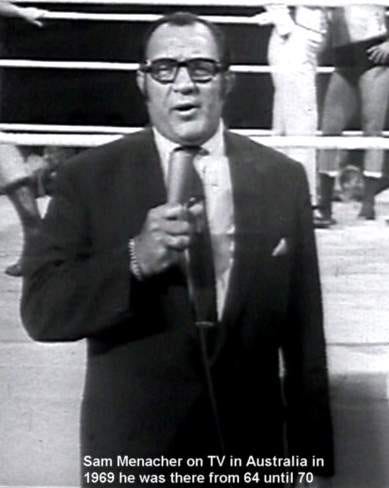
Menacker’s involvement in on-screen antics was memorable. In the early 1960s, he appeared as a special guest announcer in Indianapolis for events involving wrestlers like Art Shires, Dick the Bruiser, and Gene Kiniski, leading to physical altercations despite Bruiser’s babyface status at the time. He also guest-refereed bouts, often ending with Bruiser dramatically ripping off his shirt and ejecting him from the ring. As the Detroit territory evolved under Eddie Farhat (The Sheik), Menacker was replaced as commentator by Athol Layton. Undeterred, he moved on to work with Stu Hart in Calgary’s Stampede Wrestling, contributing to its television presence, and later joined Jim Barnett and Johnny Doyle in promoting wrestling in Australia.
Menacker’s transition to full-time announcing solidified his legacy in wrestling’s television boom. By the 1960s, he became a ringside commentator for Wrestling at the Chase, a prominent program in St. Louis associated with promoter Sam Muchnick. His engaging style, alongside announcers like George Abel and Mickey Garagiola, helped draw viewers during the show’s run from 1962 to 1973. Later, in the 1970s, he served as an announcer for the WWA in Indianapolis, Indiana, where he was praised for his skillful commentary. He retired from this role in the late 1970s, marking the end of his active involvement in broadcasting.
Video: Some of Sam Menacker’s Interview Work on WWA All Star Wrestling
Parallel to his wrestling work, Menacker pursued acting, appearing in films that often leveraged his wrestling fame. Notable roles included parts in Mighty Joe Young (1949), Always Leave Them Laughing (1949), Alias the Champ (1949), Abbott and Costello in the Foreign Legion (1950), and The Wrestler (1974). These appearances bridged wrestling and Hollywood, further elevating his profile.
In his later years, Menacker retired to Illinois, where he passed away on January 7, 1994, in Auburn, at the age of 79. He was buried in Springfield, Illinois. His marriage to June Byers was a partnership both personal and professional, blending their shared passions for wrestling and aviation.
Sam Menacker’s legacy endures as a bridge between wrestling’s athletic roots and its entertainment evolution. His innovations in promotion, mentorship of stars like Gorgeous George, and pioneering television commentary helped professional wrestling capture mainstream audiences. Though not as flashy as the wrestlers he promoted, Menacker’s behind-the-scenes work was instrumental in the sport’s growth, making him a true unsung hero of the squared circle.
This is the second in my series on 31 Great Territory Era Television Announcers. The third installment is coming soon here at the Pro Wrestling Time Tunnel!
Here’s the archive list of this series so far:
31 Great Territory Era Television Announcers
Profile 1: Larry Matysik, Wrestling At The Chase, St. Louis, Missouri
Thank You for Reading
I’m Tony Richards, Pro Wrestling Historian, Author and Storyteller. I share pro wrestling historical items in each issue of the Time Tunnel Pro Wrestling History Newsletter. Thanks for reading! If you enjoy my information on select events, matches and insights, please share it with folks you think might like to be a subscriber!
Remember, paid subscribers get access to exclusive and special content such as some special issues including a multi-part deep dives on wrestling territories, wrestler bios and championship title histories, special audio and video interviews on territory pro wrestling and more available in the Pro Wrestling Time Tunnel for Premium Subscribers.
Plus Sammy stole Stu Hart's airplane and flew it to his next territory. Stu still rehired him 30 years later despite the grand theft. By then he cut such a pale, waxy, dyed black vampiric appearance that the Bulldogs started a rumor that he slept in a coffin. Several names from long ago star in Mighty Joe Young with Sammy. Good movie.