


Written and Produced by Tony Richards, Pro Wrestling Time Tunnel
Gordon Solie, Championship Wrestling From Florida, Tampa Florida, Georgia Championship Wrestling, Atlanta, Georgia and Continental Championship Wrestling, Birmingham, Alabama
In the colorful and chaotic world of professional wrestling, where larger-than-life characters and dramatic storylines captivate audiences, the role of the announcer is pivotal in bridging the spectacle with credibility. Few individuals mastered this art as profoundly as Gordon Solie, often hailed as the “Dean of Wrestling Announcers.” Born Jonard Frank Labiak on January 26, 1929, in Minneapolis, Minnesota, Solie became synonymous with the territorial wrestling era, particularly in the southeastern United States. His gravelly voice, measured delivery, and insightful commentary elevated the sport’s presentation, earning him comparisons to broadcasting legends like Walter Cronkite and Howard Cosell. Over a career spanning nearly five decades, Solie worked primarily in Florida, Georgia, Alabama, and other territories, leaving an indelible mark on wrestling’s golden age. This essay explores Solie’s life, from his humble beginnings to his enduring legacy, highlighting his contributions to the industry and the personal challenges he faced.
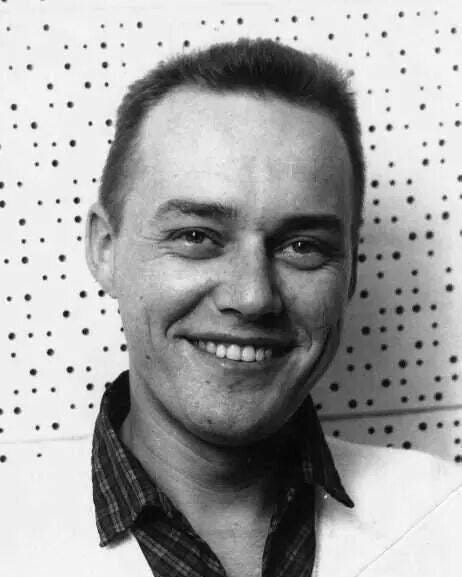
Gordon Solie’s path to wrestling fame was rooted in post-World War II America. After serving in the United States Air Force, he relocated to Tampa, Florida, in the 1950s, seeking new opportunities in a warmer climate. Initially, Solie worked as a radio disc jockey and promotions man, honing his skills in public speaking and audience engagement. His entry into professional wrestling was modest; in 1950, he began as a ring announcer for weekly shows in the Tampa Bay area, earning a mere $5 per night. This grassroots involvement exposed him to the raw energy of the sport, where promoters like Cowboy Luttrall emphasized treating wrestling as a legitimate athletic contest to attract mainstream fans.

Pictured: Eddie Graham and Gordon Solie on the set of Championship Wrestling from Florida in the 1960s
By 1960, Solie’s talents had propelled him to the role of lead announcer for Championship Wrestling from Florida (CWF), a position he held for over 25 years. Broadcasting from Tampa, his Saturday morning television shows became a staple for fans across the region. Solie’s approach was influenced by Luttrall’s advice to present the action with subtlety and professionalism, avoiding hype in favor of factual, engaging narration. He immersed himself in the wrestlers’ world, even experiencing holds and maneuvers in the ring to authentically describe the pain and intensity involved. This dedication set him apart, transforming him from a novice emcee into a respected voice in the industry
.
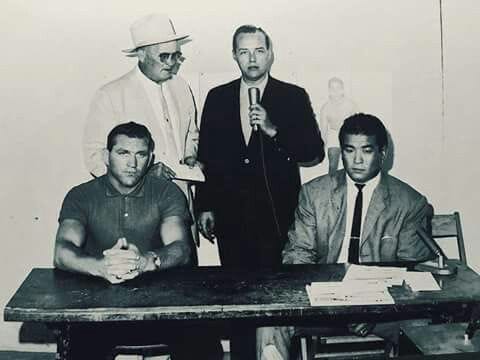
Pictured: Gordon Solie, Cowboy Luttrall, Danny Hodge and Hiro Matsuda
The 1970s and 1980s marked the peak of Solie’s career, coinciding with the territorial system’s heyday. Based in Florida, he became the face—and voice—of CWF, commentating on matches featuring icons like Dusty Rhodes, the Brisco Brothers (Jack and Jerry), Dory Funk Jr., The Great Malenko, Handsome Harley Race, and Ric Flair. His broadcasts reached up to 10 million viewers weekly by the early 1980s, thanks to syndication on Superstation WTBS, which expanded his influence beyond local markets.
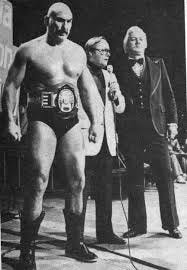
Pictured: The Mongolian Stomper (Archie Gouldie), Gordon Solie and Don Carson on Georgia Championship Wrestling in the WTBS studios.
Solie’s work extended to other territories, solidifying his regional dominance. In Georgia, he served as the announcer for Georgia Championship Wrestling (GCW), which aired nationally on TBS, introducing him to a broader audience. He also lent his talents to Continental Championship Wrestling in Alabama, as well as promotions in Puerto Rico. Gordon also was the lead announcer on the first two Starrcade Thanksgiving events for Jim Crockett Promotions, Starrcade 1983 and 1984, working alongside fellow legendary wrestling commentator Bob Caudle. These collaborations allowed Solie to cover a diverse array of talent and storylines, from high-flying aerial assaults to brutal brawls.
What truly distinguished Solie was his distinctive announcing style. His gravelly, soothing voice conveyed authority without bombast, using subtle tone shifts to underscore dramatic moments. He coined memorable phrases that became wrestling lexicon: describing a bloodied face as a “crimson mask,” a wild melee as a “Pier Six brawl,” a submission hold leading to “five letters, two words: I Quit,” or a quick wrestler as “not fast, he’s sudden.” His pronunciation of “suplex” as “su-play” added a unique flair, endearing him to fans while maintaining the sport’s seriousness. Solie’s sign-off, “So long from the Sunshine State,” accompanied by a wink, became a ritual for Florida viewers, fostering a sense of community and nostalgia.
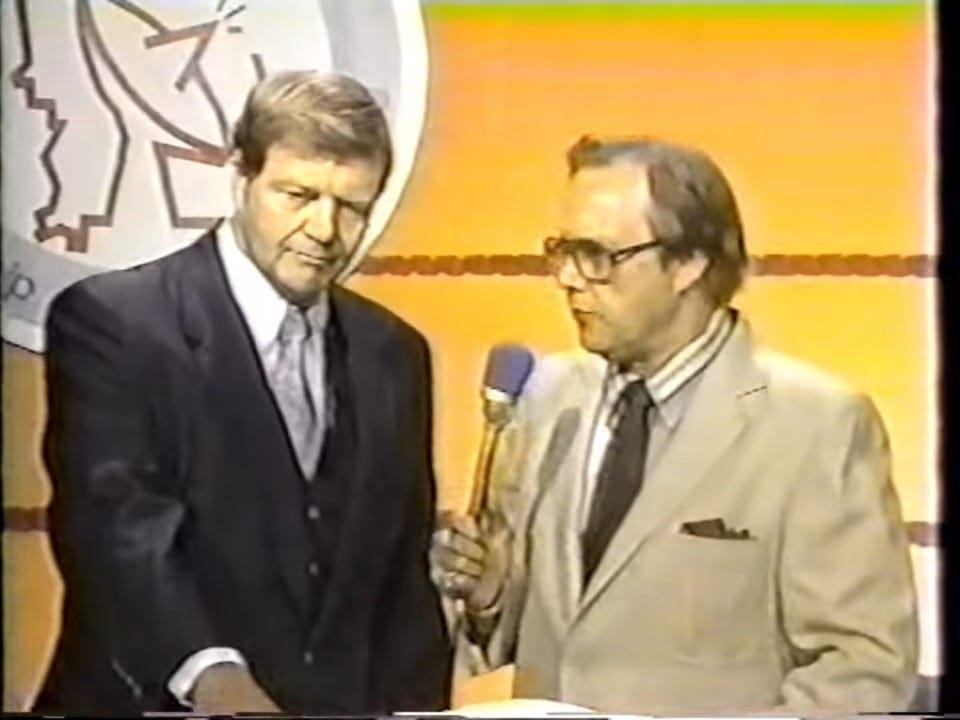
Pictured: Booker George Scott and Gordon Solie on Georgia Championship Wrestling on WTBS-17
As wrestling evolved in the late 1980s, Solie adapted to changes in the industry. When CWF folded in 1987, he transitioned to GCW and later the National Wrestling Alliance (NWA), which rebranded as World Championship Wrestling (WCW). He continued as a lead announcer for WCW television programs until 1995. In the mid-1990s, Solie expanded internationally, announcing via satellite for broadcasts in six languages, reaching audiences in Europe, India, Africa, and Japan.
However, his later years were marred by professional and health struggles. In 1995, Solie resigned from WCW amid disagreements, including opposition to inducting Angelo Poffo into the WCW Hall of Fame at Randy Savage’s request, believing such honors should not be influenced by wrestlers or families. Ironically, he was inducted into the WCW Hall of Fame that year at Slamboree, marking his retirement. His final WCW call occurred the following month, though it went largely unnoticed.
Post-retirement, Solie faced a devastating diagnosis of throat cancer, which led to the removal of his vocal cords. This silenced the voice that had defined wrestling for generations. His last planned appearance was at the Heroes of Wrestling pay-per-view in 1999, but declining health prevented his participation. Solie passed away on July 27, 2000, at the age of 71, succumbing to the cancer that had ravaged him. Tributes poured in, with WCW honoring him via a 10-bell salute on Nitro and WWE acknowledging his legacy on Raw through his friend Jim Ross.
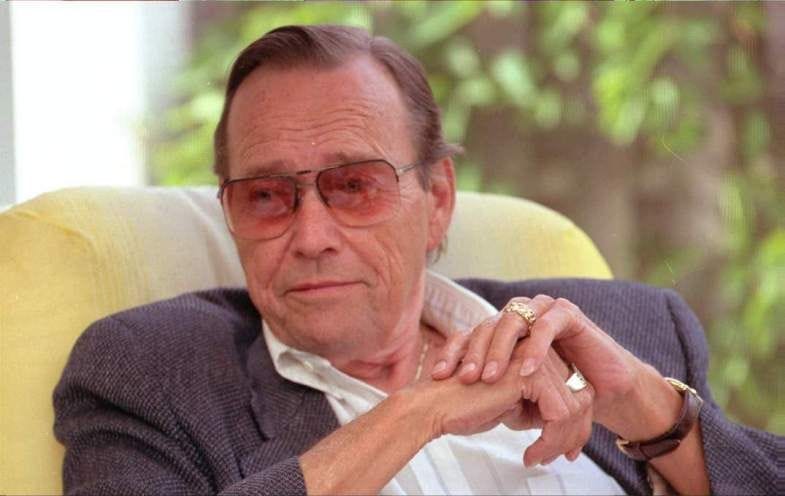
Beyond the ring, Solie was a family man, leaving behind five children: Pam, Danise, Jonard, Eric, and Greg. His personal writings, including short stories and poetry, were compiled posthumously in the 2005 book Gordon Solie...Something Left Behind, published by Florida Media, Inc. In 2009, his biography The Solie Chronicles, co-authored by his daughter Pamela Solie Allyn, son-in-law Robert Allyn, and Scott Teal, was released, drawing from his notes and files to fulfill a promise to preserve his story.
Solie’s impact endures through numerous honors. He was inducted into the WCW Hall of Fame in 1995, the Professional Wrestling Hall of Fame in 2004, the National Wrestling Alliance Hall of Fame in 2005, and posthumously into the WWE Hall of Fame in 2008, where Jim Ross inducted him, and his children accepted the award. WWE’s 24/7 On Demand service featured The Film Room with Gordon Solie, hosted by Ross, showcasing his classic calls. He was also recognized at the 1996 Cauliflower Alley Club event.
Gordon Solie’s life and career exemplify the transformative power of thoughtful broadcasting in professional wrestling. From his Minnesota roots to his Florida-based empire, he navigated the territories of Florida, Georgia, Alabama, and beyond with unparalleled professionalism, turning scripted chaos into compelling narrative. Though his voice was silenced by illness, his phrases and philosophy continue to resonate, influencing announcers like Jim Ross and Michael Cole. As wrestling evolves into a global phenomenon, Solie’s legacy as the “Dean” reminds us of the era when a single, steady voice could make the unbelievable feel real. His story, chronicled by family and fans alike, ensures that the Sunshine State’s greatest announcer will never be forgotten.
Here’s the archive list of this series so far:
31 Great Territory Era Television Announcers
Profile 1: Larry Matysik, Wrestling At The Chase, St. Louis, Missouri
Profile 2: Sam Menacker, World Wrestling Association, Indianapolis, Indiana
Profile 3: Bob Caudle, Mid-Atlantic Championship Wrestling, Raliegh, North Carolina
Thank You for Reading
I’m Tony Richards, Pro Wrestling Historian, Author and Storyteller. I share pro wrestling historical items in each issue of the Time Tunnel Pro Wrestling History Newsletter. Thanks for reading! If you enjoy my information on select events, matches and insights, please share it with folks you think might like to be a subscriber!
Remember, paid subscribers get access to exclusive and special content such as some special issues including a multi-part deep dives on wrestling territories, wrestler bios and championship title histories, special audio and video interviews on territory pro wrestling and more available in the Pro Wrestling Time Tunnel for Premium Subscribers.