


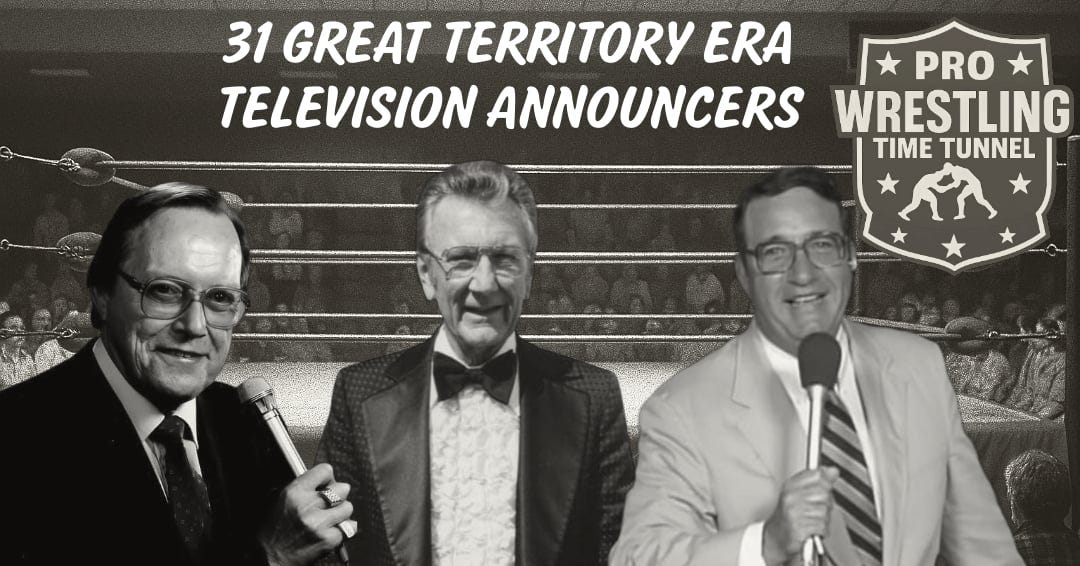
Profile 11: Marty O’Neill
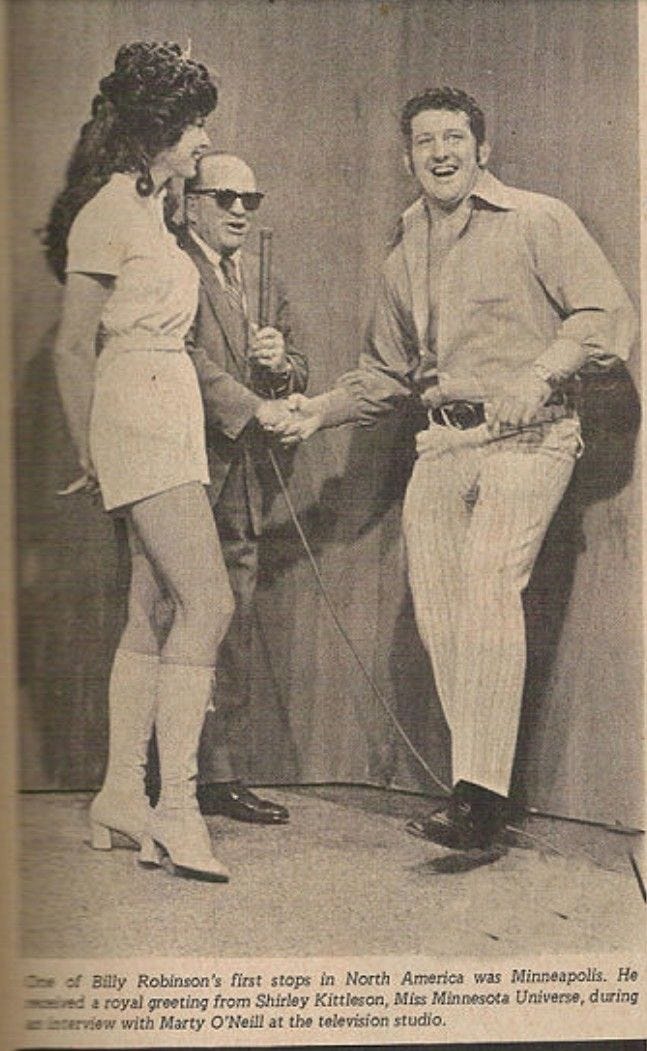
Pictured: Marty O’Neill, Billy Robinson and Miss Minnesota Universe, Shirley Kittleson
At a time when the regional territories dominated the worldwide landscape, few figures embodied the spirit of Midwestern grit and authenticity quite like Marty O’Neill. As the longtime ring announcer and interviewer for the American Wrestling Association (AWA), based in Minneapolis, Minnesota, O’Neill became a staple of Saturday morning television for generations of fans. His deep, resonant voice introduced legendary matches and conducted post-bout interviews that captured the drama, bravado, and occasional absurdity of the squared circle. Though not a wrestler himself, O’Neill’s contributions to the AWA helped elevate it from a local spectacle to a nationally syndicated phenomenon. His career spanned decades, blending his passion for sports broadcasting with the theatrical world of pro wrestling, earning him respect for his knowledge, humility, and flawless delivery.
Marty O’Neill was born on February 18, 1908, in what would become a life deeply intertwined with Minnesota’s sports culture. Growing up in St. Paul, he attended Central High School, graduating in 1929. There, O’Neill distinguished himself as a three-sport athlete, earning letters in football, basketball, and baseball. His prowess on the field earned him spots on the all-city teams for both football and basketball, showcasing the competitive drive that would later define his professional endeavors.

Beyond high school, O’Neill’s love for sports extended into amateur and semi-professional leagues. He played baseball with remarkable success, culminating in a national championship win in 1937. He also spent two seasons with the Duluth team in the Northern League, honing his skills in a competitive environment that demanded discipline and resilience. Even after his playing days, O’Neill remained involved in athletics, officiating high school and college football games. This hands-on experience in sports not only built his encyclopedic knowledge but also instilled a humility that would endear him to colleagues and fans alike. As he later reflected, his entry into broadcasting was driven purely by his passion for sports, a sentiment that permeated every aspect of his career.
These early years in Minnesota’s sporting scene laid the groundwork for O’Neill’s transition to media. The Twin Cities area, with its rich history of amateur and professional athletics, provided a fertile ground for broadcasters who could capture the excitement of live events. O’Neill’s athletic background gave him an insider’s perspective, allowing him to speak with authority on the physical and strategic elements of competition—skills that would prove invaluable when he stepped into the world of professional wrestling.

O’Neill’s broadcasting career began at WMIN Radio in St. Paul, where he served as the sports director. In this role, he provided play-by-play commentary for the St. Paul Saints, covering both baseball and hockey games. His voice, characterized by its clarity and enthusiasm, quickly made him a favorite among listeners in the Minneapolis-Saint Paul area. This period in radio honed his delivery skills, teaching him to engage audiences without visual aids, a technique that would translate seamlessly to television wrestling announcements.
By the mid-1950s, O’Neill’s reputation as a versatile sports broadcaster opened doors to new opportunities. In 1955, he began announcing for professional wrestling, a move that merged his love for sports with the emerging spectacle of televised grappling. Wrestling at the time was transitioning from carnival sideshows to mainstream entertainment, particularly in the Midwest, where promotions like the Minneapolis Boxing & Wrestling Club thrived. O’Neill’s involvement came at a pivotal moment, as the industry sought credible voices to lend legitimacy to its scripted dramas.

Pictured: Marty O’Neill and AWA World Heavyweight Champion, Mad Dog Maurice Vachon
His work in radio and early wrestling gigs established O’Neill as a prominent figure in Minnesota media. He was inducted as a charter member into the Minnesota Baseball Association’s Hall of Fame in 1963, recognizing his contributions to the sport both as a player and broadcaster. Later honors included the St. Paul Central High School Athletic Hall of Fame in 1995 and the Pavek Museum of Broadcasting Hall of Fame in 2010, underscoring his lasting impact on local sports journalism.
The American Wrestling Association, founded in 1960 by Verne Gagne and Wally Karbo, became O’Neill’s most enduring platform. Breaking away from the National Wrestling Alliance (NWA), the AWA positioned itself as a powerhouse in the Midwest, emphasizing technical wrestling and athletic realism over pure spectacle. Gagne, a former University of Minnesota wrestler and Olympic alternate, trained stars on his Chanhassen farm, creating a roster that included Nick Bockwinkel, Hulk Hogan, and the Road Warriors. The promotion’s flagship show, AWA All-Star Wrestling, aired locally on WTCN-TV (later KMSP-TV) and was syndicated nationally, reaching audiences far beyond Minnesota.
O’Neill served as the ring announcer for local broadcasts, introducing matches with a professional gravitas that contrasted the wrestlers’ outlandish personas. He also conducted post-match interviews, a role that required quick thinking and composure amid the chaos of heels (villains) and babyfaces (heroes). For syndicated versions, commentary was provided by Rodger Kent, but O’Neill’s voice was the one Twin Cities viewers associated with the AWA’s authenticity. His knowledge of wrestling’s intricacies—gained from years of observation and his sports background—allowed him to ask probing questions that enhanced storylines.

Pictured: Marty O’Neill interviews Larry “The Axe” Hennig and Lars Anderson
Throughout the 1960s and 1970s, O’Neill was the steady presence at ringside, often at the Calhoun Beach Hotel studio where shows were taped. He interviewed icons like Reggie “Da Crusher” Lisowski, whose ad-libbed promos were a highlight, and Bobby “The Brain” Heenan, who once disrupted an interview by unfurling a Playboy centerfold disguised as a “wrestling plan.” O’Neill handled such antics with unflappable poise, earning him the moniker “the Dean of wrestling announcers.”
One memorable anecdote involves O’Neill’s attempts to interview Jim Raschke, who later became Baron von Raschke. As a shy babyface in a USA wrestling jacket, Raschke struggled with promos, remaining “meek and mild” despite O’Neill’s efforts to draw him out. This highlighted O’Neill’s role in character development, helping wrestlers find their voices in the AWA’s narrative-driven format.
In the early 1970s, an AFTRA union strike tested O’Neill’s principles. As a union member, he refused to cross the picket line, prompting AWA owner Verne Gagne to recruit Gene Okerlund as a temporary replacement. Okerlund, initially unfamiliar with wrestling, impressed enough to share duties upon O’Neill’s return. By the mid-1970s, O’Neill’s prolonged illness led to occasional substitutions by Al DeRusha and others. Okerlund eventually took over permanently in 1979, just before O’Neill’s passing.

Pictured: Marty O’Neill and Nick Bockwinkel
These challenges underscored the evolving nature of wrestling broadcasting, as the AWA expanded to ESPN and faced competition from Vince McMahon’s WWF. O’Neill’s era represented a more regional, grounded approach, contrasting the glitz that would dominate the 1980s.
O’Neill’s health declined in the late 1970s, leading to his retirement from the AWA. He passed away on February 7, 1983, in St. Paul, just days before his 75th birthday. His death marked the end of an era for Minnesota wrestling, but his influence endured. Posthumous honors celebrated his contributions, and figures like Okerlund—nicknamed “Mean Gene” by Jesse Ventura—credited O’Neill for paving the way.
O’Neill’s legacy lies in his ability to bridge sports journalism and entertainment. He lent credibility to pro wrestling during its formative televised years, helping the AWA become a training ground for global stars.
31 Great Territory Era Television Announcers Series
Profile 1: Larry Matysik, Wrestling At The Chase, St. Louis, Missouri
Profile 2: Sam Menacker, World Wrestling Association, Indianapolis, Indiana
Profile 3: Bob Caudle, Mid-Atlantic Championship Wrestling, Raleigh, North Carolina
Profile 5: Ed Whalen, Stampede Wrestling, Calgary, Alberta, Canada
Profile 6: Paul Boesch, Houston Wrestling, Houston, Texas
Profile 7: Ray Morgan, WWWF Washington, D.C.
Profile 8: Bill Mercer, Big Time & World Class Championship Wrestling, Dallas, Texas
Profile 9: Lord Athol Layton, Toronto, Detroit & Australia
Profile 10: Dick Lane, NWA Hollywood, Los Angeles, California
Thank You for Reading
I’m Tony Richards, Pro Wrestling Historian, Author and Storyteller. I share pro wrestling historical items in each issue of the Time Tunnel Pro Wrestling History Newsletter. Thanks for reading! If you enjoy my information on select events, matches and insights, please share it with folks you think might like to be a subscriber!
Remember, paid subscribers get access to exclusive and special content such as The Evolution of Pro Wrestling special issues including a multi-part deep dives on wrestling territories, wrestler bios and championship title histories, special audio and video interviews on territory pro wrestling and more available in the Pro Wrestling Time Tunnel for Premium Investors.
Wrestling will never sound as classy again as it did when Solie and Caudle were announcing.